


- Company
- Products
- Catalogs
- News & Trends
- Exhibitions
LIFTING MAGNETS, EMX SERIES
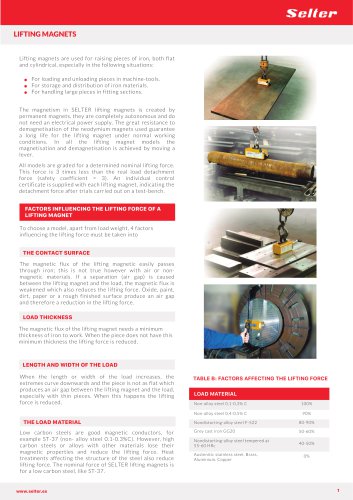
LIFTING MAGNETS, EMX SERIES
Lifting magnets by SELTER are designed for raising iron pieces, both flat and cylindrical, without the need for an electrical power supply. They utilize permanent neodymium magnets, known for their resistance to demagnetization, ensuring long-lasting performance. Magnetization and demagnetization are controlled via a lever.
Specifications:
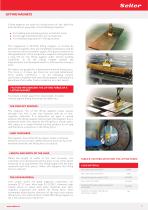
Each model is rated for a specific nominal lifting force, which is one-third of the actual load detachment force, providing a safety coefficient of 3. An individual control certificate accompanies each magnet, detailing the detachment force after testing.
Factors Influencing Lifting Force:
- Contact Surface: Air gaps caused by oxide, paint, dirt, or rough surfaces weaken the magnetic flux, reducing lifting force.
- Load Thickness: Insufficient thickness of iron reduces the lifting force.
- Load Dimensions: Increased length or width can cause curvature, creating air gaps and reducing force.
- Load Material: Low carbon steels are optimal for magnetic conduction, while high carbon steels or alloys reduce lifting force.
EMX Series Features:
The EMX series includes a range of lifting magnets suitable for flat and cylindrical pieces, featuring bipolar design and high penetration power. They include a safety blocking lever and are designed for one-handed operation. The safety coefficient remains at 3, with detachment force significantly higher than nominal force. The magnets are lightweight and constructed with neodymium for durability.
Model Specifications:
- EMX-250: Lifts 250 Kg for flat pieces, 100 Kg for round pieces, with a detachment force of 800 daN.
- EMX-500: Lifts 500 Kg for flat pieces, 250 Kg for round pieces, with a detachment force of 1600 daN.
- EMX-1000: Lifts 1000 Kg for flat pieces, 500 Kg for round pieces, with a detachment force of 3500 daN.
- EMX-2000: Lifts 2000 Kg for flat pieces, 1000 Kg for round pieces, with a detachment force of 6400 daN.
Graphical Data:
Graphs illustrate the relationship between air gap and lifting capacity for different thicknesses, highlighting the importance of maintaining minimal air gaps for optimal performance.
Catalog excerpts
LIFTING MAGNETS Lifting magnets are used for raising pieces of iron, both flat and cylindrical, especially in the following situations: • For loading and unloading pieces in machine-tools. • For storage and distribution of iron materials. • For handling large pieces in fitting sections. The magnetism in SELTER lifting magnets is created by permanent magnets, they are completely autonomous and do not need an electrical power supply. The great resistance to demagnetisation of the neodymium magnets used guarantee a long life for the lifting magnet under normal working conditions. In all the lifting magnet models the magnetisation and demagnetisation is achieved by moving a lever. All models are graded for a determined nominal lifting force. This force is 3 times less than the real load detachment force (safety coefficient = 3). An individual control certificate is supplied with each lifting magnet, indicating the detachment force after trials carried out on a test-bench. To choose a model, apart from load weight, 4 factors influencing the lifting force must be taken into The magnetic flux of the lifting magnetic easily passes through iron; this is not true however with air or nonmagnetic materials. If a separation (air gap) is caused between the lifting magnet and the load, the magnetic flux is weakened which also reduces the lifting force. Oxide, paint, dirt, paper or a rough finished surface produce an air gap and therefore a reduction in the lifting force. The magnetic flux of the lifting magnet needs a minimum thickness of iron to work. When the piece does not have this minimum thickness the lifting force is reduced. When the length or width of the load increases, the extremes curve downwards and the piece is not as flat which produces an air gap between the lifting magnet and the load, especially with thin pieces. When this happens the lifting force is reduced. THE LOAD MATERIAL Low carbon steels are good magnetic conductors, for example ST-37 (non- alloy steel 0.1-0.3%C). However, high carbon steels or alloys with other materials lose their magnetic properties and reduce the lifting force. Heat treatments affecting the structure of the steel also reduce lifting force. The nominal force of SELTER lifting magnets is for a low carbon steel, like ST-37. TABLE B: FACTORS AFFECTING THE LIFTING FORCE LOAD MATERIAL Non-alloy steel 0,1-0,3% C 100% Grey cast iron GG20 50-60% Nondistorting-alloy steel tempered at Austenitic stainless steel, Brass, 0% Aluminium, Copper
Open the catalog to page 1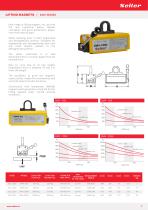
New range of lifting magnets, for use with flat and cylindrical pieces. Bipolar conception and great penetration power, even with large air gaps. Safety blocking lever in both magnetised and demagnetised position. Designed for magnetising and demagnetising with only one hand. Smooth setback to the demagnetised position. The safety coefficient is 3: load detachment force is 3 times higher than the nominal force. Easy to carry due to its low weight. Detachment force is between 70 and 115 times the weight The possibility to grind the magnetic contact poles, enable the maintenance and avoid the power...
Open the catalog to page 2All SELTER catalogs and technical brochures
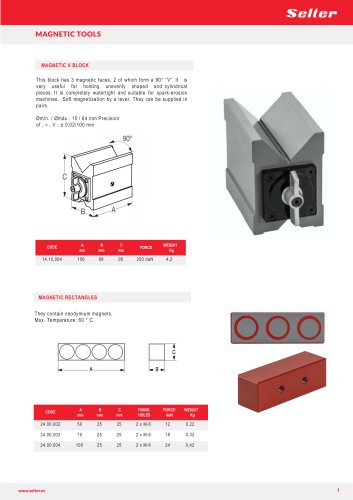 MAGNETIC TOOLS
2 Pages
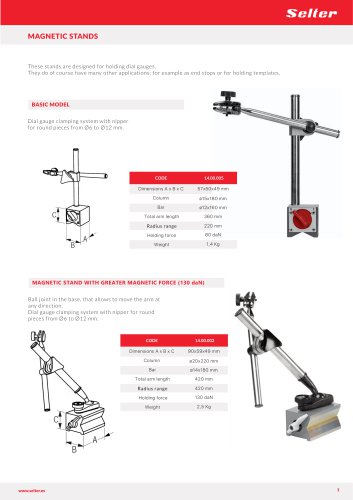 MAGNETIC STANDS
2 Pages
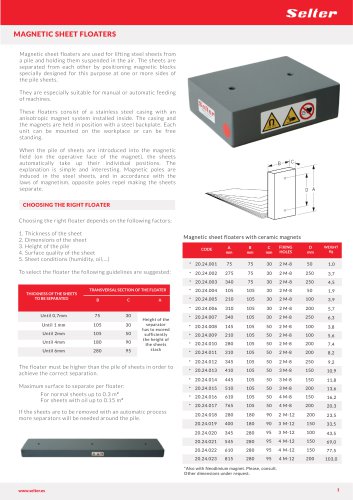 MAGNETIC SHEET FLOATERS
1 Page
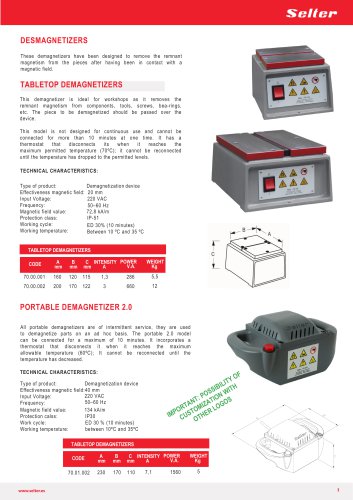 DEMAGNETIZERS
2 Pages
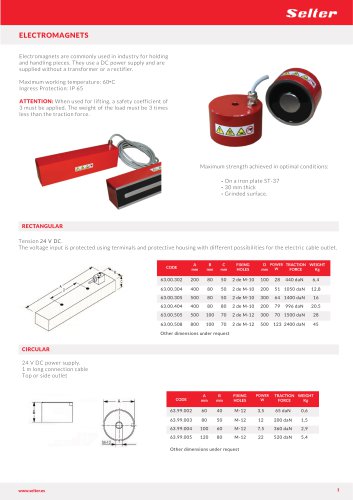 ELECTROMAGNETS
2 Pages
- DC power supply
- AC/DC power supply
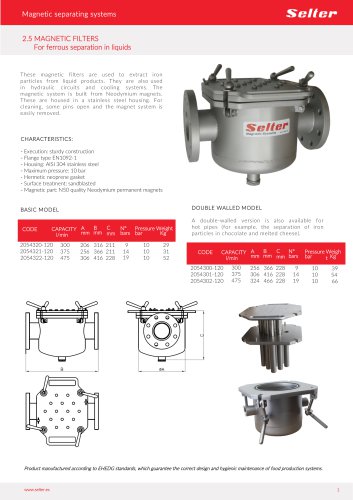
- Liquid filter
- Filter with cartridge
- Power supply for industrial applications
- Eddy current separator
- Solenoid
- Hydraulic filter
- Metal classifier
- Particulate pre-filter
- Steel flange
- Magnetic chuck
- DC solenoid
- Electro lifting magnet
- Grinding magnetic chuck
- Electrically switched electro lifting magnet
- Permanent lifting magnet
- Holding solenoid