

Conveyor chains, wheels & sprockets

Conveyor chains, wheels & sprockets
This document provides detailed technical information on conveyor chains, including specifications, components, and applications across various industries. It covers standard and special chains, along with the necessary technical details for their operation.
- ISO Standard Chains: Conform to ISO 1977 standards, focusing on tensile strength, pitch, and pin/roller types. Includes bush, roller, and wheel chains.
- BS Standard Chains: Designed according to British standards (BS 4116), available in metric and imperial dimensions with various attachments.
- French Series Chains: Suitable for high-load and abrasive environments, available in light, normal, and high resistance series.
- Block Chains: High tensile strength chains for heavy or abrasive loads, often with bushed blocks for wear resistance.
- Galle Chains: Used for low-speed transmission and oscillating movements, featuring waisted or straight side plates and flanged pins.
Conveyor chains consist of pins, bushes, and plates, with various attachments for load support, including drilled plates and attachment plates (G, F, K types).
- Connecting Links: Available in self-locking nuts, cottered pins, and riveted pins.
- Chain Wheels & Sprockets: Made from machine-welded steel or cast iron, with options for machined teeth and various hub configurations.
- Number of Teeth and Dimensions: Standard and custom options for chain wheels, with detailed specifications.
Conveyor chains are used in industries such as food, heavy industry, urban, energy, and more, with specific applications in escalators, automotive, water treatment, cement, paper, and steel.
Tailored for specific industries like food, waste treatment, and heavy industry, with detailed specifications for each application.
Describes various operation modes, including sliding on guides, rolling on wheels, and support by idler wheels, depending on the chain's position.
Conveyor chains handle continuous or non-continuous loads, which can be bulk materials or separate objects.
The route affects forces acting on the chain, with considerations for straight, inclined, curved, or mixed routes.
Factors such as drag, shock loading, torsion, polygonal effect, speed, and environmental conditions are considered.
Involves collecting data, calculating forces, and choosing a chain based on tensile strength and wear resistance.
Formulas are provided for calculating maximum traction and normal forces, with corrections for curves.
Ensures the tensile strength is sufficient, considering shock and excavation conditions.
Guidelines for limiting contact pressure and selecting appropriate materials for wheels.
Details calculations for chain weight, accessory weight, and carried load.
Friction coefficients for different materials and conditions are provided.
Guidelines for supporting and guiding chain strands, including alignment and parallelism requirements.
- Tension Force: Should not exceed 10% of the working load or 1% of the tensile strength.
- Center Distance Adjustment: Necessary for installation, maintenance, and compensation for elongation.
- Sprocket Teeth: Reduce the number of teeth to minimize size, but avoid significant polygonal effects below 12 teeth.
- Purpose: Reduce wear, prevent seizure, protect against corrosion, reduce noise, and dissipate heat.
- Frequency and Method: Determined with suppliers; manual or continuous drip feed methods are common.
- Lubricant Type: Mineral oil with viscosity based on operating temperature; avoid grease unless specified.
- Symbols and Units: Detailed list of symbols and units used in calculations.
- Main Formulas: Includes formulas for maximum traction force, weight calculations, and pressure in articulations.
- Wear Resistance: Case-hardening and DELTA® pins for improved wear resistance.
- Corrosion Resistance: Galvanization, SEDIS anti-corrosion treatment, and stainless steel options.
- Maintenance-Free Solutions: VERTE® chains with self-lubricating composite bushings and sealing ring chains.
Sedis wheels are available in machine-welded steel or cast iron, with options for machined teeth and various configurations.
Wheels can be customized with machined teeth, different numbers of teeth, or as special wheels.
Detailed tables of dimensions and weights for various pitches and numbers of teeth are provided.
Chains are available with pitches ranging from 40 to 630 mm, with varying breaking loads and working surfaces.
Various attachments and connecting links are available, including cottered connecting links and links with self-locking nuts.
References ISO Standard Chains from 1977, with specific models like M20, M56, M80, M112, and M160.
Standard items can be dispatched within two weeks, with non-standard items available on request.
Outlines specifications for connecting links and chains, including dimensions and minimum breaking load.
Details different types of connecting links, including external links to be riveted and cottered connecting links.
Includes details on pitch, plate widths, pin diameter, and riveted length, along with minimum breaking load.
Specifications for chain wheels, including number of teeth and various diameters.
Fields for customer information, including company name and chain requirements.
Contact details for SEDIS offices and factories in France, Italy, the UK, and Germany.
Section for additional notes for customization or specification by the customer.
SEDIS reserves the right to modify products without notice and liability.
Catalog excerpts

Conveyor Chains wheels & sprockets
Open the catalog to page 1
POWERFUL CHAINS IN A CHANGING WORLD
Open the catalog to page 2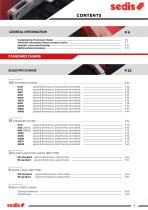
CONTENTSsedis GENERAL INFORMATION Components of conveyor chains - P 6 Technical information about conveyor chains- P 7 Symbols, units main formulas - P 18 sEdIS technical solutions- P 19 STANDARD CHAINS M 20 - general dimensions, attachments and wheels P 26 M 56 - general dimensions, attachments and wheels P 28 M80 - general dimensions, attachments and wheels P 30 M112 - general dimensions, attachments and wheels P 32 M160 - general dimensions, attachments and wheels P 34 M224 - general dimensions, attachments and wheels ...
Open the catalog to page 3
CONTENTS HOLLOW PIN CONVEYOR CHAINS MC 27 (ZM28) - general dimensions, attachments and wheels _______________________________ P 76 MC 55 (ZM54) - general dimensions, attachments and wheels _______________________________ P 78 MC 110 - general dimensions, attachments and wheels _______________________________ P 80 - general dimensions, attachments and wheels _______________________________ P 82 - general dimensions, attachments and wheels _______________________________ P 84 BLOCK CHAINS BM Type ___________________________________________________________________________ B Type ___________________________________________________________________________...
Open the catalog to page 4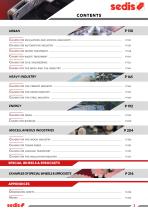
CONTENTS URBAN Chains for escalators and moving walkways _________________________________________ Chains for automotive industry ______________________________________________________ Chains for water treatment ___________________________________________________________ Chains for waste treatment ___________________________________________________________ Chains for civil engineering __________________________________________________________ Chains for the brick and tile industry ________________________________________________ HEAVY INDUSTRY Chains for the cement industry ________________________________________________________...
Open the catalog to page 5
GENERAL INFORMATION
Open the catalog to page 6
Technical INFORMATION
Open the catalog to page 7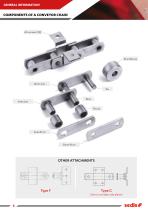
GENERAL INFORMATION COMPONENTS OF A CONVEYOR CHAIN Plain Roller Outer Link Pin Bush Inner Link Inner Plate Outer Plate OTHER ATTACHMENTS Type G (bent or straight side plates)
Open the catalog to page 8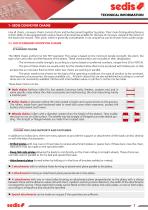
sedis TECHNICAL INFORMATION Like all chains, conveyor chains consist of pins and bushes joined together by plates. Their main distinguishing feature is their ability to be equipped with various means of accessories suitable for the type of conveyor used and the nature of the load to be moved. Their pitch, which is generally considerable, is not unique but can be chosen from a wide range. 1.1- ISO STANDARD CONVEYOR CHAINS STANDARD CHAINS The SEDIS chains conform to ISO 1977 standard. This range is based on the minimum tensile strength, the pitch, the type of pin and roller and the features of...
Open the catalog to page 9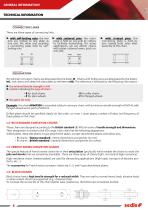
GENERAL INFORMATION TECHNICAL INFORMATION CONNECTING LINKS There are three types of connecting links: ► with self-locking nuts: the two pins are riveted to one plate at one end, the other end receiving a connecting plate held by selflocking nuts ► with cottered pins: the outer plate is held on one side by cotters to facilitate dismantling. For some applications, we can deliver chains with plates cottered every pitch on one side. ► with riveted pins: the connecting plate is held by pins riveted both sides after assembly of the chain. DESIGNATION ISO solid pin conveyor chains are designated by...
Open the catalog to page 10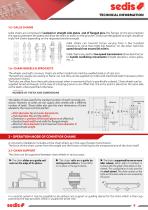
TECHNICAL INFORMATION 1.5- GALLE CHAINS Galle chains are composed of waisted or straight side plates and of flanged pins.The flanges on the pins maintain the spacing between the plates and allow the chain to mesh on the sprocket. Chains are designated as single, double or triple link chains depending on the requested tensile strength. Galle chains can transmit forces varying from a few hundred Newtons to more than 1000 kilo Newton; on the other hand the speed should not exceed 20 m/min. Galle chains are used for low speed transmission (draw benches) or to handle oscillating movements (freight...
Open the catalog to page 11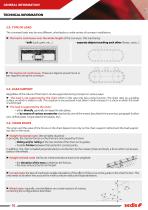
GENERAL INFORMATION TECHNICAL INFORMATION 2.2- TYPE OF LOAD The conveyed loads may be very different, what leads to a wide variety of conveyor installations. ► The load is continuous over the whole length of the conveyor, this load being: • bulk (coal, grain, etc...) • separate objects touching each other (boxes, cases...) ► The load is not continuous. These are objects spread more or less regularly along the conveyor. Regardless of the nature of the load, it can be supported during transport in various ways: ► The load is not supported by the chain which in this case only has a drive function....
Open the catalog to page 12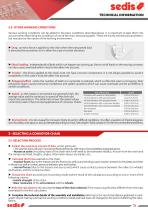
sedis TECHNICAL INFORMATION 2.5- OTHER WORKING CONDITIONS Various working conditions can be added to the basic conditions described above. It is important to take them into account when describing the conditions of use of the chain (next paragraph). These are mainly mechanical parameters, but may also be the nature of the working environment. ► Drag : an extra force is applied to the chain when the transported load is exercised by excavation as it is often the case in bucket elevators. ► Shock loading : independently of jerks which can happen on starting up, the arrival of loads on the moving...
Open the catalog to page 13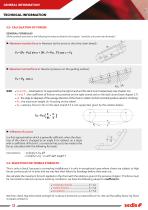
GENERAL INFORMATION TECHNICAL INFORMATION 3.2- CALCULATION OF FORCES GENERAL FORMULAS All the symbols and units in the following formulas are listed in the chapter " symbols, units and main formulas". Ft ► Maximum traction force in Newtons (at the entry to the drive chain wheel) : Pt ► Maximum normal force in Newton (pressure on the guiding surface) : With: • Pt and Pm : total loads (in N) supported by the tight strand and the slack strand respectively (see chapter 3.6) • f and f' : the coefficient of friction encountered on the tight strand and on the slack strand (see chapter 3.7) • a : the...
Open the catalog to page 14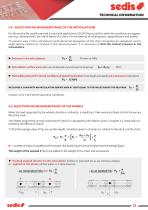
TECHNICAL INFORMATION 3.4- SELECTION FOR WEAR RESISTANCE OF THE ARTICULATIONS For the service life usually required in industrial applications (50,000 hours) and/or when the conditions are aggressive (e.g. abrasive dust), the risk of failure of a chain is in the wearing of rubbing parts, especially pins and bushes. To prevent wear in the articulations (with abnormal elongation of the chain disrupting its operation) and to avoid seizure causing an increase in the required power, it is necessary to limit the contact pressure in the articulations. ► Pressure in the articulations : Pa = Ft ► Articulation...
Open the catalog to page 15All SEDIS catalogs and technical brochures
 Rolmor range
4 Pages
 Record range
8 Pages
 Delta range
4 Pages
 Alpha Premium range
4 Pages
 Corporate brochure SEDIS
20 Pages
 Industrial Components
204 Pages
 Principal Products
76 Pages

- Transmission chain
- Metal chain
- Roller chain
- Steel chain
- Straight-toothed sprocket wheel
- Metal conveyor chain
- Stainless steel chain
- Steel conveyor chain
- Chain sprocket wheel
- Metal sprocket wheel
- Corrosion-resistant chain
- Hub sprocket wheel
- Power transmission chain
- Lifting chain
- Attachment chain
- Roller conveyor chain
- Agriculture chain