


Q7-928

Q7-928
The Q7-928 module user manual provides comprehensive guidance on the module, which is compliant with Qseven® Rel. 2.0 and features the NXP i.MX6 processor. It emphasizes the proprietary nature of the information and prohibits unauthorized use or disclosure. The manual has been revised multiple times to enhance technical accuracy and clarity.
The product comes with a one-year warranty under Italian Law Decree 24/2002, in line with European Directive 1999/44/CE. The warranty covers repair, replacement, or credit, with shipping costs for non-conforming items borne by the customer. An RMA number is required for returns, and items must be returned in original packaging without damage.
SECO S.r.l. offers support services, including a website for product information, sales representatives for problem-solving, and a help-desk for technical assistance. Faulty products can be sent to the SECO Repair Centre with an RMA number.
The Q7-928 module operates at low voltages, requiring careful handling to avoid damage to electronic components. Electrostatic discharge precautions are necessary, and the module is RoHS compliant, manufactured on a lead-free production line.
The manual details the technical specifications, including electrical and mechanical aspects, power consumption, and block diagrams. It describes various connectors such as the FFC/FPC Camera Interface, μSD Card Slot, and Qseven® Connector.
Definitions for technical terms and standards relevant to the Q7-928 module are provided to aid understanding of the technical content.
The Q7-928 is a CPU module in the Qseven® format, utilizing the NXP i.MX6 processor based on the ARM® Cortex®-A9 architecture. It supports single, dual, and quad-core configurations with frequencies up to 1.2GHz, suitable for multimedia and parallel computing applications. The module integrates a CPLD Lattice LCMXO640 and supports various peripherals and bus interfaces, including PCI-Express and SATA, within a compact 70x70mm form factor.
- Processors: NXP i.MX6 Family (i.MX6S Solo, i.MX6D Dual, i.MX6DL Dual Lite, i.MX6Q Quad)
- Memory: Up to 4GB DDR3 onboard
- Graphics: 2D and 3D hardware accelerators, OpenGL® ES2.0, OpenVG™ (not available on all models)
- Video Interfaces: LVDS and HDMI, supporting up to three independent displays
- Mass Storage: Onboard eMMC Disk up to 32GB, SD/MMC/SDIO interface, and external SATA channel
- USB: 1 x USB OTG, 4 x USB 2.0 Host interfaces
- Networking: Gigabit Ethernet interface
- Audio: AC’97 Audio interface
- PCI Express: 1 x PCI-e x1 lane
- Other Interfaces: I2C, LPC Bus, SM Bus, CAN port, Serial ports
- Power: +5VDC ± 5%, with standby and backup battery voltage requirements
- Operating Systems: Linux, Android, Windows Embedded Compact 7
- Dimensions: 70 x 70 mm
The Q7-928 requires a +5VDC power supply and includes standby and backup battery voltage for RTC and CMOS memory. Power consumption varies based on configuration and active interfaces, with significant consumption from PCI-express and SATA interfaces. The board adheres to Qseven® specifications with dimensions of 70 x 70 mm and a ten-layer printed circuit board design.
The MXM connector supports different heights, with standard options being 7.8mm and 7.5mm, while maintaining compliance with Qseven® standards. Consider the maximum component height of 2.2mm ± 0.1 on the bottom side of the Q7-928 when selecting connector heights.
The block diagram outlines the module's interfaces, including USB, UART, I2C, SPI, Audio, CAN, SATA, PCI Express, LVDS, HDMI, and Ethernet. Key components include the NXP i.MX6 processor, SMSC USB2514 hub controller, and Micrel KSZ9031RN Ethernet transceiver.
- FFC/FPC Camera Interface: Utilizes the NXP i.MX6 processor's Image Processing Subsystem for video applications. The connector supports a 10-bit parallel port and MIPI CSI port, with specific pin assignments for video input.
- μSD Card Slot: The i.MX6 processor's SDI/O port #4 connects to a μSD card slot, requiring the removal of the heatsink for card access.
- Qseven® Connector: A 230-pin card edge connector that interfaces with standard MXM connectors. Not all Qseven® standard signals are implemented, and the document provides a detailed pin assignment table.
- PCI Express: Supports one PCI Express lane managed by the i.MX6 processor, compatible with Gen 2.0 (5Gbps) and Gen 1.1 standards.
- UART: Offers one UART interface with TTL electrical levels, requiring an RS-232 transceiver for standard serial port connections.
- Gigabit Ethernet: Utilizes a Micrel® KSZ9031 transceiver with a maximum speed of 470Mbps due to i.MX6 limitations. The document details the differential pairs and signal indicators for Ethernet management.
The manual emphasizes the importance of adhering to Qseven® specifications and provides guidance on selecting appropriate components and configurations for optimal performance. It also highlights the need for independent analysis and judgment in using the provided schematics and material.
For Ethernet connections at 10/100 Mbps, only MDI0 and MDI1 differential lanes are necessary. Unused pairs can be left unconnected.
The Q7-928 module has one S-ATA interface managed by the i.MX6 processor, available only on i.MX6 Quad and Dual versions. Key signals include transmit and receive differential pairs and an activity LED signal.
The i.MX6 processor supports four USB 2.0 controllers. Core #0 supports OTG capabilities, while Core #1 operates in Host mode. Cores #2 and #3 are unused. Overcurrent detection and EMI/ESD protection are necessary for proper USB management.
The i.MX6 processor offers multiple SDIO interfaces for various storage options. The SDI/O port supports multiple communication modes, with signals for card detection, clock, command, and data transfer.
The Q7-928 module supports AC’97 audio format with signals for synchronization, reset, bit clock, and data transfer. These signals must connect to an AC’97 Audio Codec on the carrier board.
The i.MX6 processor includes an LVDS Display Bridge for connecting displays. It supports various configurations for single and dual-channel outputs, with signals for data pairs, clock, and power management.
The processor includes an HDMI Tx module for HDMI 1.4a compliant displays. Signals include TMDS differential pairs and control lines for data, clock, and hot plug detection.
The module supports LPC Bus interface or GPIOs, with signals for data bus, clock, frame, DMA request, and IRQ request. GPIOs can be programmed using SECO APIs or Linux File System.
The i.MX6 processors offer up to four SPI interfaces for connecting EEPROMs and Serial Flash devices, supporting speeds up to 20MHz.
The Q7-928 module supports a CAN interface compliant with CAN specifications 2.0 part B. It requires a CAN Bus Transceiver on the carrier board for connection to a CAN Bus. The CAN0_TX and CAN0_RX signals operate at +3.3V_S.
The module includes several power management signals such as PWGIN, PWRBTN#, RSTBTN#, BATLOW#, WAKE#, SUS_STAT#, SUS_S3#, SUS_S5#, SLP_BTN#, and LID_BTN#. These signals manage power states and transitions, with specific voltage levels and resistor configurations.
Additional signals include WDTRIG#, WDOUT, BOOT_ALT#, GPIO_6, GPIO_19, GP_TIMER_IN, GP_PWM_OUT1, GP_PWM_OUT2, SMB_CLK, SMB_DAT, GP0_I2C_CLK, and GP0_I2C_DAT. These signals serve various functions such as watchdog management, boot configuration, and general-purpose I/O.
The Q7-928 module includes JTAG signals for programming the internal FPGA, accessible via MFG_NCx pins. These signals are reserved for manufacturing and should not be used by customers. The module can be configured to provide i.MX6 JTAG access if needed.
Effective thermal management is crucial for the Q7-928 module. A heatspreader is recommended to transfer heat to external cooling solutions. The choice of cooling solution should consider processor workload and system environment. SECO provides specific heatspreaders and heatsinks for different module versions.
Catalog excerpts
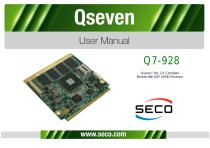
Q7-928 Qseven® Rel. 2.0 Compliant Module with NXP i.MX6 Processor
Open the catalog to page 1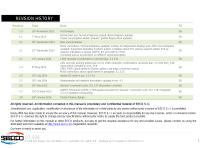
REVISION HISTORY Revision First Release Introduction and Technical features revised; Block Diagram updated Power consumption added; Qseven® golden finger pinout updated Minor corrections; Technical features updated: number of independent displays and LVDS max resolutions updated; Supported Operating Systems added. Limitation about PCI express support added. Pull-up resistors indicated on signals UART0_RX and UART0_CTS#. Corrected pull-up to pull-down on WDOUT signal description LVDS resolution combinations corrected (par. 3.2.3.8) μSD card slot warning added (par 3.2.2); LVDS resolution combinations...
Open the catalog to page 2
Q7-928 Q7-928 User Manual - Rev. First Edition: 1.0 - Last Edition: 3.0 - Author: S.B. - Reviewed by P.Z Copyright © 2016 SECO S.r.l.
Open the catalog to page 3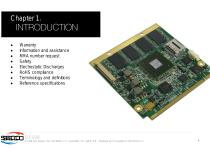
Warranty Information and assistance RMA number request Safety Electrostatic Discharges RoHS compliance Terminology and definitions Reference specifications Q7-928 Q7-928 User Manual - Rev. First Edition: 1.0 - Last Edition: 3.0 - Author: S.B. - Reviewed by P.Z Copyright © 2016 SECO S.r.l.
Open the catalog to page 4
1.1 Warranty This product is subject to the Italian Law Decree 24/2002, acting European Directive 1999/44/CE on matters of sale and warranties to consumers. The warranty on this product lasts for 1 year. Under the warranty period, the Supplier guarantees the buyer assistance and service for repairing, replacing or credit of the item, at the Supplier’s own discretion. Shipping costs that apply to non-conforming items or items that need replacement are to be paid by the customer. Items cannot be returned unless previously authorised by the supplier. The authorisation is released after completing...
Open the catalog to page 5
1.2 Information and assistance What do I have to do if the product is faulty? SECO S.r.l. offers the following services: SECO website: visit http://www.seco.com to receive the latest information on the product. In most of the cases it is possible to find useful information to solve the problem. SECO Sales Representative: the Sales Rep can help to determine the exact cause of the problem and search for the best solution. SECO Help-Desk: contact SECO Technical Assistance. A technician is at disposal to understand the exact origin of the problem and suggest the correct solution. E-mail: [email protected]...
Open the catalog to page 6
1.4 Safety The Q7-928 module uses only extremely-low voltages. While handling the board, please use extreme caution to avoid any kind of risk or damages to electronic components. Always switch the power off, and unplug the power supply unit, before handling the board and/or connecting cables or other boards. Avoid using metallic components - like paper clips, screws and similar - near the board when connected to a power supply, to avoid short circuits due to unwanted contacts with other board components. If the board has become wet, never connect it to any external power supply unit or battery....
Open the catalog to page 7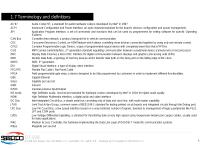
1.7 Terminology and definitions AC’97 ACPI API CAN Bus CEC CPLD CSI2 DDC DDR DDR3 DVI FFC/FPC FPGA GBE Gbps GND GPI/O HD Audio HDMI I2C Bus JTAG LPC Bus LVDS MAC Mbps Audio Codec’97, a standard for audio hardware codecs developed by Intel® in 1997 Advanced Configuration and Power Interface, an open industrial standard for the board’s devices configuration and power management. Application Program Interface, a set of commands and functions that can be used by programmers for writing software for specific Operating Systems Controller Area network, a protocol designed for in-vehicle communication...
Open the catalog to page 8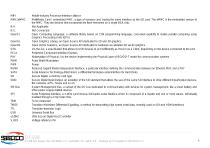
MIPI MMC/eMMC N.A. N.C. OpenCL OpenGL OpenVG OTG PCI-e PHY PWM PWR RGMII SATA SD SDIO SM Bus SPI TBM TMDS TTL USB uSDHC V_REF Mobile Industry Processor Interface alliance MultiMedia Card / embedded MMC, a type of memory card, having the same interface as the SD card. The eMMC is the embedded version of the MMC. They are devices that incorporate the flash memories on a single BGA chip. Not Applicable Not Connected Open Computing Language, a software library based on C99 programming language, conceived explicitly to realise parallel computing using Graphics Processing Units (GPU) Open Graphics...
Open the catalog to page 9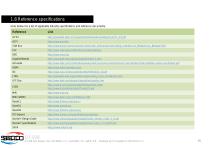
1.8 Reference specifications Here below it is a list of applicable industry specifications and reference documents. Gigabit Ethernet Qseven® Design Guide Qseven specifications Q7-928 Q7-928 User Manual - Rev. First Edition: 1.0 - Last Edition: 3.0 - Author: S.B. - Reviewed by P.Z Copyright © 2016 SECO S.r.l.
Open the catalog to page 10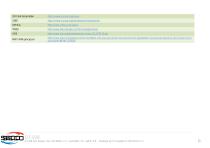
Q7-928 Q7-928 User Manual - Rev. First Edition: 1.0 - Last Edition: 3.0 - Author: S.B. - Reviewed by P.Z Copyright © 2016 SECO S.r.l.
Open the catalog to page 11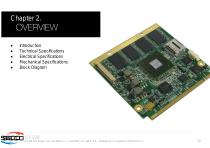
Introduction Technical Specifications Electrical Specifications Mechanical Specifications Block Diagram Q7-928 Q7-928 User Manual - Rev. First Edition: 1.0 - Last Edition: 3.0 - Author: S.B. - Reviewed by P.Z Copyright © 2016 SECO S.r.l.
Open the catalog to page 12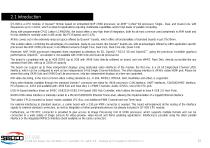
2.1 Introduction Q7-928 is a CPU module, in Qseven® format, based on embedded NXP i.MX6 processor, an ARM® Cortex®-A9 processor, Single-, Dual- and Quad-Core, with frequencies up to 1.2GHz, which is ideal for applications requiring multimedia capabilities and/or high levels of parallel computing. Along with programmable CPLD Lattice LCMXO640, the board offers a very high level of integration, both for all most common used peripherals in ARM world and for bus interfaces normally used in x86 world, like PCI-Express and S-ATA. All this comes out in the extremely reduced space offered by Qseven®...
Open the catalog to page 13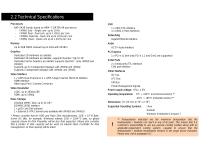
2.2 Technical Specifications Processors NXP i.MX6 Family, based on ARM® CORTEX-A9 processors - i.MX6S Solo - Single core up to 1GHz - i.MX6D Dual - Dual core up to 1.2GHz per core - i.MX6DL Dual Lite - Dual core up to 1GHz per core - i.MX6Q Quad - Quad core up to 1.2GHz per core Memory Up to 4GB DDR3 onboard (up to 2GB with i.MX6S) Graphics Dedicated 2D Hardware accelerator Dedicated 3D Hardware accelerator, supports OpenGL® ES2.0 3D ™ Dedicated Vector Graphics accelerator supports OpenVG (only i.MX6D and i.MX6Q) Supports up to 3 independent displays with i.MX6D and i.MX6Q Supports 2 independent...
Open the catalog to page 14All SECO catalogs and technical brochures
 DEV-KIT-SMARC
3 Pages
Archived catalogs
 SBC-C57
2 Pages
 ETX-A61
2 Pages
 SECO Products Guide 2021
48 Pages
 SBC-C90
2 Pages
 SM-B69
73 Pages
 SM-B71
2 Pages
 Q7 STARTER KIT 2.0
2 Pages
 SYS-B68-IGW
19 Pages
 COMe-C42-BT7
82 Pages
 SYS-D14-MED
2 Pages
 COMe-B75-CT6
78 Pages
 Flexy Vision 21.5 APL
3 Pages
 COMe-A98-CT6
75 Pages
 SENSE-D01
24 Pages
 SYS-B68-IPC
19 Pages
 μQ7-C72
37 Pages
 μQ7-A76-J
67 Pages
 COMe-C55-CT6
87 Pages
 Q7-C26
45 Pages
 COMe-C24-CT6
76 Pages
 COMe-B09-BT6
77 Pages
 Q7-A36
73 Pages
 COMe-A41-CT6
72 Pages
 SBC-992-pITX
58 Pages
 SBC-A44-pITX
65 Pages
 μQ7-A75-J
40 Pages
 Q7-C25
41 Pages
 SBC-A80-eNUC
63 Pages
 Q7-B03
73 Pages
 SBC-B08
36 Pages
 SBC-C43
43 Pages
 SBC-984
38 Pages
 SBC-A62-J
39 Pages
 SBC-B68-eNUC
73 Pages
 SBC-C23
34 Pages
 SBC-C31
42 Pages
 SYS-C90-DS
2 Pages
 SYS-A90-IPC
2 Pages
 SBC-C66
2 Pages
 COM EXP T6 DEV KIT
2 Pages
 COM EXP T7 DEV KIT
2 Pages
 Q7 DEV KIT 2.0
2 Pages
 SYS-C23-IGW
2 Pages
 COMe-C89-CT6
2 Pages
 COMe-C08-BT6
2 Pages
 SYS B08-7
2 Pages
 SYS-A62-10
2 Pages
 SM-C12
2 Pages
 μQ7-962
2 Pages
 SBC-C20
2 Pages
 SBC-C41-pITX
2 Pages
 SBC-C61
2 Pages
- Digital imager
- Visible imager
- CMOS camera module
- Industrial camera module
- SECO Intel® Core™ PC
- SECO industrial PC
- SECO fanless PC
- SECO HDMI PC
- SECO embedded PC
- SECO box PC
- SECO RS-232 PC
- SECO USB 2.0 PC
- SECO Windows PC
- SECO SATA PC
- SECO Linux PC
- SECO USB PC
- SECO RS-485 PC
- SECO USB 3.0 PC
- SECO gigabit Ethernet PC
- Compact PC