
- Catalogs
- SECO TOOLS
- Update 2013-2


Update 2013-2

Update 2013-2
- Counterboring: Parameters include ap x Dc, ae x Dc, vc (m/min), n (rev/min), f (feed per revolution), and vf (mm/min). Coolant types are specified as air, dry, emulsion, or mist spray.
- Chamfering: Similar parameters are provided with specific values for different diameter ranges.
- Deburring: Cutting data is provided for dry and mist spray operations, with specific values for different diameter ranges.
- Slotting: Parameters include ap x Dc, ae x Dc, vc, n, fz (mm), and vf, with specific values for different diameter ranges.
- Side Milling Roughing: Cutting data is provided for various coolant types, with specific values for different diameter ranges.
- Features the Safe-Lock™ tool pull-out protection system.
- Reinforced design with a maximum run-out of 3 μm at 3xd.
- Includes coolant supply channels towards the tool.
- Available in various sizes with specific part numbers and dimensions.
- Also equipped with the Safe-Lock™ system and reinforced design.
- Similar run-out specifications as the Monobloc holders.
- Detailed dimensions and part numbers provided for different shank sizes.
- Designed for high run-out precision and high transmittable torque.
- Run-out is limited to 3 μm at 3xd with specific ER HP collets.
- Includes guidelines for balancing, tool shank compatibility, and coolant supply options.
- Recommended tightening torques and maximum RPMs are specified for different collet sizes.
- Includes kits of balancing screws, stop end screws, and sealing plugs.
- Roller spanners and dynamometric spanners are recommended for tightening and releasing collet nuts.
- Emphasizes the importance of following detailed operating instructions for optimal use.
- Notes on the potential impact of stop end screws on tool run-out.
Catalog excerpts

SECO TOOLS AB SE-737 82 FAGERSTA, SWEDEN TEL. +46 223 400 00 WWW.SECOTOOLS.COM 02897553, ST20136412 GB, © SECO TOOLS AB, 2013. All rights reserved. Technical specifications are subject to change without notice. Printed by Elanders 2013
Open the catalog to page 1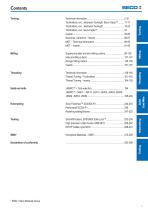
* SMG = Seco Material Group 1
Open the catalog to page 2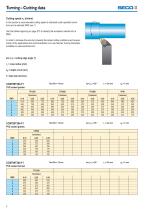
Turning – Cutting data Cutting speed vc (m/min) In this section a recommended cutting speed is indicated under specied conditions and a selected SMG (ver.1) Use the tables beginning on page 273 to classify the workpiece material into a SMG. In order to increase the accuracy towards the actual cutting conditions and requirements of the applications the recommendation is to use Secolor Turning Calculator available on www.secotools.com kar (r) = cutting edge angle (°) r = nose radius (mm) ap = depth of cut (mm) f = feed rate (mm/rev) Tool life = 15 min
Open the catalog to page 3
Turning – Cutting data Tool life = 15 min CVD coated grades TH1500 f (mm/rev) SMG 7
Open the catalog to page 4
Turning – Cutting data CNMG120408-MF2 PVD coated grades TH1000 f (mm/rev) SMG 7 CVD coated grades TM4000 f (mm/rev) SMG 8 9 10 11 PVD coated grades CP500 f (mm/rev) SMG 8 9 10 11 PVD coated grades CP500 f (mm/rev) SMG 8 9 10 11
Open the catalog to page 5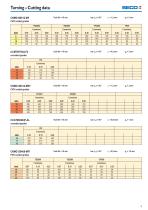
Turning – Cutting data CNMG160612-M5 uncoated grades HX f (mm/rev) 0,10 145 130 110 90 uncoated grades KX f (mm/rev) SMG 16 17 18
Open the catalog to page 6
Turning – Cutting data CNMG120408-MF1 uncoated grades 883 f (mm/rev) SMG 19 20 21 22 Note: We recommend to use the Secolor Turning Calculator, see www.secotools.com, using accurate workpiece material classication, SMG (ver.1)
Open the catalog to page 7
Turning – JetstreamTooling® Finishing inducer Roughing inducer The mounted Jetstream Tooling® Finishing Inducer gives a universally applicable coolant jet, which provides a well positioned coolant wedge from nishing to medium-roughing applications. As accessories there are Jetstream Tooling® Roughing Inducers available for easy exchange providing a more boosted coolant wedge for clearer roughing applications or for cases demanding more space for the chip ow. Changing the insert Simply loosen both locking screws, and rotate the inducer clear of the insert. Check the conditions of the tool, screws...
Open the catalog to page 8
Turning – Secomax, Ceramics Introduction Secomax ceramics include a range of products developed to meet the manufacturing industries ever increasing demands on productivity and product performance. The inserts are die-pressed and sintered by a HIP process using very ne and pure raw materials with ne microstructure to reach excellent material properties. All surfaces are then ground ensuring a product with superior dimensions and tolerances. This comes together in a product with outstanding features: – high thermal shock resistance – optimised fracture toughness – excellent wear resistance – high...
Open the catalog to page 9
Turning – Secomax, Ceramics Geometry recommendations Strong cutting edge geometries are always preferred. • Negative cutting geometry • Chamfered cutting edge • Large nose radius Edge preparation, chamfer size and angle S CS100 is a Sialon type ceramic grade for rough machining of nickel based superalloys High resistance against notch wear Superior edge strength Solid insert Cutting data recommendations The following are recommended cutting data start values Speed (m/min) Feed (mm/rev)
Open the catalog to page 10
Turning – Secomax, Ceramics Troubleshooting Problem Possible cause Suggested actions Flank wear Excessive feed rate and cutting speed Reduce cutting speed Use larger corner radius Use high wear-resistant grade Crater wear Excessive cutting speed Reduce cutting speed Use smaller lead angle Check edge geometry Thermal cracking Severe cycle of heating & cooling during cutting Excessive feed rate and cutting speed Reduce cutting speed Reduce feed rate Change to dry machining Notch wear Excessive feed rate and cutting depth Reduce cutting depth Reduce feed rate Increase coolant supply Edge aking Excessive...
Open the catalog to page 11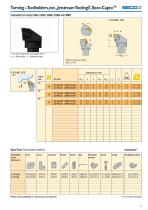
Turning –Toolholders, ext., JetstreamTooling®, Seco-Capto™ Toolholders for inserts CNGA, CNGG, CNMA, CNMG and CNMM C.-PCLNR/L...JETL For insert programme, see page(s) 30-37 o˚= Rake angle, s˚= Inclination angle Right-hand version shown kar (r) = 95° Dimensions in mm Capto size Spare Parts, Parts included in delivery Toolholder/ Insert dimension C.-PCLNR C.-PCLNL Please check availability in current price and stock-list Finishing inducer Roughing inducer
Open the catalog to page 12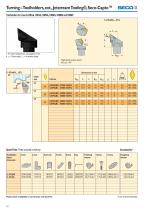
Turning –Toolholders, ext., JetstreamTooling®, Seco-Capto™ Toolholders for inserts DNGA, DNGG, DNMA, DNMG, DNMM and DNMX C.-PDJNR/L...JETL For insert programme, see page(s) 41-47 o˚= Rake angle, s˚= Inclination angle Right-hand version shown kar (r) = 93° Dimensions in mm Capto size Spare Parts, Parts included in delivery Toolholder/ Insert dimension C.-PDJNR C.-PDJNL Please check availability in current price and stock-list Finishing inducer Roughing inducer
Open the catalog to page 13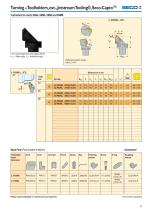
Turning –Toolholders, ext., JetstreamTooling®, Seco-Capto™ Toolholders for inserts SNGA, SNMA, SNMG and SNMM C.-PSSNR/L...JETL For insert programme, see page(s) 56-60 o˚= Rake angle, s˚= Inclination angle Right-hand version shown kar (r) = 45° Dimensions in mm Capto size Spare Parts, Parts included in delivery Lever Toolholder/ Insert dimension Please check availability in current price and stock-list Finishing inducer Roughing inducer
Open the catalog to page 14
Turning –Toolholders, ext., JetstreamTooling®, Seco-Capto™ Toolholders for inserts TNGA, TNMA, TNMG, TNMM and TNMX C.-PTJNR/L...JETL For insert programme, see page(s) 68-73 o˚= Rake angle, s˚= Inclination angle Right-hand version shown kar (r) = 93° Dimensions in mm Capto size Spare Parts, Parts included in delivery Toolholder/ Insert dimension C.-PTJNR C.-PTJNL Please check availability in current price and stock-list Finishing inducer
Open the catalog to page 15
Turning –Toolholders, ext., JetstreamTooling®, Seco-Capto™ Toolholders for inserts VNGA, VNGG and VNMG C.-PVJNR/L...JETL For insert programme, see page(s) 78-79 o˚= Rake angle, s˚= Inclination angle Right-hand version shown kar (r) = 93° Dimensions in mm Capto size Spare Parts, Parts included in delivery Toolholder/ Insert dimension Finishing inducer Please check availability in current price and stock-list
Open the catalog to page 16All SECO TOOLS catalogs and technical brochures
 KIT_CATALOG_GT24-100
24 Pages
 DigitalTransition 2024
10 Pages
 TURBO 16
6 Pages
 DOUBLE QUATTROMILL™ 14
70 Pages
 SECO NEWS 2019.1
16 Pages

Archived catalogs
 SECO NEW TOOLING & EXPANSIONS
64 Pages
 MILLING
752 Pages
 HIGHFEED 4 LO06
21 Pages
 Seco X4
2 Pages
 MN 2012 Threading (4 Mb)
126 Pages
 MN 2012 Turning
652 Pages
 MN 2012 Holemaking (22 Mb)
499 Pages
 MN 2012 Update
116 Pages
 Advanced Cutting Materials
55 Pages
 MN 2014 Update 1
164 Pages
 TS2000 & TS2500
20 Pages
 Duratomic® TM2000 and TM4000
20 Pages
 HIGHFEED 2 LP05
22 Pages
 MN 2012 Tooling (21 Mb)
422 Pages
 MN 2012 Solid End Mills (17 Mb)
298 Pages
 Jabro? Composite cutters
55 Pages
 VHM Conventional Tools
56 Pages
 Diamond Coated Tools
13 Pages
 MN 2014 Milling
675 Pages
 Mini - Miniature Tools
15 Pages
 Jabro? JHP 770 & JHP 780
2 Pages
 Jabro-Solid²
4 Pages
 Double Octomill? R220.48
511 Pages
 Quattromill Alu
2 Pages
 Disc Milling brochure
36 Pages
 MM4500
2 Pages
 NEW MILLING GRADES 2008
16 Pages
 Tooling
358 Pages
 TTP2050 – NEW THREADING GRADE
14 Pages
 GL25-HEADS RANGE EXPANSION
13 Pages
 TOOLING
14 Pages
 CATALOG & TECHNICAL GUIDE – INCH
627 Pages
 CATALOG & TECHNICAL GUIDE 2020.2
598 Pages
 SECO TOOLS - Catalog Jabro Tools
172 Pages


- Solid milling cutter
- Drilling tool
- Steel milling cutter
- SECO insert milling cutter
- Solid drill bit
- Metal milling cutter
- SECO clamping milling cutter
- Milling cutter with cylindrical shank
- Grade
- Cast iron milling cutter
- SECO face milling cutter
- SECO shell-end milling cutter
- Solid carbide milling cutter
- Ball nose milling cutter
- Multi-purpose drilling tool
- Cutting milling cutter
- Corner radius milling cutter
- SECO coated milling cutter