
- Catalogs
- SECO TOOLS
- DigitalTransition 2024


DigitalTransition 2024

DigitalTransition 2024
Manufacturing is increasingly embracing digital solutions, yet many small and medium-sized enterprises (SMEs) find Industry 4.0 daunting. Despite understanding the need for digitization to stay competitive, these manufacturers often struggle with where to start and which technologies offer the best ROI. Fortunately, affordable digital solutions now enable manufacturers of all sizes to benefit from the Industrial Internet of Things (IIoT) through comprehensive tool data and inventory management systems.
While digital technology is recognized as crucial, SMEs face challenges due to limited resources and time for research. Decision-makers often juggle multiple roles, making it difficult to explore digital solutions. Concerns about downtime and ROI further complicate the decision to integrate digital technologies, especially in high-mix/low-volume production environments.
Contrary to the belief that digital integration is time-consuming, many turnkey systems can be implemented quickly, offering rapid ROI through improved data management and process security. Tool data matrices, such as laser-marked codes, provide essential tooling data, reducing user errors and enhancing machining processes.
Laser-marked data matrix codes offer serialized numbers for individual tools, providing detailed data on tool design, production, and usage. This data helps in setting accurate machining parameters and supports recycling efforts. The integration of such data into machining processes can significantly reduce user errors.
Apps complement tooling ID data matrices by offering resources for tool and application assistance. They enable manufacturers to compare tooling products, optimize cutting strategies, and enhance productivity. Apps like Seco Assistant provide machining calculators and tool recommendations, streamlining the decision-making process.
Effective inventory management is crucial, as a significant portion of tooling inventory is often uncontrolled or obsolete. Modern inventory management systems, akin to vending machines, automate tool distribution and reduce costs by optimizing tool usage and procurement processes. These systems can lead to immediate cost savings and improved inventory control.
Despite the ease of integrating digital technologies, selecting the right solution remains challenging. Collaborating with OEMs and suppliers can help shops identify bottlenecks and implement effective digital solutions. Operator education and cross-training further enhance the benefits of digital integration, transforming businesses with advanced technologies.
Shops should evaluate their tooling needs, control inventory, and leverage supplier support to enhance productivity and reduce costs. Addressing issues like tool selection errors, inventory management, and operator training can significantly impact the bottom line.
Catalog excerpts

Making the move to digital manufacturing solutions
Open the catalog to page 1
“Moving to digital manufacturing solutions can be a long journey, but it is still feasible.” Manufacturing continues to move further into the digital age, but for many small and medium-sized shops, the concept of Industry 4.0 still seems out of reach. Many of these manufacturers understand that they need to take advantage of digitization to remain competitive, but they are not sure where to begin or what technologies they can integrate for the highest return on investment (ROI). Fortunately, relatively inexpensive digital solutions have simplified this process – and made it possible for manufacturers...
Open the catalog to page 2
Overcome digital integration challenges Regardless of shop size, nearly all manufacturing professionals understand the importance of digital technology. More than 40 years have passed since the first IIoT device went online: a Coca-Cola vending machine at Carnegie Mellon University that reported on the quantity of bottles available and their temperature. Today, OEMs in the metalworking industry offer a wider range of digital manufacturing products than ever before. Those involving tooling range from laser marked QR codes to easily accessible apps and full tool inventory management systems. The...
Open the catalog to page 3
Ready-to-deploy digital solutions Manufacturers generally have a good understanding of how digital technology can help them improve throughput, reduce risks and help operators add more value to part production. However, many of them believe that integrating digital solutions is a time-consuming process. When in fact, there are many simple turnkey systems that manufacturers can integrate in a matter of days – and that pay for themselves in months, if not weeks, thanks to better data management and process security. Enter the tool data matrix While machine and equipment data is essential to establish...
Open the catalog to page 4
What makes certain laser-marked data matrix codes uniquely powerful is that they represent serialized numbers for each individual tool, as opposed to one code for an entire batch/package of the same model. As part of its tooling ID program, Seco populates the Data Matrix database with three types of data – as designed, as produced and as used. As-designed data basically consists of product information – the specific tool and its corresponding catalog information, tool drawings and recommendations in terms of applications and cutting parameters. As-produced data includes measurement protocols,...
Open the catalog to page 5
Digital solutions: there are apps for that Working in tandem with laser marked tooling ID data matrixes, apps provide manufacturers with valuable resources for tool and application assistance. These apps are immediately accessible with smartphones, tablets, laptops and desktop computers. Through apps, manufacturers can efficiently compare different tooling products based on feeds and speeds, along with cutting data. They can then find the best tool based on their application as well as quickly and easily identify approaches and strategies to reduce costs and increase productivity. Tool-based...
Open the catalog to page 6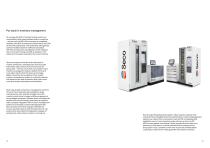
Put stock in inventory management On average, 30-60% of a shop’s tooling inventory is uncontrolled, often simply stacked next to a machine – and as much as 60% of the inventory is completely obsolete, with 80% of production performed by only 20% of the total tooling stock. This redundant, disorganized system inevitably results in inefficient processes, with 15% of production jobs delayed or even stopped due to incorrect tooling and 20% of operators’ nonproductive time spent looking for the correct tooling. Given the expense of tools and the fast pace of modern production, manufacturers need accurate...
Open the catalog to page 7
Conclusion While medium and small-sized shops have an easier time than ever integrating digital technologies, finding the right solution can still be difficult. In many cases, it can be difficult to decide on what solution best fits a shop’s needs. Luckily, OEMs and suppliers are increasingly partnering with their customers to help them begin their digital integration journey. Shops interested in finding out how to improve their operations with digital solutions should start by partnering with their suppliers to conduct efficiency evaluations that help shops identify bottlenecks and suggest solutions...
Open the catalog to page 8
The first steps your shop should take Know your tool need Does your mix of jobs mean you often need more tooling on hand to meet a variety of material and application requirements? Is your productivity impacted by errors in manually entered tool data or other mistakes by unexperienced operators? Has slow tool selection caused your setup times to go up and accuracy go down? Are wasted time and excessive tooling impacting your bottom line? Take advantage of support Do you waste significant amounts of time comparing the tools offered by various suppliers? Are you missing out on machining approaches...
Open the catalog to page 9
WWW.SECOTOOLS.COM 10094598, ST20216757 GB, © SECO TOOLS AB, 2024. All rights reserved. Technical specifications are subject to change without notice.
Open the catalog to page 10All SECO TOOLS catalogs and technical brochures
 KIT_CATALOG_GT24-100
24 Pages
 TURBO 16
6 Pages
 DOUBLE QUATTROMILL™ 14
70 Pages
 SECO NEWS 2019.1
16 Pages

Archived catalogs
 SECO NEW TOOLING & EXPANSIONS
64 Pages
 MILLING
752 Pages
 HIGHFEED 4 LO06
21 Pages
 Seco X4
2 Pages
 MN 2012 Threading (4 Mb)
126 Pages
 MN 2012 Turning
652 Pages
 MN 2012 Holemaking (22 Mb)
499 Pages
 MN 2012 Update
116 Pages
 Advanced Cutting Materials
55 Pages
 MN 2014 Update 1
164 Pages
 TS2000 & TS2500
20 Pages
 Duratomic® TM2000 and TM4000
20 Pages
 HIGHFEED 2 LP05
22 Pages
 Update 2013-2
298 Pages
 MN 2012 Tooling (21 Mb)
422 Pages
 MN 2012 Solid End Mills (17 Mb)
298 Pages
 Jabro? Composite cutters
55 Pages
 VHM Conventional Tools
56 Pages
 Diamond Coated Tools
13 Pages
 MN 2014 Milling
675 Pages
 Mini - Miniature Tools
15 Pages
 Jabro? JHP 770 & JHP 780
2 Pages
 Jabro-Solid²
4 Pages
 Double Octomill? R220.48
511 Pages
 Quattromill Alu
2 Pages
 Disc Milling brochure
36 Pages
 MM4500
2 Pages
 NEW MILLING GRADES 2008
16 Pages
 Tooling
358 Pages
 TTP2050 – NEW THREADING GRADE
14 Pages
 GL25-HEADS RANGE EXPANSION
13 Pages
 TOOLING
14 Pages
 CATALOG & TECHNICAL GUIDE – INCH
627 Pages
 CATALOG & TECHNICAL GUIDE 2020.2
598 Pages
 SECO TOOLS - Catalog Jabro Tools
172 Pages


- SECO milling cutter
- SECO chuck
- Solid milling cutter
- Drilling tool
- Steel milling cutter
- SECO insert milling cutter
- Solid drill bit
- Metal milling cutter
- SECO clamping milling cutter
- Milling cutter with cylindrical shank
- Grade
- Cast iron milling cutter
- SECO face milling cutter
- SECO shell-end milling cutter
- Solid carbide milling cutter
- Ball nose milling cutter
- Multi-purpose drilling tool
- Cutting milling cutter
- Corner radius milling cutter
- SECO coated milling cutter