

PT-130 Laser Tachometer

PT-130 Laser Tachometer
- Measures RPM, Hz, or Total with a simple selector switch.
- Lightweight and ergonomic design for comfortable long-term use.
- Bright LED display for easy viewing in various lighting conditions.
- Automatically records maximum, minimum, last value, and up to 96 data points.
- Laser operation aids in precise measurement targeting.
- Range: 2.50-99,999 RPM; 0.05-999.99 Hz; 1-10,000 Count.
- Resolution: 0.01 RPM (2.50-999.99 RPM), 0.1 RPM (1000.0-9999.9 RPM), 1 RPM (10,000 RPM and up); 0.01 Hz (0.05-999.99 Hz).
- Display: 5-digit, 0.7” (18 mm) green LED.
- Accuracy: +/-0.05% + 1 digit.
- Sampling Time: 0.8 seconds (over 120 RPM).
- Detection: Laser.
- Measuring Distance: 2-20” (50-500 mm).
- Memory: Stores maximum, minimum, last value, and up to 96 readings.
- Dimensions: 6.1 x 2.8 x 1.4 inches (155 x 70 x 35 mm).
- Power: 3 x 1.5V AAA batteries.
- Enclosure: ABS plastic housing.
- Product Weight: 0.4 lb (181 g); Package Weight: 0.9 lb (408 g).
- Certification: CE, RoHS.
- Warranty: 1 year.
- Included Accessories: 3 AAA batteries, protective carrying case, reflective tape.
Catalog excerpts
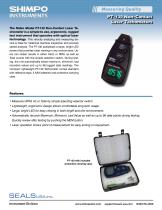
PT-130 Non-Contact Laser Tachometers The Nidec Model PT-130 Non-Contact Laser Tachometer is a simple to use, ergonomic, rugged test instrument that operates with optical laser technology. This velocity analyzing and measuring device is ideal for rotational machine inspection and process speed analysis. The PT-130 possesses a large, bright LED screen that provides clear viewing in any environment. Users can obtain results in either Hertz or RPM, as well as Total counts with the simple selection switch. During testing, the unit automatically saves maximum, minimum, last recorded values and up to 96 logged data readings. The compact, lightweight PT-130 Tachometer comes standard with reflective tape, 3 AAA batteries and protective carrying case. Features • Measures RPM, Hz or Total by simple adjusting selector switch • Lightweight, ergonomic design allows comfortable long term usage. • Large, bright LED for easy viewing in both bright and dim environments • Automatically records Maximum, Minimum, Last Value as well as up to 96 data points during testing. Quickly review after testing by pushing the MEM button. • Laser operation shows point of measurement for easy aiming on equipment. PT-130 with included protective carrying case.
Open the catalog to page 1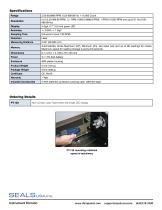
Specifications Range Sampling Time Measuring Distance Automatically stores Maximum (UP), Minimum (dn), last value (LA) and up to 96 readings for review. Maximum speed for reading storage is every 0.8 seconds. Product Weight Package Weight Included Accessories 3 AAA batteries, protective carrying case, reflective tape. Non-Contact Laser Tachometer with bright LED display PT-130 recording rotational speed of machinery.
Open the catalog to page 2All SEALS USA catalogs and technical brochures
 FGS-200W
2 Pages
 ST-329 LED Stroboscope Array
2 Pages
 Series DT-326B
2 Pages
 DT-735
2 Pages
 DT-311D
2 Pages
 DT-3011J
2 Pages
 TNC
TNC2 Pages
 DT-3015N
2 Pages
 TTC Torque Tool Tester
2 Pages
 FG-PUNCTURE
1 Page
 FILTERPULSE
2 Pages


Archived catalogs
 SPEED MEASUREMENT
40 Pages
 SHIMPO - Force measurement
20 Pages
- Measuring device
- Test stand
- Proximity switch
- Cylindrical proximity sensor
- Inductive proximity sensor
- Photoelectric sensor
- IP67 proximity sensor
- Automated test bench
- Industrial tester
- Generator
- Digital gauge
- DC proximity sensor
- Industrial measuring module
- Crane scale
- Industrial test bench
- Threaded proximity sensor
- Digital force gauge
- Stainless steel proximity sensor
- M12 proximity sensor
- Manual test station
- VirtualExpo Group
- Our Partners
- Recruitment
- Testimonials