
- Catalogs
- Scienta Omicron
- LT STM_2017

LT STM_2017

LT STM_2017
Introduction and System Overview
The document details the third generation Low Temperature Scanning Probe Microscope (LT SPM) system by Scienta Omicron, designed for ultra-high stability and performance in low temperature environments using liquid helium cryostats. It supports advanced research in spectroscopy, atomic manipulation, superconductors, semiconductors, and magnetics. Additionally, it covers Scienta Omicron’s broader surface science instrumentation for sample preparation, transfer, and electron spectroscopy under ultra-high vacuum (UHV) conditions.
Key Features and Performance Enhancements
- Extended Liquid Helium Hold Time: Enlarged helium reservoir in the cryostat extends hold time beyond 40 hours, reducing operational costs and increasing experimental flexibility.
- High-Frequency Wiring: Supports GHz-range time-resolved scanning tunneling spectroscopy (STS) via advanced wiring for tip and sample.
- Improved Spectroscopic Resolution: Enhanced energy resolution optimized for superconducting material studies.
- Proven Reliability: Based on a platform with over 100 worldwide installations ensuring high uptime.
- Independent Thermal Control: Separate temperature regulation for tip and sample enables precise thermal management.
Cryostat and Stage Design
The cryostat features an enlarged 2nd stage helium reservoir to minimize evaporation. The sample stage uses a mixed suspension system combining spring suspension and eddy current damping, achieving femtometer-level vibration isolation and stability. The design supports fast cooldown, easy tip/sample exchange, and high-performance STM experiments.
Scanning Probe and Imaging Capabilities
Supports non-contact atomic force microscopy (nc-AFM) with atomic resolution, enabling detection of short-range chemical interactions. Simultaneous evaporation by two evaporators is possible with advanced thermal shielding to minimize heat impact. Large scan ranges and orthogonal coarse positioning allow precise navigation and relocation of nanostructures.
Optical Access and In Situ Evaporation
Optional long working distance optical microscope provides sub-micron resolution for sensor navigation. Multiple optical ports and configurable shielding enable in situ evaporation and sensor exchange without compromising thermal stability.
Tip Positioning and Repositioning Accuracy
Unique tip positioning allows independent X, Y, Z movement with micrometer precision. Guided coarse approach supports hundreds of ultra-stable steps, achieving repositioning accuracy better than 1 nm after tip retraction, critical for repeated atomic/molecular measurements.
Sample and Sensor Handling
Patented piezo inertial coarse positioning drive and transfer plate system enable quick, damage-minimized sensor exchange within minutes. Tip holders support various tip materials with secure mounting and preparation options including sputtering and electron beam heating.
Magnetic Field and Temperature Control
Vertical magnetic fields generated by superconducting coils behind the sample plate avoid heat generation during operation. Options for pulsed or DC fields are available. Built-in heaters and sensors allow rapid temperature variation from 1.5 K to 300 K during operation and up to 500 K in bake-out mode. Spring-loaded electrical contacts provide flexibility for experimental device driving and signal measurement.
System Variants and Configurations
- Basic LT SPM System: Main chamber with fast entry and wobble stick for reliable sample/tip transfer.
- Extended System: Adds preparation chamber for heating, sputter cleaning, evaporation, and analysis (AES, XPS).
- Advanced System: Further extends preparation and analysis capabilities with fast cold sample transfer to maintain low temperatures.
Additional options include in situ sensor systems, optical access, tip preparation chambers, magnetic transfer rods, and sample carousels for high throughput and flexible experiments.
Scientific Applications and Research Highlights
- Atomic-scale imaging and manipulation of molecules and nanostructures via AFM and STM.
- Bottom-up fabrication of atomically precise graphene nanoribbons for spintronics.
- Characterization of chemically and electronically precise oligomer chains for organic electronics.
- High-resolution spectroscopy and imaging of surface-assisted chemical reactions and molecular orbitals.
Summary of Critical Parameters and Best Practices
- Maintain enlarged helium reservoir volume to maximize hold time and reduce costs.
- Use high-frequency wiring and shielding to enable GHz-range time-resolved spectroscopy.
- Employ mixed suspension stage design for optimal vibration isolation and stability.
- Leverage precise tip positioning for reproducible measurements and in situ evaporation.
- Customize modular system configurations to balance throughput, preparation, and analysis needs.
Additional Scienta Omicron Surface Science Systems
The document also describes Scienta Omicron’s advanced UHV systems for sample preparation, transfer, and electron spectroscopy:
- Sample Handling: Fast entry load locks, manipulators with heating/cooling, sample carousels, and wobble sticks for precise, cryogenic-compatible sample transfer.
- Preparation and Analysis Chambers: Equipped with sputter sources, evaporators, and energy analyzers enabling in situ growth and characterization.
- Electron Spectroscopy Analyzers: Next-generation hemispherical analyzers with multichannel detection, high transmission, low noise, and imaging capabilities for XPS and UPS with atomic resolution.
- Performance: Pass energies down to 2 eV, entrance slits to 0.2 mm, linear response at high count rates, and cooling options down to 10 K with long hold times.
- Control Software: Certified software with graphical status, remote interfaces, touchscreen operation, and safety interlocks for reproducible and safe experiments.
- Laboratory Systems: Compact, configurable systems for materials development under hydrogen, thin film deposition, and broad research fields including semiconductors, organics, topological insulators, oxides, and solar cells.
Technical Specifications
- Orthogonal, independent sample coarse positioning axes.
- Standard Scienta Omicron sample plates.
- Energy resolution with pass energies as low as 2 eV.
- Operational temperature range from room temperature to cryogenic (LN2 and LHe cooling).
- Base pressure below 1x10⁻¹⁰ mbar ensuring ultra-high vacuum.
- Scan ranges up to several hundred eV depending on mode.
- Optimized downtime and hold times for long experiments (e.g., >24 hours at low temperatures).
Applications and Research Highlights
- Chemical state mapping, band mapping, and dynamic process observation at atomic scale.
- Studies of superconductivity, semiconductor interfaces, and molecular adsorption dynamics.
- High stability and precision manipulators and analyzers enabling cutting-edge experiments with fast data acquisition.
Summary of Key Advantages
- High stability and precision sample manipulators with heating and cooling capabilities.
- Fast, reliable sample transfer maintaining cryogenic temperatures.
- Next-generation electron spectrometers with multichannel detection and imaging.
- Flexible configurations combining preparation and analysis.
- Advanced software control ensuring reproducibility and safety.
- Compact design suitable for integration into existing vacuum systems.
- Wide applicability across materials science, surface physics, and nanotechnology.
Contact and Support
Scienta Omicron offers global sales and technical support. Detailed product information and publications are available at www.ScientaOmicron.com.
Catalog excerpts
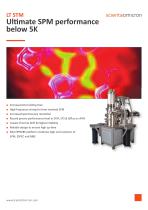
Ultimate SPM performance below 5K ■ Increased LHe holding time ■ High-frequency wiring for time-resolved SPM ■ Increased spectroscopy resolution ■ Record proven performance level in STM, STS & QPIus nc-AFM ■ Lowest Thermal Drift & Highest Stability ■ Reliable design to ensure high up-time ■ MULTIPROBE platform combines high-end solutions of SPM, ESPEC and MBE
Open the catalog to page 1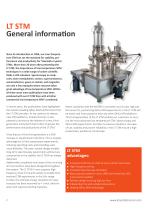
L S enera in ormation Since its intro uction in our Lo emperature S as set t e stan ar or sta i it perormance an pro ucti it or 4LHe at cr ostat S s ore t an ears a er presentin t e L S t e importance o o temperature S tec ni ues in a i e ran e o acti e scientific fie s is sti un ro en Spectroscop on mo e cu es atom manipu ation car on supercon uctors semicon uctors ases on meta s an ma netics are on a e e amp es ere researc ta es reat a anta e o o temperature S it in a t ese areas more pu ications a e een pro uce it our L S t an it a ot er commercia o temperature S s com ine n recent ears the...
Open the catalog to page 2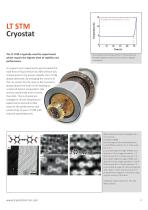
To support such experiments we increased the hold time of liquid helium by 30% without any compromise to the proven stability the LT STM always delivered. By enlarging the volume of the LN2 vessel, the LN2level in the cryostat is always above the level of LHe leading to a reduced helium evaporation rate and an overall hold time of more than 65h. This is of great advantage for all low temperature experiments and will further improve the performance and productivity of your LT STM with reduced operating costs. The cryostat of the third generation LT STM provides an extended holdtime of above 65...
Open the catalog to page 3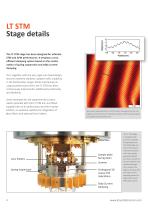
The LT STM stage has been designed for ultimate STM and AFM performance. It employs a very efficient damping system based on the combination of spring suspension and eddy current damping. This, together with the very rigid scan head design, ensures excellent vibration isolation with a stability in the femtometer range. While maintaining its unique performance level, the LT STM has been continuously improved for additional functionality and flexibility. Some examples for the experimental customisation possible with the LT STM are: pre-fitted tapped holes at all optical axes and the cryostat bottom,...
Open the catalog to page 4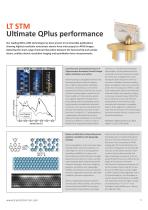
LT STM Ultimate QPIus performance Our leading QPIus AFM technology has been proven in innumerable publications showing highest resolution noncontact atomic force microscopy (nc-AFM) images. Detecting the short range chemical interaction between the foremost tip and sample atoms, enables atomic resolution imaging and quantitative force measurements. Local Electronic and Chemical Structure of Oligo-acetylene Derivatives Formed Through Radical Cyclizations at a Surface Semiconducting n-conjugated polymers have attracted significant interest for applications in light-emittng diodes, field-effect...
Open the catalog to page 5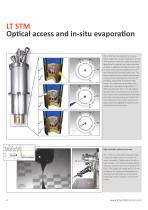
The LT STM has the capability for simultaneous evaporation by two evaporators during STM operation. With the sample facing down, deposition of materials from below becomes possible. In addition, the large Z-coarse range of 10 mm for tip positioning allows for removal of the tip from the evaporation zone. The easy to operate thermal shield compartment consists of two shield pairs for LHe and LN2 shielding, respectively. To minimize heat impact, the shield concept provides three wobble stick selectable configurations: (i) SPM operation with Tmin < 5 K; (ii) evaporation port open and sample/sensor...
Open the catalog to page 6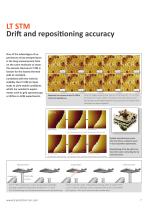
L S ri an repositionin accurac ne o t e a anta es o e periments at o temperatures is t e on measurement time on t e same mo ecu e or atom e Scienta micron L S is no n or t e o est t erma ri o om ine it t e intrinsic sta i it t e L S pm ea s to u tra sta e con itions ic are nee e in e periments suc as ri spectroscop or us nc e periments Series o i ages ac uired o er a period o hours at . .S on Si . . n . he white cross ar s the Si corner ho e position at the beginning o the easure ent. o so ware dri correction has been e p o ed. treme o t erma ri o in t erma e ui i rium Re ia e repositionin accurac...
Open the catalog to page 7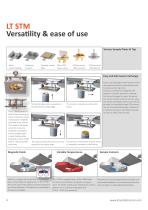
Various Sample Plates & Tips STM tip carrier STM tip carrier (QPIus version) (STM version) Direct 4 electrical Standard sample QPIus AFM current heating contacts plate sensor carrier The transfer plate with a new sensor is inserted into the sample stage. The scanner is moved up to pick up the sensor. The LT STM tip holder allows for easy mounting of any tip material by simple clamping and is magnetically fixed at the scanner. The transfer plate allows access for various tip preparation techniques such as sputtering and e-beam heating, while keeping the sensor holder itself in a secure position...
Open the catalog to page 8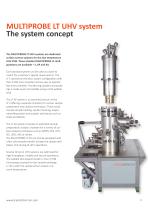
The MULTIPROBE LT UHV systems are dedicated surface science systems for the low temperature UHV STM. Three standard MULTIPROBE LT configurations are available - S, XP and XA. Each standard system can be used as a base to match the customer's special requirements. The LT S represents the basic system configuration with the LT STM main chamber and an easy to operate fast entry chamber. Transferring samples and probe tips is made quick and reliable using a UHV wobble stick. The LT XP system is an extended version of the LT S offering a separate chamber for various sample preparation and analysis...
Open the catalog to page 9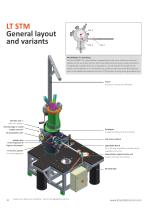
LT STM General layout and variants Pos. 2 \ Pos. 1 Interface port to other UHV systems Cleaving stage or cooled sample carousel* Tip preparation tool* Wobble Stick ln-situ evaporator & high-res microscope* ln-situ lens system* in convocal geometry MULTIPROBE LT S (Handling): The MULTIPROBE LT S (shown below) is equipped with a fast entry load lock to introduce samples (or tips via Scienta Omicron tip transfer plates) into the vacuum system (position 1). A magnetically coupled transfer rod (,mag probe') is used to transfer the sample into the sample carousel (position 2). In this position, the...
Open the catalog to page 10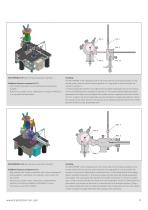
MULTIPROBE LT XP (with XP-type preparation chamber) Additional features compared to LT S: - UHV sample manipulator, various heating and cooling options available - Ports for e.g. sputter source, evaporators, and LEED or RHEED for in-situ growth characterisation Handling: The MULTIPROBE LT XP is equipped with a fast entry load lock to introduce samples (or tip transfer plates) into the vacuum system (position 1). A mag probe is used to transfer the sample to position 2. A second mag probe transfers it to a high precision sample manipulator (LN2 or LHe cooling and various heating options available)...
Open the catalog to page 11All Scienta Omicron catalogs and technical brochures
 NanoESCA
4 Pages
 UHV Suitcase
2 Pages
 ARPES-Lab
4 Pages
 Cryo Manipulators
2 Pages
 XPS-Lab
2 Pages
 Fermi DryCool SPM
8 Pages
 TESLA JT SPM
8 Pages
 EFM Evaporators
8 Pages
 Argus CU
7 Pages
 UHV NANOPROBE
12 Pages
 Fermi SPM
8 Pages
 Leonova Diamond
8 Pages
 Leonova Emerald
12 Pages
 Intellinova
4 Pages
 MULTIPROBE
8 Pages
 Omicron EFM V05
8 Pages
 PRO-75/100 MBE Systems
2 Pages
 EVO-25/50 MBE Systems
2 Pages
 LAB-10 MBE System
2 Pages
 ISE 5
ISE 52 Pages
 EKF 300
2 Pages
 Omicron CN 10 V02
2 Pages
 MBD-LEED
8 Pages
 FOCUS PEEM
16 Pages
 Argus
Argus12 Pages
 MULTISCAN Lab
2 Pages
 LT NANOPROBE
8 Pages
 UHV STM 1
2 Pages
 Cryogenic STM & SFM
4 Pages
 SPHERA
8 Pages
 NanoSAM Lab
6 Pages


Archived catalogs
 VT SPM
11 Pages
 VT SPM_2012
20 Pages
 ESCA+_2010
8 Pages
 LT STM_2012
16 Pages
 MATRIX SPM Control System
8 Pages
 EFM 2
EFM 28 Pages
 CMA 100
4 Pages
 NanoESCA
8 Pages
 SPECTALEED
8 Pages
 SPM PROBE
2 Pages
 EKF 1000
2 Pages
 Multiscan STM
2 Pages
 MS5 & Control Unit
2 Pages
- Liquids analyzer
- Laboratory microscope
- Integration analyzer
- Compact analyzer
- Laboratory spectrometer
- Desktop microscope
- Spectrum analyzer
- Process evaporator
- Process spectrometer
- High-resolution spectrometer
- Laboratory evaporator
- X-ray source
- Lamp illumination
- Compact illumination
- UV illumination
- Ergonomic microscope
- 3D microscope
- R&D spectrometer