
- Catalogs
- Schweizer GmbH & Co. KG
- Comparison of international standards for materials

Comparison of international standards for materials

1 / 1 PageView full catalog
Comparison of international standards for materials
Product catalog summary
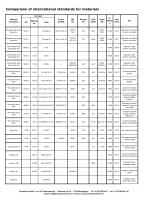
Comparison of International Standards for Materials
1. Patented Drawn Spring Steel Wire
Two types are compared: SH (type C) and DH (type D). Both are suitable for high static and medium dynamic conditions, with a maximum temperature of 80°C. They are standardized under EN 10270-1 and have equivalents in various international standards including NFA, ASTM, and JIS.
Two types are compared: SH (type C) and DH (type D). Both are suitable for high static and medium dynamic conditions, with a maximum temperature of 80°C. They are standardized under EN 10270-1 and have equivalents in various international standards including NFA, ASTM, and JIS.
2. Oil Tempered Valve Spring Steel Wire
These materials are designed for high dynamic conditions with a maximum temperature range of 250°C to 300°C. They are standardized under EN 10270-2 and have equivalents in international standards such as ASTM and JIS.
These materials are designed for high dynamic conditions with a maximum temperature range of 250°C to 300°C. They are standardized under EN 10270-2 and have equivalents in international standards such as ASTM and JIS.
3. Rust-Proof Spring Steel
Several types are listed, each with different corrosion resistance and temperature limits ranging from 250°C to 350°C. They are standardized under EN 10270-3 and EN 10088-3, with equivalents in international standards like ASTM, JIS, and BS. Applications include corrosion-resistant springs, non-magnetic springs, and springs for use in seawater.
Several types are listed, each with different corrosion resistance and temperature limits ranging from 250°C to 350°C. They are standardized under EN 10270-3 and EN 10088-3, with equivalents in international standards like ASTM, JIS, and BS. Applications include corrosion-resistant springs, non-magnetic springs, and springs for use in seawater.
4. Non-Magnetic Springs
Materials such as brass wire, phosphorous bronze, and copper beryllium are included, with maximum temperatures ranging from 100°C to 200°C. These are standardized under EN 12166 and have equivalents in international standards.
Materials such as brass wire, phosphorous bronze, and copper beryllium are included, with maximum temperatures ranging from 100°C to 200°C. These are standardized under EN 12166 and have equivalents in international standards.
5. High-Temperature and Corrosive Environment Springs
Materials like Hastelloy C4, Inconel X750, Nimonic 90, and Duratherm are designed for extreme conditions, with maximum temperatures ranging from 450°C to 650°C. These materials are suitable for high-temperature areas and extremely corrosive atmospheres.
Materials like Hastelloy C4, Inconel X750, Nimonic 90, and Duratherm are designed for extreme conditions, with maximum temperatures ranging from 450°C to 650°C. These materials are suitable for high-temperature areas and extremely corrosive atmospheres.
Key Parameters
The document provides a detailed comparison of material codes, maximum temperature limits, and their applications across different international standards, highlighting the versatility and specific use cases of each material type.
The document provides a detailed comparison of material codes, maximum temperature limits, and their applications across different international standards, highlighting the versatility and specific use cases of each material type.
See more
Catalog excerpts
Schweizer GmbH + Co. KG Federntechnik - Keltenstr.16-18 - 72766 Reutlingen - Tel.: 07127/95792-0 - Fax: 07127/95792-115 Email: [email protected] Internet: www.schweizer-federn.de
Open the catalog to page 1All Schweizer GmbH & Co. KG catalogs and technical brochures
 Catalogue
98 Pages
*Prices are pre-tax. They exclude delivery charges and customs duties and do not include additional charges for installation or activation options. Prices are indicative only and may vary by country, with changes to the cost of raw materials and exchange rates.
About DirectIndustry
DirectIndustry is a marketplace that offers B2B players a complete experience, from product sourcing to purchase. DirectIndustry is an entity of VirtualExpo Group.
Are you a buyer?
Are you a supplier?