
- Catalogs
- Schweitzer Engineering Laboratories
- SEL-487E-3, -4 Transformer Differential Relay


- Company
- Products
- Catalogs
- News & Trends
- Exhibitions
SEL-487E-3, -4 Transformer Differential Relay

SEL-487E-3, -4 Transformer Differential Relay
The SEL-487E Transformer Differential Relay provides comprehensive three-phase differential protection for transformers, supporting up to five three-phase restraint current inputs. It includes three independent restricted earth fault (REF) elements for sensitive ground-fault detection and a negative-sequence differential element for detecting turn-to-turn winding faults. The relay also offers over- and undervoltage, frequency, and volts/hertz protection, along with monitoring capabilities for critical substation assets such as breaker wear and transformer thermal conditions.
The relay ensures high-speed differential protection with a two-stage slope for fast and secure operation. It includes multiple synchrophasor data channels for system-wide monitoring and supports harmonic blocking and restraint features for inrush and overexcitation detection. Additional features include combined overcurrent elements, directional element performance optimization, and backup protection for transformers and feeders.
System integration is simplified through Ethernet communication using DNP3 LAN/WAN and IEC 61850 protocols. The relay supports serial data communication and input/output scaling with various modules, and features setting and commissioning standardization with ACSELERATOR QuickSet® software.
The SEL-487E supports Precision Time Protocol (PTP) for high-accuracy timing and Time-Domain Link (TiDL) technology for remote data acquisition. It includes relay functions such as synchronism check, breaker failure protection, and adaptive time-overcurrent elements, with a front-panel display for operational status and support for various communication protocols.
The SEL-487E is suitable for transformer applications, offering features like harmonic restraint and blocking, wave-shape-based inrush detection, and configurable CT inputs. It provides comprehensive protection for generator step-up transformers and can serve as a station-wide synchrophasor measurement device.
The relay includes adaptive differential elements with two slope settings and harmonic blocking/restraint elements for optimal speed and security during inrush conditions. It offers volts/hertz protection with frequency tracking from 40.0 to 65.0 Hz and customizable V/Hz curves for transformer protection.
The relay includes five undervoltage and five overvoltage elements with definite-time delay, and six frequency elements with undervoltage supervision, maintaining accuracy from 40.0 to 70.0 Hz.
Instantaneous overcurrent elements are available for phase, negative-sequence, and zero-sequence currents. The relay supports adaptive time-overcurrent elements with programmable time-delay and pickup levels, allowing dynamic adjustments based on system conditions.
The REF protection feature detects internal ground faults on grounded wye-connected transformer windings and autotransformers, using single-phase neutral current inputs and directional elements.
The relay includes synchronism-check elements to prevent circuit breaker closure under out-of-phase conditions and provides breaker-failure protection for up to five breakers, with high-speed open-phase sensing logic.
This element detects turn-to-turn internal faults on transformer windings using a sensitive negative-sequence current differential element, providing security during external faults and inrush conditions.
Directional elements supervise phase and ground overcurrent elements, with settings for CT polarity reversal and voltage-polarized directional elements for backup protection.
The SEL-487E supports remote data acquisition through TiDL technology, providing low-latency data over a point-to-point architecture. It also includes flexible control logic to replace traditional panel control switches and integrate with SCADA systems.
The document discusses the use of SELOGIC control equations for programming local control points in the SEL-487E relay. These points can be used for various functions, including taking terminals out of service for testing. The QuickSet software allows for the creation of application-specific settings templates. SELOGIC can be programmed using structured text or graphical logic diagrams via the Graphical Logic Editor (GLE).
The relay supports 32 remote control points, which can be set, cleared, or pulsed via serial port commands. These points can be integrated into control schemes for SCADA-type operations. Additionally, 32 latching control points replace traditional latching relays, with conditions programmable via SELOGIC control equations.
The relay features 24 tri-color latching target LEDs and 12 programmable pushbuttons with LEDs. Custom messages can be displayed on the LCD, driven by SELOGIC control equations.
High-accuracy timekeeping is achieved using IRIG-B from a GPS clock, with time-tagging accuracy within 1 µs. The relay also supports IEEE 1588 Precision Time Protocol (PTPv2) for synchronization via Ethernet, achieving accuracy of ±100 ns.
Expanded SELOGIC control equations allow for 250 lines of protection logic and 1000 lines of automation logic. The alias capability improves readability by allowing more meaningful variable names.
The SEL-487E provides dynamic one-line diagrams for control of disconnects and breakers. These diagrams can be customized with user-defined labels and analog quantities.
This technology enables bidirectional relay-to-relay digital communication, enhancing coordination and enabling faster tripping.
The relay offers multiple serial communication features, including four EIA-232 ports and support for various SEL protocols. Ethernet communication is available with optional cards, supporting Telnet, FTP, and IEEE C37.118 synchrophasor data.
The relay supports IEC 61850 Ethernet-based communication for interoperability between intelligent devices within substations. It allows for high-speed control and monitoring using GOOSE messages and provides a data server for relay monitoring.
All relay files transferable via FTP can also be transferred using MMS file services. MMS authentication requires a setting in the CID file, necessitating an Access Level 2 password for client requests to initiate an MMS session.
This software is used to manage logical node data for IEC 61850 devices, providing displays for identifying and binding network data using CID files.
The document details various communication protocols including ASCII for human and machine communication, Compressed ASCII for data reports, and binary protocols like SEL Fast Meter for machine-to-machine communication. It also covers protocols like Ymodem, DNP3 Level 2, and MIRRORED BITS for exchanging information among SEL relays.
The relay provides metering functions for fundamental and RMS voltages and currents, differential metering, and power/energy metering quantities. Optional FTP and Telnet services are available for Ethernet-based communication.
The SEL-487E includes thermal modeling for transformers, using temperature data to calculate hot-spot temperatures and insulation aging. It provides alarms and control actions based on temperature thresholds.
This feature monitors through-fault events, which are external overcurrent events, and calculates cumulative data to aid in maintenance scheduling.
The relay monitors breaker wear by capturing interrupted current and operation counts, providing alarms when thresholds are exceeded.
The SEL-487E measures and reports substation battery voltage, providing alarms and control for battery systems.
Event reports and SER features aid in post-fault analysis and relay testing. The relay provides detailed event summaries and stores up to 1000 events.
ACSELERATOR QuickSet SEL-5030 Software allows for offline settings development and event report conversion. The front-panel display includes an LCD screen and customizable LED indicators for local control functions.
The document outlines the specifications for the SEL-487E-3, -4, including off frequency at 2.8 kHz with a tolerance of ±5%, digital filtering with full-cycle cosine after low-pass analog filtering, and protection and control processing at 8 times per power system cycle. Control points include 32 remote bits, 32 local control bits, and 32 latch bits in both protection and automation logic.
Differential elements are detailed with one zone (A, B, and C elements) and five windings. TAP pickup ranges from 0.1 to 32.0 times INOM A secondary, with a TAP range of TAPMAX/TAPMIN ≤35. Time-delay accuracy is ±0.1% plus ±0.125 cycle. Restraint and unrestraint differential elements have specific pickup ranges and accuracies, with harmonic elements covering 2nd, 4th, and 5th harmonics.
The document specifies various protection elements, including negative-sequence differential elements, open-phase detection logic, restricted earth fault elements, and overcurrent elements. Each element has defined pickup ranges, accuracies, and time-delay settings.
Phase directional elements, phase-to-phase directional elements, and ground directional elements are described, each with specific polarization, sensitivity, and accuracy parameters.
Undervoltage and overvoltage elements have defined pickup ranges and accuracies, with maximum pickup/dropout times specified. Under- and overfrequency elements have a pickup range of 40.01–69.99 Hz with high accuracy.
The document includes details on volts/hertz elements, breaker failure instantaneous overcurrent settings, timers, directional overpower/underpower elements, bay control, and station DC battery system monitor specifications.
Metering accuracy is provided for phase-angle, currents, voltages, power, energy, and demand/peak demand metering. Optional RTD elements and synchrophasor capabilities are also detailed, including data streams, accuracy, and recording capabilities.
Breaker monitoring includes running total of interrupted current, percent kA interrupted for trip operations, percent breaker wear, and compressor/motor start and run time.
The document is © 2012–2017 by Schweitzer Engineering Laboratories, Inc., with all rights reserved. It includes a standard SEL 10-year warranty and contact information for further inquiries.
Catalog excerpts

SEL-487E-3, -4 Transformer Differential Relay Three-Phase Transformer Protection, Automation, and Control System Major Features and Benefits The SEL-487E Transformer Differential Relay provides three-phase differential protection for transformer applications with as many as five three-phase restraint current inputs. Use the three independent restricted earth fault (REF) elements for sensitive ground-fault detection in grounded wye-transformer applications. Detect turn-to-turn winding faults for as little as two percent of the total transformer winding with the negative-sequence differential element. Apply the two three-phase voltage inputs for over- and undervoltage, frequency, and volts/hertz protection. Make any overcurrent element directional using voltage polarized directional elements as torque control inputs to the overcurrent elements. Monitor and protect critical substation assets with comprehensive breaker wear and transformer thermal and through-fault monitoring. Perform bay control functions for as many as five breakers and 20 disconnect switches using the built-in system mimic diagrams. Schweitzer Engineering Laboratories, Inc.
Open the catalog to page 1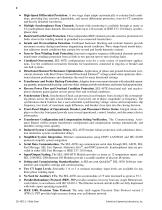
High-Speed Differential Protection. A two-stage slope adapts automatically to external fault conditions, providing fast, sensitive, dependable, and secure differential protection, even for CT saturation and heavily distorted waveforms. Multiple Synchrophasor Data Channels. System-wide monitoring is available through as many as 24 synchrophasor data channels. Record and store up to 120 seconds of IEEE C37.118 binary synchrophasor data. Restricted Earth Fault Protection. Three independent REF elements provide sensitive protection for faults close to the winding neutral in grounded wye-connected...
Open the catalog to page 2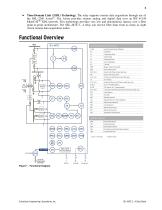
► Time-Domain Link (TiDL) Technology. The relay supports remote data acquisition through use of the SEL-2240 Axion®. The Axion provides remote analog and digital data over an IEC 61158 EtherCAT® TiDL network. This technology provides very low and deterministic latency over a fiber point-to-point architecture. The SEL-487E-3, -4 relay can receive fiber links from as many as eight Axion remote data acquisition nodes. Functional Overview 1 Copper or Fiber Optic * Optional Feature Figure 1 Functional Diagram Schweitzer Engineering Laboratories, Inc.
Open the catalog to page 3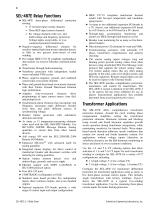
SEL-487E Relay Functions ► SEL-487E three-phase differential protection sensing: ^ 15 restraint input current channels ^ Three REF input current channels ^ Six voltage channels with over- and undervoltage and frequency protection. Voltage inputs accept delta- or wye-connected potential transformers. ► Negative-sequence differential element for sensitive internal fault (turn-to-turn) detection detects as little as two percent short-circuit of total winding ► Five unique IEEE C37.118 compliant synchrophasor data streams via serial or Ethernet communications ports ► Transformer through-fault monitoring ►...
Open the catalog to page 4
High Voltage Transformer Differential Zone Tertiary Voltage Two-Winding Transformer Application Use the negative-sequence differential element for sensitive detection of interturn faults within the transformer winding. Phase, negative-, and zero-sequence overcurrent elements provide backup protection. Use breaker failure protection with subsidence detection to detect breaker failure and minimize system coordination times. When voltage inputs are provided to the SEL-487E, voltage-based protection elements and frequency tracking are made available. Frequency tracking from 40.0 to 65.0 Hz over-...
Open the catalog to page 5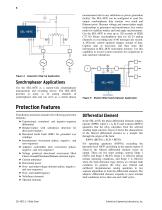
measurement unit in any substation or power generation facility. The SEL-487E can be configured to send five unique synchrophasor data streams over serial and Ethernet ports. Measure voltage and current phase angle relationships at generators and transformers, key source nodes for stability studies and load angle measurements. Use the SEL-487E to store up to 120 seconds of IEEE C37.118 binary synchrophasor data for all 24 analog channels at a recording rate of 60 messages per second. A SELOGIC control equation triggers storage of data. Capture data as necessary, and then store this information...
Open the catalog to page 6
The differential element includes one harmonic blocking and one harmonic restraint element; select either one or both of them. The combination of harmonic blocking and restraint elements provides optimum operating speed and security during inrush conditions. Wave-shape-based inrush detection addresses inrush conditions that contain low second and fourth harmonic content. Fast sub-cycle external fault detection supervision adds security during external faults with CT saturation. The harmonic blocking element includes common or independent 2nd and 4th harmonic blocking and independent 5th harmonic...
Open the catalog to page 7
Adaptive Time-Overcurrent Elements (51S) The relay supports ten adaptive time-overcurrent elements with selectable operate quantity and programmable time-delay and pickup levels. Choose from the ten time-overcurrent curves shown in Table 2 (5 IEC and 5 U.S.). Each torque-controlled time-overcurrent element has two reset characteristics. One choice resets the elements if current drops below pickup for one cycle while the other choice emulates the reset characteristic of an electromechanical induction disk relay. Table 2 Supported Time-Overcurrent Curves The adaptive time-overcurrent elements in...
Open the catalog to page 8
Synchronism Check Synchronism-check elements prevent circuit breakers from closing if the corresponding phases across the open circuit breaker are excessively out of phase, magnitude, or frequency. The SEL-487E synchronism-check elements selectively close circuit breaker poles under the following criteria: ➤ The systems on both sides of the open circuit breaker are in phase (within a settable voltage angle difference). ➤ The voltages on both sides of the open circuit breaker are healthy (within a settable voltage magnitude window). The synchronism-check function is available for as many as five...
Open the catalog to page 9
An ORDER setting is provided to prioritize the selection of zero- or negative-sequence polarization for directional control of ground overcurrent elements using patented Best Choice Ground Directional Element switching logic. Positive- and negative-sequence voltages are used for directional control of phase-overcurrent elements. Positive-sequence voltage memory is used to provide security during three-phase faults. Loss-of-potential elements supervise the voltage-polarized directional elements. Current Unbalance Elements The current unbalance logic uses the average terminal current to calculate...
Open the catalog to page 10All Schweitzer Engineering Laboratories catalogs and technical brochures
 SEL-C662
1 Page
 2019 CATALOG
248 Pages
 2018 CATALOG
374 Pages
 METERING ACCESSORIES CATALOG
20 Pages
 STANDARD CABINET CATALOG
28 Pages
 SEL-3622 Security Gateway
12 Pages
 SEL-710-5 Motor Protection Relay
28 Pages
 SEL-3610 Port Server
12 Pages
 2017 SEL Catalog
373 Pages
 SEL-2664 Field Ground Module
12 Pages
 SEL-2533 Annunciator
12 Pages
 SEL-2414 Transformer Monitor
20 Pages
 SEL-2244 Digital I/O Module
8 Pages
 SEL-2243 Power Coupler
4 Pages
 SEL-2242 Chassis/Backplane
8 Pages
 SEL-2240 Axion®
32 Pages
 SEL-1102 Computing Platform
12 Pages


Archived catalogs
 2015 Modern Solutions Catalog
331 Pages
 SEL 2008 Product Catalog EOS Mfg
44 Pages


