1. Catalogs
  2. Schweitzer Engineering Laboratories
  3. SEL-421-4, -5 Protection and Automation System

SEL-421-4, -5 Protection and Automation System

SEL-421-4, -5 Protection and Automation System
1 / 32 PagesView full catalog

SEL-421-4, -5 Protection and Automation System

Product catalog summary
Overview: The SEL-421-4, -5 Protection, Automation, and Control System by Schweitzer Engineering Laboratories, Inc. is designed for high-speed line protection, automation, and control in a two-breaker bay setup. It integrates distance and directional protection with automation features to enhance system reliability and efficiency.
Protection Features: The system offers five zones of phase and ground-distance protection with Mho or Quadrilateral characteristics. It includes high-speed elements and series compensation logic for critical lines. The patented CCVT transient overreach logic enhances security, while the Best Choice Ground Directional Element® logic optimizes performance.
Automation and Control: The SEL-421-4, -5 includes 32 programmable elements for local and remote control, protection latching, and automation latching. It supports serial and Ethernet communication for data transmission, including synchrophasors and event reports. The system can incorporate up to 1000 lines of automation logic.
Synchrophasors and Communications: The system supports real-time phasor measurements for informed load dispatch decisions and system-wide disturbance recording. It uses MIRRORED BITS® communications for relay-to-relay monitoring and supports IEEE C37.118-2005 format synchrophasors.
Redundancy and Protocols: The SEL-421 provides primary potential redundancy and supports Parallel Redundancy Protocol (PRP) for seamless Ethernet network recovery. It offers optional Ethernet access for relay functions and supports various protocols like IEC 61850 and DNP3.
Monitoring and Maintenance: The system includes features for breaker maintenance scheduling, monitoring electrical and mechanical operating times, and providing alarm notifications for battery voltage issues. It also supports programmable trip and reclose functions for integrated substation control.
Advanced Features: The SEL-421 includes out-of-step blocking and tripping, switch-onto-fault protection, fault location, oscillography, and a rules-based settings editor. It supports thermal overload modeling and comprehensive metering functions.
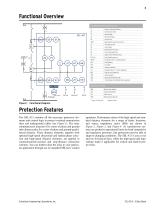
Functional Overview: The SEL-421 is equipped with protective elements and control logic for transmission lines and cables. It measures five zones of phase and ground mho distance and quadrilateral distance, with optional high-speed directional and faulted phase selection elements.
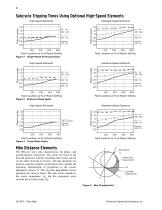
Distance Elements: The system uses mho characteristics for distance protection, with high-speed elements providing subcycle tripping times. Load-encroachment logic prevents operation under high load conditions, and CCVT transient detection logic enhances security.
Directional Elements: The SEL-421 includes multiple directional elements for increased sensitivity and security, using patented principles for ground overcurrent elements. The optional High-Speed Directional and Faulted Phase Selection (HSDPS) element provides faster relay operation.
Communications-Assisted Tripping Schemes: The SEL-421 is suitable for use in transmission systems, offering advanced protection and control features to adapt to changing operational conditions.
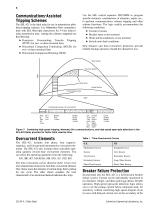
Pilot-Based Tripping Schemes: The document discusses pilot-based tripping schemes using MIRRORED BITS communications with SEL fiber-optic transceivers, achieving relay-to-relay transmission times of 3–6 ms. Supported schemes include Permissive Overreaching Transfer Tripping (POTT), Directional Comparison Unblocking (DCUB), and Directional Comparison Blocking (DCB). The SEL control equation TRCOMM is used to program specific elements for communication scheme tripping, accommodating conditions like current reversals and weak-infeed conditions.
Overcurrent Elements: The SEL-421 relay includes multiple overcurrent elements: four phase, four negative-sequence, and four ground instantaneous overcurrent elements, along with three selectable inverse-time overcurrent elements. The time-overcurrent curves offer two reset characteristic choices, enhancing flexibility and reliability.
Breaker Failure Protection: The SEL-421 incorporates a comprehensive breaker failure system, allowing individual monitoring of two breakers. It features high-speed open-pole detection logic, improving sensitivity and stability even with delayed current zero scenarios.
Thermal Overload Protection: The relay supports SEL-2600 Fast Messages for thermal overload protection, integrating magnitude and status information into predefined relay values and bits.
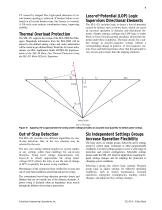
Loss-of-Potential (LOP) Logic: LOP logic supervises directional elements, detecting potential loss due to failures like blown fuses. It blocks or forces directional elements based on sudden voltage changes, ensuring secure and fast operation.
Out-of-Step Detection: The SEL-421 offers two algorithms for out-of-step detection, including a zero setting method requiring no system studies. It uses local voltage measurements to approximate swing center voltage, effectively detecting power swings.
Settings Groups: The relay stores six independent settings groups, selectable by control input or command, allowing adaptation to various protection and control contingencies.
Combined Current for Protection Flexibility: The SEL-421 can accept separate inputs from two CTs, combining currents mathematically for enhanced protection and monitoring, especially in systems with multiple breakers.
Control Inputs and Outputs: The relay includes multiple control inputs and outputs, programmable via SELOGIC control equations, with options for additional I/O boards depending on the chassis size.
Multifunction Recloser: The SEL-421 supports single-pole and three-pole trip and reclose functions, with programmable synchronism check and reclosing sequences for flexible system operation.
Remote Voltage for Second Contingency Operation: An LOP condition can trigger voltage information transfer from another source, maintaining normal protection operation and signaling operators for system errors.
Two-Breaker Control: The relay provides full control for two breakers, including monitoring functions and separate elements for tripping and closing, allowing for flexible control schemes.
Voltage and Frequency Elements: The SEL-421 includes six independent over- and undervoltage elements and six frequency elements, with programmable settings for comprehensive protection.
System Functional Overview: The SEL-421 acts as a standalone protection, automation, and control device, integrating with communication processors for comprehensive station protection and monitoring.
Network Connection and Integration: The relay connects to LANs via an optional Ethernet card, supporting high-speed data transfer and integration with SCADA and other substation IEDs using protocols like DNP3 and IEC 61850.
Telnet and FTP: With Ethernet communications, the SEL-421 supports Telnet and FTP for remote access to settings and reports, enhancing communication capabilities.
IEEE C37.118 Synchrophasors: The relay supports IEEE synchrophasor protocol for synchronized phasor measurement data communication, enhancing data integration and control applications.
IEC 61850 Ethernet Communications: IEC 61850 provides interoperability between intelligent devices, reducing wiring and simplifying logic for substation monitoring and control.
Control Functions: The document outlines the capabilities of the SEL-421 relay, which can handle up to 128 incoming GOOSE messages for controlling 256 control bits with less than 3 ms latency. It also supports 8 outgoing GOOSE messages for high-speed control and monitoring of external devices. The relay is equipped with an IEC 61850 Data Server, supporting up to seven simultaneous client associations, allowing for monitoring of relay elements and SELOGIC equations.
Metering and Monitoring: The SEL-421 provides comprehensive metering capabilities, including instantaneous voltage and current measurements, power/energy metering, demand/peak demand metering, and synchrophasors. It also features event reporting and a Sequential Events Recorder (SER) for post-fault analysis, with oscillography available in COMTRADE formats.
Time Synchronization: The relay supports high-accuracy timekeeping using IRIG-B and Precision Time Protocol (PTP) for synchronization, achieving accuracies of ±100 ns with PTP. SNTP is also supported for cost-effective synchronization.
Substation Battery Monitoring: The SEL-421 monitors substation battery voltage, providing alarms and control for two separate battery systems. It includes dual ground detection and reports voltage drops during control operations.
Breaker Monitoring: The relay features a breaker monitor for wear-based maintenance scheduling, integrating interrupted current and operation counts to schedule maintenance effectively.
Automation and Integration: The SEL-421 supports TiDL technology for remote data acquisition with low latency. It offers flexible control logic to replace traditional panel controls, RTU-to-relay wiring, and latching relays. The relay supports open communications protocols, including ASCII and binary protocols, for various functions.
Settings and Configuration: QuickSet software allows for offline settings development, checking interrelated settings, and transferring settings via PC. It supports creating custom views and enforcing settings limits. SELOGIC control equations provide expanded capabilities for relay logic programming.
Specifications: The SEL-421-4 and SEL-421-5 models are designed with a focus on compliance and performance. They are manufactured under an ISO 9001 certified quality management system and comply with FCC Class A digital device standards, ensuring minimal interference in commercial environments. The devices are UL listed and CE marked.
AC Analog Inputs: The devices support a sampling rate of 8 kHz for AC current inputs, with nominal current ratings of 1 A and 5 A. They have specific thermal ratings and saturation current limits, ensuring robust performance under various conditions.
AC Voltage Inputs: These inputs support three-phase, four-wire connections with a rated voltage range of 0–300 VLN and a ten-second thermal rating of 600 Vac.
Power Supply: The devices operate on a range of power supplies, including 24–48 Vdc, 48–125 Vdc, and 125–250 Vdc, with specific operational voltage ranges and interruption capabilities.
Control Outputs: Standard and hybrid control outputs are available, with specific make, carry, and break capacities. High-speed, high-current interrupting options are also provided.
Control Inputs: Direct coupled and optoisolated inputs are available, supporting a wide range of DC and AC signals with specific voltage thresholds and sampling rates.
Communications Ports: The devices feature multiple EIA-232 ports and optional Ethernet card slots, supporting various communication protocols and fiber-optic connections.
Time Inputs: IRIG-B and PTP inputs are supported, providing synchronization accuracy and compatibility with master clocks.
Environmental Specifications: The devices operate within a temperature range of –40° to +85°C and support humidity levels from 5% to 95% without condensation.
Type Tests and Safety: The devices have undergone extensive type testing for electromagnetic compatibility, environmental resilience, and safety, including dielectric strength and impulse tests.
Event Reports and Processing: High-resolution data sampling and event reporting capabilities are included, with storage for event summaries and breaker histories. The devices process AC voltage and current inputs at 8000 samples per second, with digital filtering and protection logic running multiple times per cycle.
Relay Element Specifications: The devices feature mho and quadrilateral phase-distance elements with specific impedance reach settings, sensitivity, and accuracy parameters, ensuring precise operation under various conditions.
See more

Catalog excerpts

SEL-421-4, -5 Protection and Automation System-1

SEL-421-4, -5 Protection and Automation System High-Speed Line Protection, Automation, and Control System Major Features and Benefits The SEL-421-4, -5 Protection, Automation, and Control System combines high-speed distance and directional protection with complete control for a two-breaker bay. ➤ Protection. Protect any transmission line by using a combination of five zones of phase- and grounddistance and directional overcurrent elements. Select Mho or Quadrilateral characteristics for any phase or ground-distance element. Use the optional high-speed elements and series compensation logic to optimize protection for critical lines or seriescompensated lines. Use the ACSELERATOR QuickSet® SEL-5030 Software (a graphical user interface) to speed and simplify setting the relay. Patented Coupling Capacitor Voltage Transformer (CCVT) transient overreach logic enhances the security of Zone 1 distance elements. Best Choice Ground Directional Element® logic optimizes directional element performance and eliminates the need for many directional settings. ➤ Automation. Take advantage of enhanced automation features that include 32 programmable elements for local control, remote control, protection latching, and automation latching. Local metering on the large format front-panel Liquid Crystal Display (LCD) eliminates the need for separate panel meters. Use serial and Ethernet links to efficiently transmit key information, including metering data, protection element and control I/O status, IEEE C37.118 Synchrophasors, IEC 61850 GOOSE messages, Sequential Events Recorder Schweitzer Engineering Laboratories, Inc. (SER) reports, breaker monitor, relay summary event reports, and time synchronization. Use expanded SELOGIC® control equations with math and comparison functions in control applications. Incorporate as many as 1000 lines of automation logic (depending on the model) to speed and improve control actions. ➤ Synchrophasors. Make informed load dispatch decisions based on actual real-time phasor measurements from SEL-421 Relays across your power system. Record streaming synchrophasor data from SEL-421 Relays for system-wide disturbance recording. Control the power system by using local and remote synchrophasor data. ➤ Digital Relay-to-Relay Communications. Use MIRRORED BITS® communications to monitor internal element conditions between relays within a station, or between stations, by using SEL fiber-optic transceivers. Send digital, analog, and virtual terminal data over the same MIRRORED BITS channel. Receive synchrophasor data from as many as two other devices transmitting IEEE C37.118-2005 format synchrophasors at rates as high as 60 messages per second. The SEL-421 time-correlates the data for use in SELOGIC control equations.

 Open the catalog to page 1
SEL-421-4, -5 Protection and Automation System-2

► Primary Potential Redundancy. Multiple voltage inputs to the SEL-421 provide primary input redundancy. Upon loss-of-potential (LOP) detection, the relay can use inputs from an electrically equivalent source connected to the relay. Protection remains in service without compromising security. ► Parallel Redundancy Protocol (PRP). This protocol is used to provide seamless recovery from any single Ethernet network failure, in accordance with IEC 62439-3. The Ethernet network and all traffic are fully duplicated with both copies operating in parallel. ► Ethernet Access. Access all relay functions...

 Open the catalog to page 2
SEL-421-4, -5 Protection and Automation System-3

ANSI NUMBERS/ACRONYMS AND FUNCTIONS Phase and Ground Distance Synchronism Check Directional Power Dual Breaker Failure Overcurrent Directional Overcurrent Out-of-Step Block/Trip Single-/Three-Pole Reclosing SEL Mirrored Bits® Communications Event Reports Operator Interface Expanded SELOGIC® Control Equations High-Accuracy Metering Sequential Events Recorder Time-Domain Link Remote Data Acquisition Breaker Wear Monitor Load Encroachment Fault Locator Station Battery Monitor 1 Copper or Fiber Optic * Optional Feature Figure 1 Functional Diagram The SEL-421 contains all the necessary protective...

 Open the catalog to page 3
SEL-421-4, -5 Protection and Automation System-4

Subcycle Tripping Times Using Optional High-Speed Elements Standard-Speed Elements High-Speed Elements 20% 40% 60% 80% Fault Location as % of Reach Setting Figure 2 20% 40% 60% 80% Fault Location as % of Reach Setting Single-Phase-to-Ground Faults Standard-Speed Elements High-Speed Elements 60% 80% 20% 40% Fault Location as % of Reach Setting Figure 3 60% 80% 20% 40% Fault Location as % of Reach Setting Phase-to-Phase Faults Standard-Speed Elements High-Speed Elements 60% 80% 20% 40% Fault Location as % of Reach Setting Fault Location as % of Reach Setting Figure 4 Three-Phase Faults The SEL-421...

 Open the catalog to page 4
SEL-421-4, -5 Protection and Automation System-5

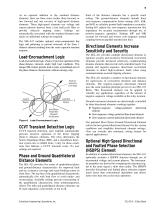
As an optional addition to the standard distance elements, there are three zones (either three forward, or two forward and one reverse) of high-speed distance elements. These high-speed elements use voltage and current phasors derived from a fast half-cycle filter to provide subcycle tripping times. Settings are automatically associated with the standard element zone reach; no additional settings are required. The SEL-421 includes optional series-compensated line logic and polarizing to prevent overreach of the Zone 1 distance element resulting from the series capacitor transient response. Load-Encroachment...

 Open the catalog to page 5
SEL-421-4, -5 Protection and Automation System-6

Communications-Assisted Tripping Schemes The SEL-421 is the ideal relay for use in transmission pilot-based tripping schemes. Use Mirrored Bits communications with SEL fiber-optic transceivers for 3-6 ms relay-to-relay transmission time. Among the schemes supported are the following: ► Permissive Overreaching Transfer Tripping (POTT) for two- or three-terminal lines ► Directional Comparison Unblocking (DCUB) for two- or three-terminal lines ► Directional Comparison Blocking (DCB) Use the SEL control equation TRCOMM to program specific elements, combinations of elements, inputs, etc., to perform...

 Open the catalog to page 6
SEL-421-4, -5 Protection and Automation System-7

Loss-of-Potential (LOP) Logic Supervises Directional Elements CT caused by trapped flux, high-speed detection of circuit breaker opening is achieved. If breaker failure is initiated on all circuit breaker trips, this feature is essential. A 5/8-cycle reset reduces coordination times, improving stability. The SEL-421 includes logic to detect a loss-of-potential caused by failures such as blown fuses, which can cause an incorrect operation in distance and directional elements. Simple settings configure the LOP logic to either block or force forward ground and phase directional elements under these...

 Open the catalog to page 7

All Schweitzer Engineering Laboratories catalogs and technical brochures

  1. SEL-C662

    1  Page

  2. 2019 CATALOG

    248  Pages

  3. 2018 CATALOG

    374  Pages

  4. 2017 SEL Catalog

    373  Pages

*Prices are pre-tax. They exclude delivery charges and customs duties and do not include additional charges for installation or activation options. Prices are indicative only and may vary by country, with changes to the cost of raw materials and exchange rates.