
- Catalogs
- Schweitzer Engineering Laboratories
- SEL-387E Current Differential and Voltage Protection Relay


- Company
- Products
- Catalogs
- News & Trends
- Exhibitions
SEL-387E Current Differential and Voltage Protection Relay

SEL-387E Current Differential and Voltage Protection Relay
The SEL-387E Relay provides comprehensive protection for power apparatus, featuring three-phase voltage inputs for metering and protection, harmonic elements for transformer energization security, and extensive automation capabilities. Standard features include oscillographic event reports, a Sequential Events Recorder (SER), and a circuit breaker contact wear monitor. Optional expanded I/O and dual fail-over Ethernet communications are available.
The relay protects transformers, buses, generators, and reactors using differential, overcurrent, and volts/hertz protection. It includes a dual-slope percentage differential characteristic for enhanced security during through-fault conditions.
The relay provides instantaneous measurements of voltage, current, power, and energy, along with recorded peak demand data.
Features include breaker maintenance scheduling, substation battery voltage monitoring, and through-fault event monitoring.
Automation features include local and remote control, latch control, and efficient data transmission via serial communications ports. Optional DNP3 Level 2 Slave protocol and dual Ethernet communications support are available.
The ACSELERATOR QuickSet® SEL-5030 Software facilitates relay settings and logic programming, with built-in HMI for commissioning and troubleshooting support.
The SEL-387E includes protective elements and control logic for two- or three-winding power transformers, reactors, and generators. It features current differential elements with percentage restraint and harmonic blocking, sensitive restricted earth fault (REF) elements, and overcurrent elements.
The relay has three differential elements using operate and restraint quantities from input currents. It offers single- or dual-slope percentage differential characteristics to prevent undesired operation due to CT imbalance.
The REF protection feature detects internal ground faults on grounded wye-connected transformer windings and autotransformers.
The relay includes 11 overcurrent elements for each set of three-phase current inputs, with various torque-controlled and phase-segregated elements.
These elements help create protection and control schemes, such as blown transformer high-side fuse detection and undervoltage load shedding.
The relay provides six steps of over- and under-frequency elements, operating based on the system frequency.
The relay detects overexcitation using a volts/hertz element, providing sensitive definite-time delayed and tripping elements.
The SEL-387E offers extensive metering capabilities, including individual phase currents, voltages, power, energy, and sequence currents and voltages.
These features simplify post-fault analysis and improve understanding of protective scheme operations. Event reports provide detailed information on relay, scheme, and system performance.
The SEL-387E relay offers advanced monitoring and control capabilities for substation equipment. It includes a Sequential Events Recorder (SER) that logs up to 512 entries, capturing input/output changes and element operations with precise time data synchronized via an IRIG-B source.
The relay provides detailed metering for individual phase, negative-, and zero-sequence currents, as well as three-phase real and reactive power. It also measures differential currents and harmonics up to the 15th harmonic for each winding.
The SEL-387E monitors substation battery voltage, offering programmable threshold comparators for alarm and control. This feature helps prevent battery voltage from dropping to unacceptable levels.
The relay tracks mechanical and electrical wear on circuit breakers, using manufacturer data to schedule maintenance effectively. It calculates and accumulates current for each phase, providing alarms when wear exceeds set thresholds.
This feature records overcurrent events external to the differential protection zone, helping to schedule maintenance and justify mitigation efforts by calculating and storing I2t data.
The ACSELERATOR QuickSet software simplifies relay settings and analysis, offering tools for waveform and harmonic analysis, and facilitating remote monitoring and testing.
The SEL-387E replaces traditional control switches and relays with programmable logic, reducing wiring and enhancing control flexibility. It supports serial communications with multiple protocols, including IEC 61850 for Ethernet-based interoperability.
Advanced SELOGIC control equations allow customization of relay outputs and logic, using Relay Word bits to create tailored control schemes. The relay supports multiple open communication protocols for versatile integration.
The document provides detailed technical specifications and features of the SEL-387E relay by Schweitzer Engineering Laboratories, Inc. It covers various aspects such as independent timers, setting groups, user interface, digital inputs/outputs, wiring diagrams, and compliance standards.
The SEL-387E relay includes timers with independent time-delay pickup and dropout settings, allowing for custom protection or control schemes. These timers can be programmed with any element and assigned to trip logic or other control schemes.
The relay supports six independent setting groups, enhancing operational flexibility. These groups can be selected based on contact input, command, or programmable conditions, making the relay adaptable to changing system conditions.
The front-panel user interface includes a two-line LCD, 16 LED target indicators, and 8 pushbuttons for local communication. The LCD displays event, metering, setting, and relay self-test status information.
The base model includes 8 output contacts and 6 optoisolated inputs, with options for additional inputs and outputs. These can be programmed for control functions and monitoring logic.
The document includes typical AC and DC connection diagrams for three-winding transformer applications, along with front- and rear-panel diagrams for different mounting options.
The SEL-387E is designed under an ISO 9001 certified quality management system and complies with various safety and electromagnetic compatibility standards. It includes detailed specifications for terminal connections, AC current and voltage inputs, power supply, output contacts, and optoisolated inputs.
The relay meets several environmental and safety standards, including dielectric strength, impulse, and type tests for electromagnetic compatibility and immunity.
The relay processes differential elements, optoisolated inputs, and contact outputs at 1/8-cycle, with specified accuracy ranges for phase currents, sequence currents, and differential quantities.
The document specifies that the product is covered by a standard 10-year warranty. For more details, customers are directed to visit the company's website or contact customer service.
The accuracy for steady state is ±3% ±0.02 A, for transient is ±5% ±0.02 A, and for transient 50Q is ±6% ±0.02 A.
The document lists various curve types including U.S. Moderately Inverse, U.S. Inverse, U.S. Very Inverse, U.S. Extremely Inverse, U.S. Short-Time Inverse, and IEC Classes A, B, C, Long-Time, and Short-Time Inverse.
U.S. curves range from 0.50 to 15.00, while IEC curves range from 0.05 to 1.00. Timing accuracy is ±4% ±1.5 cycles for current between 2 and 30 multiples of pickup.
Includes induction-disk reset emulation or 1 cycle linear reset.
Pickup range is 0.00–300.00 V with a steady-state pickup accuracy of ±5% ±2 V.
Pickup range is 40.10–65.00 Hz with a steady-state plus transient overshoot of ±0.01 Hz. Timer accuracy is ±0.1% ±0.0042 s.
Includes both definite-time and inverse-time elements with specific pickup ranges, accuracy, and timing specifications.
Allows for customization with a pickup range of 100–200% and a steady-state pickup accuracy of ±1% of the set point.
Catalog excerpts

SEL-387E Current Differential and Voltage Protection Relay Versatile Solution for Power Apparatus Protection Major Features and Benefits The SEL-387E Relay includes three-phase voltage inputs for metering, overexcitation, frequency, and overand undervoltage functions. The three winding current differential elements use second-, fourth-, and fifthharmonic elements, augmented by the dc element, to provide security during transformer energization and overexcitation conditions in a user-defined choice of either harmonic restraint or harmonic blocking. Overcurrent elements, over- and underfrequency elements, over- and undervoltage elements, power and energy metering, and overexcitation protection all contribute to relay versatility. Oscillographic event reports, Sequential Events Recorder (SER), circuit breaker contact wear monitor, and substation battery monitor are all standard features. Four communications ports, local display panel, and extensive automation features are also standard. Expanded I/O is available as an option. ➤ Protection. Protect transformers, buses, generators, reactors, and other apparatus with a combination of differential, overcurrent, and volts/hertz protection. The differential element is set with either a single- or dual-slope percentage differential characteristic for increased security during through-fault conditions. ➤ Metering. Interrogate the relay for instantaneous measurements of voltage, current, MW, MVAR, MVA, MWh, MVARh, demand current, and three-phase demand power. The recorded peak demand, including the date and time of occurrence, is provided. ➤ Monitoring. Schedule breaker maintenance when the breaker monitor indicates. Notify personnel of substation battery voltage problems. Use the SEL-387E through-fault event monitor for information on system through faults and resulting cumulative I2t wear on transformer banks. Monitor critical operating temperatures through use of the SEL-2600A RTD module. ➤ Automation. Take advantage of automation features that include 16 elements for each of the following: local control and local indication with front-panel LCD and pushbuttons, remote control, and latch control. Use the serial communications ports for efficient transmission of such key information as metering data, protection elements and contact I/O status, SER reports, breaker contact wear monitor, relay summary event reports, and time synchronization. Select optional DNP3 Level 2 Slave protocol Schweitzer Engineering Laboratories, Inc.
Open the catalog to page 1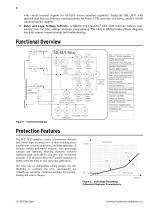
with virtual terminal support for SCADA system interface capability. Equip the SEL-387E with optional dual fail-over Ethernet communications for Telnet, FTP, read-only web server, and IEC 61850 communications support. ➤ Relay and Logic Settings Software. ACSELERATOR QuickSet® SEL-5030 Software reduces engineering costs for relay settings and logic programming. The built-in HMI provides phasor diagrams that help support commissioning and troubleshooting. Combined Time Overcurrent Phase Ground Overcurrent Time Overcurrent Phase Phase Ground Ground Neg. Seq. Neg. Seq. SELOGIC® Control Equations...
Open the catalog to page 2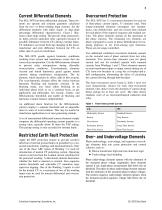
Current Differential Elements The SEL-387E has three differential elements. These elements use operate and restraint quantities calculated from the two- or three-winding input currents. Set the differential elements with either single- or dual-slope percentage differential characteristics. Figure 2 illustrates a dual-slope setting. The percent-slope characteristic helps prevent undesired relay operation because of possible imbalance between CTs during external faults. CT imbalance can result from tap changing in the power transformer and error difference between the CTs on either side of a power...
Open the catalog to page 3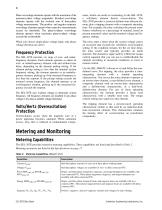
Phase overvoltage elements operate with the maximum of the measured phase voltage magnitudes. Residual overvoltage elements operate with the vectorial sum of three-phase voltage measurements. The positive- and negative-sequence overvoltage elements operate when respective measurements exceed set thresholds. The phase-to-phase overvoltage element operates when maximum phase-to-phase voltage exceeds the set threshold. nents, which can result in overheating. In the SEL-387E, a volts/hertz element detects overexcitation. The SEL-387E provides a sensitive definite-time delayed element, plus a tripping...
Open the catalog to page 4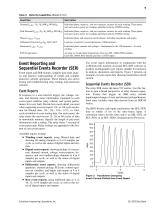
Table 2 Metering Capabilities (Sheet 2 of 2) Event Reporting and Sequential Events Recorder (SER) Event report and SER features simplify post-fault analysis and improve understanding of simple and complex protective scheme operations. These features also aid in testing and troubleshooting relay settings and protection schemes. Event Reports In response to a user-selected trigger, the voltage, current, and element status information contained in each event report confirms relay, scheme, and system performance for every fault. Decide how much detail you need when requesting an event report: 1/4-...
Open the catalog to page 5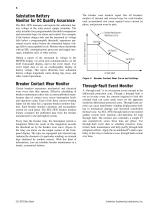
The SEL-387E measures and reports the substation battery voltage at the relay power supply terminals. The relay includes four programmable threshold comparators and associated logic for alarm and control. For example, if the battery charger fails and the measured dc voltage falls below a programmable threshold, operations personnel receive notice before the substation battery voltage falls to unacceptable levels. Monitor these thresholds with an SEL communications processor and trigger messages, telephone calls, or other actions. Obtain a report of the measured dc voltage in the METER display...
Open the catalog to page 6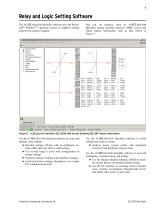
The ACSELERATOR QuickSet software uses the Microsoft® Windows® operating system to simplify settings and provide analysis support. One can, for instance, open an ACSELERATOR QuickSet human machine interface (HMI) screen and obtain phasor information such as that shown in Figure 5. yjAcSELeratortS. C:\Program Files\Ac5ELerator\LEGACY TEST.rdb [Device ID: STATION Aj File Settings Analysis HMI Communication Window Help © Device Overview • Phasors 1 © Phasors 2 © Instantaneous © D ifferential I nstantaneous G D emand O Energy Metering O T argets O Status O SER 0 Breaker Monitor Data 0 Control Window...
Open the catalog to page 7All Schweitzer Engineering Laboratories catalogs and technical brochures
 SEL-C662
1 Page
 2019 CATALOG
248 Pages
 2018 CATALOG
374 Pages
 METERING ACCESSORIES CATALOG
20 Pages
 STANDARD CABINET CATALOG
28 Pages
 SEL-3622 Security Gateway
12 Pages
 SEL-710-5 Motor Protection Relay
28 Pages
 SEL-3610 Port Server
12 Pages
 2017 SEL Catalog
373 Pages
 SEL-2664 Field Ground Module
12 Pages
 SEL-2533 Annunciator
12 Pages
 SEL-2414 Transformer Monitor
20 Pages
 SEL-2244 Digital I/O Module
8 Pages
 SEL-2243 Power Coupler
4 Pages
 SEL-2242 Chassis/Backplane
8 Pages
 SEL-2240 Axion®
32 Pages
 SEL-1102 Computing Platform
12 Pages


Archived catalogs
 2015 Modern Solutions Catalog
331 Pages
 SEL 2008 Product Catalog EOS Mfg
44 Pages


