
- Catalogs
- Schwanog Siegfried Güntert GmbH
- Machining Technology Thread Whirling


Machining Technology Thread Whirling

Machining Technology Thread Whirling
- Thread whirling is applicable to both external and internal threads, with significant cost reductions and precision improvements.
- The Schwanog WEP system uses form inserts, ensuring high precision and reducing tool change costs.
- It is particularly beneficial for machining bone screws and implants made from titanium or stainless steel, meeting high precision and finish requirements.
- The cutter body is set up with the required helix angle and driven at high speeds by the whirling spindle, while the main spindle rotates at lower speeds.
- The stock is fed through the cutter body and spindle, and once the desired thread length is achieved, the spindle retracts.
- Increased productivity due to prolonged tool life and quick tool changeovers.
- Superior surface finishes and burr-free threads.
Catalog excerpts
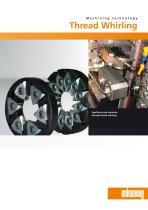
Machining technology Thread Whirling Significant cost reduction through thread whirling.
Open the catalog to page 1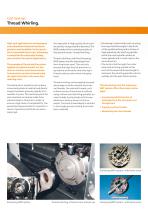
Cost Savings: Thread Whirling. High-tech applications in microsurgery and orthodontics demand maximum precision and durability. As the specialist for insertable form tools, Schwanog is committed to continually finding new solutions for special applications. The example of thread whirling when applied on implants made from titanium or stainless steel demonstrates how precision can be increased using the right tool while at the same time reducing costs. The demand for implants such as bone screws and plates in medical and dental surgery has been growing rapidly for a number of years. The...
Open the catalog to page 2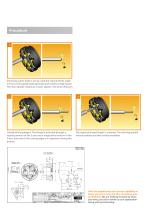
Schwanog cutter body is set up using the required helix angle in front of the guide bushing (stock) and rotates at high speed. The main spindle rotates at a lower speed in the same direction. Thread whirling begins. The thread is achieved through a rotating motion of the C-axis and a longitudinal motion of the Z-axis, only one of the cutting edges is in operation during this process. The required thread length is achieved. The whirling spindle retracts radially and then axially thereafter. Take this opportunity and use our capability to lower your part costs and thus increasing your profitability....
Open the catalog to page 3
Insertable tooling systems. ID Whirling (Thread mills) Thread milling Polygon turning Form drilling Shave tools Rotary transfer machines Selector system Schwanog LLC 1630 Todd Farm Drive · Elgin, IL 60123 Phone: 847- 289 -10 55 · Fax: 847- 289 -10 56 www.schwanog.com · [email protected] Schwanog Sàrl 89 Allée des Nénuphars · F - 74300 Thyez Téléphone 0450 18 65 16 · Fax 0450 18 47 75 www.schwanog.com · [email protected] Schwanog · Siegfried Güntert GmbH Shanghai Representative Office · Room 757 B Tower 3, German Centre · 88 Ke Yuan Road · Shanghai Phone: +86 -21- 28 98 - 62 10 · Fax:...
Open the catalog to page 4All Schwanog Siegfried Güntert GmbH catalogs and technical brochures
 Schwanog image brochure
12 Pages
 Project report Serration
4 Pages


- Milling tool
- Drilling tool
- Milling tool with replaceable insert
- Shell-end milling cutter
- Multi-purpose drilling tool
- Tungsten carbide drill bit
- Slot milling tool
- 2-flute milling cutter
- Turning tool
- Insert turning tool
- Cutting insert drill bit
- Grooving tool
- External turning tool
- External threading tool
- Indexable insert drill bit
- Internal turning tool
- Internal grooving tool
- Internal threading tool
- Machine tool threading tool
- Thread-whirling threading tool