


White Paper IP Protection

White Paper IP Protection
This document discusses the importance of IP protection in electrical products, focusing on safeguarding against moisture and foreign particles. It highlights the necessity for reliable and safe operation of electrical devices in adverse conditions, such as in food processing and medical technology.
IP Degree of Protection
The IP degree of protection, as per IEC/EN 60529, indicates how well a product is shielded from environmental influences. It consists of two digits: the first for protection against foreign bodies and contact, and the second for water protection. For example, IP 65 signifies 'dust-tight' and protection against 'strong water jets'.
Differentiation of IP Protection
There is a distinction between front and rear IP protection. Front protection refers to sealing against external ingress, while rear protection concerns internal components. This differentiation is crucial for safety and suitability for specific applications, such as ATEX/IECEx.
Plugged in vs. Unplugged State
The IP protection level varies between the 'plugged-in' and 'unplugged' states. In the plugged-in state, components are connected, requiring high IP protection through proper installation and sealing. In the unplugged state, protection can be maintained with covers for plugs and sockets.
Conclusion
IP protection is vital for ensuring the safety and functionality of electrical components in industrial applications. Proper assembly and adherence to manufacturer instructions are essential. SCHURTER offers a range of components with enhanced IP protection, including appliance plugs and control elements.
About SCHURTER
SCHURTER is a global innovator and manufacturer of electronic components, providing safe and clean power supply solutions. They offer a wide range of products and services, ensuring high local service and product delivery through their global network.
Catalog excerpts

White Paper schurter.com/downloads Dirt particles, moisture and other foreign matter have no place in electrical products. The IP degree of protection provides information on how well a product is protected in this respect. SCHURTER device plug combination element 5707: IP 54 Protection of the plug connection to the housing (frontside), additional IP 65 protection in the housing device (rearside). Very often, electrical devices have to work reliably and safely for years under adverse conditions. For example in food processing, medical technology or similar industries. Dirt, bacteria, dust and moisture can rarely be kept away. So you have to start at a different point. It is important to prevent dirt or moisture from penetrating into the housing while at the same time providing the best possible protection for persons operating the equipment. The degree of protection against ingress of dirt and moisture is indicated by the so-called IP degree of protection. This IP degree of protection according to IEC/ EN 60529 specifies the extent to which an electrical component or device can be exposed to adverse environmental influences without being damaged or presenting a safety risk to persons. IP degree of protection The abbreviation IP stands for "International Protection". In the English language area, however, it is preferably translated with "Ingress Protection". The IP degree of protection must be clearly distinguished from the electrical protection class. The IP degrees of protection define the degree of protection of the housing against contact, foreign bodies and water. In contrast, the electrical protection classes describe measures to prevent hazardous voltages on parts of equipment which are not live during operation. The IP protection class - sometimes also called IP code - usually consists of two digits. The first digit stands for protection against the ingress of foreign bodies or in case of contact. The second digit indicates the protection against water. For example: IP 65, the first digit 6 means "dust-tight", the second digit 5 means protection against "strong water jets". The higher these two digits, the higher the protection of the component. Details on the structure and nomenclature of the IP protection rating can be found here [1].
Open the catalog to page 1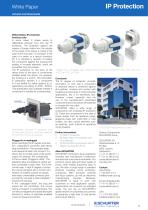
Plugged in vs. unplugged state: waterproof IEC connector SCHURTER Type 4761 and Type 4762 with IP 67 or IP 69K Differentiation IP protection front/rear side In some cases, it makes sense to differentiate between front and rear IP protection. The protection against the ingress of foreign matter from the outside to the inside of the device is meant in the case of the front side. For example, in the case of a switch or a device connector [2]. It is therefore a question of sealing the component against the housing and sealing of movable elements, which are accessible from the outside. The IP protection...
Open the catalog to page 2All SCHURTER catalogs and technical brochures
 FMAD NEO
6 Pages
 THS
THS5 Pages
 TTS
TTS4 Pages
 FMAB NEO
12 Pages
 UMT-W
UMT-W4 Pages
 OGN
OGN3 Pages
 0712
07123 Pages
 4751
47514 Pages
 FMAD CP
4 Pages
 4783
47834 Pages
 EF11
EF118 Pages
 PFMF
PFMF4 Pages
 PFDF
PFDF3 Pages
 4797-5
4 Pages
 6051.2063
3 Pages
 6051.2061
3 Pages
 6051.2015
3 Pages
 3-108-993
2 Pages
 3-100-361
3 Pages
 GP21
GP213 Pages
 AURORA Complete Solutions
2 Pages
 FMER SOL
10 Pages
 CMF2, CMF5
3 Pages
 CDS1
CDS15 Pages
 DKIH-3
6 Pages
 4710-5
5 Pages
 Touchkit
3 Pages
 USN 1206
3 Pages
 FPBB RAIL
7 Pages
 DD14
DD148 Pages
 VAC19KS
3 Pages
 UMK 250
4 Pages
 TA35 Rocker 1Pole
6 Pages
 4761
47613 Pages
 4732
47324 Pages
 FUS
FUS3 Pages
 DKIH
DKIH6 Pages
 FSO
FSO2 Pages
 CSO
CSO3 Pages
 CMF1, CMF4
3 Pages
 FMAC NEO
5 Pages
 MSM DP 30
8 Pages
 PSE AE 16
3 Pages
 MSM LA CS 22
7 Pages
 MSM LA CS 19
6 Pages
 PSE AE 30
5 Pages
 PSE EX 16
5 Pages
 PSE EX 19
5 Pages
 PSE NO 19
6 Pages
 PSE NO 16
6 Pages
 PSE EX 22
5 Pages
 PSE NO 27
6 Pages
 PSE NO 24
6 Pages
 PSE NO 22
8 Pages
 PSE IV 16
6 Pages
 PSE HI 22
6 Pages
 PSE NO 30
7 Pages
 PSE M22 IV
7 Pages
 MCS ES 18
3 Pages
 MCS ES 22
3 Pages
 6051.2094
3 Pages
 6051.2093
3 Pages
 6051.2078
3 Pages
 6051.2077
3 Pages
 6051.2070
3 Pages
 6051.2072
3 Pages
 6051.2071
3 Pages
 6051.2037
2 Pages
 6051.2030
3 Pages
 6051.2032
3 Pages
 6051.2031
3 Pages
 6051.2027
3 Pages
 3-107-570
2 Pages
 3-107-569
2 Pages
 VAC13KS
4 Pages
 DD21
DD215 Pages
 DD11
DD115 Pages
 DF11
DF116 Pages
 DG11
DG117 Pages
 typ_6051.2016
3 Pages
 typ_6051.2008
3 Pages
 typ_6051.2009
3 Pages
 typ_6051.2001
4 Pages
 typ_6051.2007
3 Pages
 typ_6051.2003
3 Pages
 typ_6051.2004
3 Pages
 typ_4762
3 Pages
 typ_3-101-514
3 Pages
 typ_3-101-501
3 Pages
 typ_3-100-528
3 Pages
 typ_3-100-734
3 Pages
 typ_3-100-526
3 Pages
 typ_3-100-523
3 Pages
 typ_3-100-524
3 Pages
 typ_3-100-527
3 Pages
 typ_3-100-522
3 Pages
 typ_3-100-356
3 Pages
 typ_3-100-355
3 Pages
 typ_3-100-354
3 Pages
 Application Note Surge
2 Pages
 SWA2
SWA22 Pages
 PB 1021
2 Pages
 TM12-111
6 Pages
 PTS
PTS4 Pages
 Piezo Keypads
4 Pages
 PB 1011
2 Pages
 FMAD CEE
3 Pages
 White Paper Data Center
4 Pages
 White Paper SPICE library
4 Pages
 White Paper Cord retention
4 Pages
 SCHURTER and ESA cooperation
2 Pages
 Efficient EMC Solutions
8 Pages






Archived catalogs
 SUSTAINABILITY REPORT 2022
37 Pages
 6051.2068
3 Pages
 Resettable Fuses
1 Page
 Company Profile
20 Pages
 Product News
4 Pages
 PFRY
PFRY4 Pages
 Suppression Chokes DKIH-1
6 Pages
 6051.2067
3 Pages
 Voltage Selector
1 Page
 PFRA
PFRA6 Pages
 FMAB HV
6 Pages
 DG12
DG1210 Pages
 FPG1
FPG14 Pages
 CPS
CPS7 Pages
 2020 PFHT
3 Pages
 PFDF
PFDF3 Pages
 SCHURTER Renewable Energies
6 Pages
 ASO / FSO
8 Pages
 SCHURTER Product News 2015
4 Pages
 SCHURTER range at a glance
236 Pages
 SCHURTER Company Profile
10 Pages
 Product News 2018
4 Pages
 PFUF
PFUF3 Pages
 2015 PFHT
3 Pages
 New product: UMT-H
3 Pages
 New product: UMF 250
3 Pages
 New product: UST 1206
2 Pages
 New product: CSO
2 Pages
 New product: UMZ 250
3 Pages
 New product: 6610
3 Pages
 KEB2
KEB21 Page
 SHT 6.3x32
1 Page
 Product Overview Switches
2 Pages
 ESO 10.3x38
1 Page
 PFNF
PFNF3 Pages
 CMF3, CMF6
2 Pages
 DC11
DC115 Pages
 1074
10744 Pages
 DC21
DC213 Pages
 KD-Bowdencable
4 Pages
 KG-Bowdencable
4 Pages
 6135
61355 Pages
 Felcom 64
4 Pages
 GSF1
GSF15 Pages
 GSF2
GSF24 Pages
 KE
KE4 Pages
 P685
P6852 Pages
 4741
47412 Pages
 FLBB
FLBB2 Pages
 6051.2003
2 Pages
 6051.2030
2 Pages
 6000.0224
2 Pages
 6051.5003
2 Pages
 4840.2200
2 Pages
 OMZ 125
1 Page
 SMD-FTT
1 Page
 5120
512010 Pages
 FMBB RAIL
3 Pages
 FMBB NEO
11 Pages
 FMAB RAIL
3 Pages
 FMAC SINE
4 Pages
 FMAC SINE DCL
4 Pages
 FMBD NEO
6 Pages
 FMAC RAIL
3 Pages
 FMAD RAIL
3 Pages
 DKFP
DKFP5 Pages
 TA35 Rocker 2Pol
8 Pages
 Flyer UMT 250 / UMZ 250
8 Pages
 SCHURTER - Flyer MSM CS
2 Pages
 Varistors
40 Pages
 Flyer MGA-S
6 Pages


- Electrical power supply connector
- Polymer connector
- Screw-in connector
- Socket electrical connector
- Push-button switch
- IP67 connector
- Rectangular connector
- Circuit breaker
- Straight connector
- RF connector
- Electronic filter
- Screw connector
- DIN connector
- Plug-in connector
- IEC connector
- Passive electronic filter
- Illuminated push-button switch
- Touch push-button switch
- AC electronic filter