


Hot Appliance Couplers - Guaranteed operating safety and compatibility for "Hot" Appliance Couplers

Hot Appliance Couplers - Guaranteed operating safety and compatibility for "Hot" Appliance Couplers
The document discusses SCHURTER's 1681 IEC appliance inlet, focusing on the IEC 60320-1 component standard, which is a global specification for appliance inlets and connectors. This standard addresses various current ranges, protection classes, and temperature limits, ensuring safety and compatibility across manufacturers.
Historical Context
Before IEC 60320-1, appliance couplers were governed by the DIN 49491 standard, commonly used in electric irons and waffle irons. These older designs posed safety risks such as short circuits, charring, and electric shocks due to inadequate insulation and design.
Use and Applications
High-temperature appliance inlets are essential for devices generating significant heat, such as electric grills, heaters, IT equipment, and medical devices. The IEC 60320-1 standard ensures these inlets are safe and compatible across different manufacturers.
Criteria and Standards
The IEC 60320-1 standard categorizes appliance couplers based on maximum pin temperature: cold (70°C), warm (120°C), and hot (155°C) conditions. It also defines protection classes I and II, with class I including a protective ground conductor and class II featuring enhanced insulation. The standard specifies rated currents of 2.5 A, 6 A, 10 A, and 16 A.
Technical Specifications
Table 1 in the document outlines various coupler types, their current ratings, and temperature limits. The standard also includes criteria for pull-out forces, test procedures, and insertion cycles, applicable to appliance couplers from 250 VAC to a maximum of 16 A.
Design and Compatibility
Different coupler contours ensure safe operation and prevent misuse. The standard allows for connections between inlets and outlets of different protection classes and temperature resistances, provided safety is maintained.
Company Overview
SCHURTER is a global innovator in electronic and electrical components, offering a wide range of products and services. The company is committed to providing safe, reliable power supply solutions and is open to customizing products to meet specific customer needs.
Contact Information
For further inquiries, SCHURTER provides contact details for its headquarters in Lucerne, Switzerland, and regional offices in Asia-Pacific and the USA.
Catalog excerpts
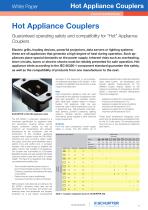
White Paper Hot Appliance Couplers Guaranteed operating safety and compatibility for "Hot" Appliance Couplers Electric grills, heating devices, powerful projectors, data servers or lighting systems: these are all appliances that generate a high degree of heat during operation. Such appliances place special demands on the power supply. Inherent risks such as overheating, short circuits, burns or electric shocks must be reliably prevented for safe operation. Hot appliance inlets according to the IEC 60320-1 component standard guarantee this safety, as well as the compatibility of products from one manufacturer to the next. damages to the equipment or surroundings. An additional advantage of IEC 60320-1 is the complete compatibility of products from a wide range of manufacturers. SCHURTER's 1681 IEC appliance inlet The IEC 60320-1 component standard is a worldwide specification for appliance inlets and connectors, covering various current ranges, protection classes as well as maximum pin temperatures and ambient temperature for the connectors. Until the introduction of this standard, appliance couplers were covered under the DIN 49491 standard and were commonly called "waffle iron plugs", since they were frequently used in electric irons and waffle irons. A porcelain insulator, with a steel tongue to establish the safety contact, was installed in the appliance. The coupler was surrounded by a Duroplast (Bakelite) housing and was typically fabricated using low quality cords with a fabric or rubber sheath. This type of hot appliance inlet design concealed serious safety risks: High temperature appliance inlets are used universally for the operation of appliances with high heat generation, for example, electric grills, table grills, raclette makers or electric heaters. Hot appliance inlets are also frequently used in other applications such as: IT equipment (e.g., high-powered computers, data servers), powerful projectors, lighting systems, medical devices, measurement instruments, power supplies or other industrial types of equipment. Criteria From the user's perspective, power supply safety is crucial. The IEC 60320 set of standards establish basic criteria for protection class, rated current, pin temperature, and provide specific measurements for the different coupler shapes. Based on the maximum permitted pin temperature, the IEC 60320-1 component standard distinguishes three main categories: - - - Appliance couplers for cold conditions maximum pin temperature 70°C Appliance couplers for warm conditions maximum pin temperature 120°C Appliance couplers for hot conditions maximum pin temperature 155°C These three temperature categories (cold, warm and hot appliances) are established only for the 10 A inlet styles. The remaining styles have only one or two temperature categories (see Table 1). Mating Appliance Coupler IEC60320-1 Appliance Inlets Gender Male Symbol Symbol Type Type Current [A] Temperature [°C] Temperature [°C] Protection classe With products manufactured according to the IEC 60320-1 standard, these risks can be eliminated, for the most part, with proper use: meaning users and appliances are properly protected, as is any related consequential Gendre Female -- Short circuits inside the socket, due to a lack of heat resistant insulation on the cord -- Charring, caused by overheating of the plug components -- Electric shocks, due to insufficiently recessed conductive contacts on the plug Table 1: Coupler categories (source: SCHURTER AG)
Open the catalog to page 1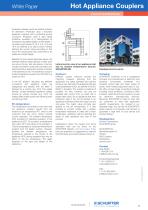
Hot Appliance Couplers PSE Multicolor Application Note White Paper Protection classes I and II are another criterion for distinction. Protection class I describes appliance couplers with a protective ground conductor. Protection class II (also called protective insulation II) is distinguished by increased or doubled insulation. In IEC 60320-1, nominal current values of 2.5 A, 6 A, 10 A and 16 A are referred to as rated current, thereby defining the current rating according to that which the manufacturer has conformed to for appliance coupler design. In the IEC 60320-1 standard, the different...
Open the catalog to page 2All SCHURTER catalogs and technical brochures
 FMAD NEO
6 Pages
 THS
THS5 Pages
 TTS
TTS4 Pages
 FMAB NEO
12 Pages
 UMT-W
UMT-W4 Pages
 OGN
OGN3 Pages
 0712
07123 Pages
 4751
47514 Pages
 FMAD CP
4 Pages
 4783
47834 Pages
 EF11
EF118 Pages
 PFMF
PFMF4 Pages
 PFDF
PFDF3 Pages
 4797-5
4 Pages
 6051.2063
3 Pages
 6051.2061
3 Pages
 6051.2015
3 Pages
 3-108-993
2 Pages
 3-100-361
3 Pages
 GP21
GP213 Pages
 AURORA Complete Solutions
2 Pages
 FMER SOL
10 Pages
 CMF2, CMF5
3 Pages
 CDS1
CDS15 Pages
 DKIH-3
6 Pages
 4710-5
5 Pages
 Touchkit
3 Pages
 USN 1206
3 Pages
 FPBB RAIL
7 Pages
 DD14
DD148 Pages
 VAC19KS
3 Pages
 UMK 250
4 Pages
 TA35 Rocker 1Pole
6 Pages
 4761
47613 Pages
 4732
47324 Pages
 FUS
FUS3 Pages
 DKIH
DKIH6 Pages
 FSO
FSO2 Pages
 CSO
CSO3 Pages
 CMF1, CMF4
3 Pages
 FMAC NEO
5 Pages
 MSM DP 30
8 Pages
 PSE AE 16
3 Pages
 MSM LA CS 22
7 Pages
 MSM LA CS 19
6 Pages
 PSE AE 30
5 Pages
 PSE EX 16
5 Pages
 PSE EX 19
5 Pages
 PSE NO 19
6 Pages
 PSE NO 16
6 Pages
 PSE EX 22
5 Pages
 PSE NO 27
6 Pages
 PSE NO 24
6 Pages
 PSE NO 22
8 Pages
 PSE IV 16
6 Pages
 PSE HI 22
6 Pages
 PSE NO 30
7 Pages
 PSE M22 IV
7 Pages
 MCS ES 18
3 Pages
 MCS ES 22
3 Pages
 6051.2094
3 Pages
 6051.2093
3 Pages
 6051.2078
3 Pages
 6051.2077
3 Pages
 6051.2070
3 Pages
 6051.2072
3 Pages
 6051.2071
3 Pages
 6051.2037
2 Pages
 6051.2030
3 Pages
 6051.2032
3 Pages
 6051.2031
3 Pages
 6051.2027
3 Pages
 3-107-570
2 Pages
 3-107-569
2 Pages
 VAC13KS
4 Pages
 DD21
DD215 Pages
 DD11
DD115 Pages
 DF11
DF116 Pages
 DG11
DG117 Pages
 typ_6051.2016
3 Pages
 typ_6051.2008
3 Pages
 typ_6051.2009
3 Pages
 typ_6051.2001
4 Pages
 typ_6051.2007
3 Pages
 typ_6051.2003
3 Pages
 typ_6051.2004
3 Pages
 typ_4762
3 Pages
 typ_3-101-514
3 Pages
 typ_3-101-501
3 Pages
 typ_3-100-528
3 Pages
 typ_3-100-734
3 Pages
 typ_3-100-526
3 Pages
 typ_3-100-523
3 Pages
 typ_3-100-524
3 Pages
 typ_3-100-527
3 Pages
 typ_3-100-522
3 Pages
 typ_3-100-356
3 Pages
 typ_3-100-355
3 Pages
 typ_3-100-354
3 Pages
 Application Note Surge
2 Pages
 White Paper IP Protection
2 Pages
 SWA2
SWA22 Pages
 PB 1021
2 Pages
 TM12-111
6 Pages
 PTS
PTS4 Pages
 Piezo Keypads
4 Pages
 PB 1011
2 Pages
 FMAD CEE
3 Pages
 White Paper Data Center
4 Pages
 White Paper SPICE library
4 Pages
 White Paper Cord retention
4 Pages
 SCHURTER and ESA cooperation
2 Pages
 Efficient EMC Solutions
8 Pages






Archived catalogs
 SUSTAINABILITY REPORT 2022
37 Pages
 6051.2068
3 Pages
 Resettable Fuses
1 Page
 Company Profile
20 Pages
 Product News
4 Pages
 PFRY
PFRY4 Pages
 Suppression Chokes DKIH-1
6 Pages
 6051.2067
3 Pages
 Voltage Selector
1 Page
 PFRA
PFRA6 Pages
 FMAB HV
6 Pages
 DG12
DG1210 Pages
 FPG1
FPG14 Pages
 CPS
CPS7 Pages
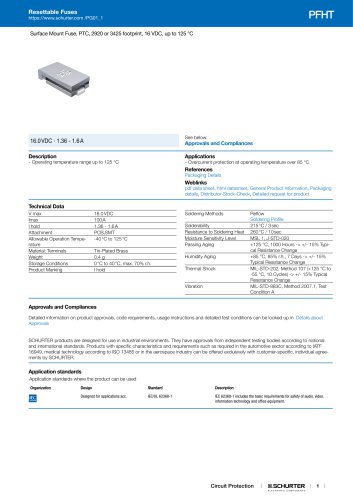 2020 PFHT
3 Pages
 PFDF
PFDF3 Pages
 SCHURTER Renewable Energies
6 Pages
 ASO / FSO
8 Pages
 SCHURTER Product News 2015
4 Pages
 SCHURTER range at a glance
236 Pages
 SCHURTER Company Profile
10 Pages
 Product News 2018
4 Pages
 PFUF
PFUF3 Pages
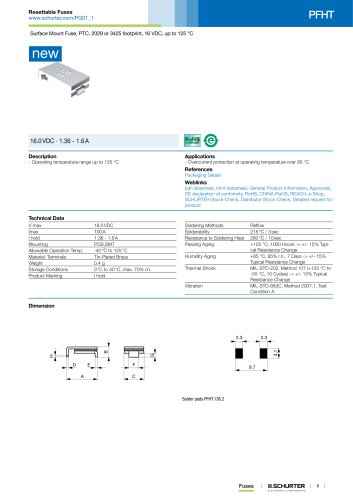 2015 PFHT
3 Pages
 New product: UMT-H
3 Pages
 New product: UMF 250
3 Pages
 New product: UST 1206
2 Pages
 New product: CSO
2 Pages
 New product: UMZ 250
3 Pages
 New product: 6610
3 Pages
 KEB2
KEB21 Page
 SHT 6.3x32
1 Page
 Product Overview Switches
2 Pages
 ESO 10.3x38
1 Page
 PFNF
PFNF3 Pages
 CMF3, CMF6
2 Pages
 DC11
DC115 Pages
 1074
10744 Pages
 DC21
DC213 Pages
 KD-Bowdencable
4 Pages
 KG-Bowdencable
4 Pages
 6135
61355 Pages
 Felcom 64
4 Pages
 GSF1
GSF15 Pages
 GSF2
GSF24 Pages
 KE
KE4 Pages
 P685
P6852 Pages
 4741
47412 Pages
 FLBB
FLBB2 Pages
 6051.2003
2 Pages
 6051.2030
2 Pages
 6000.0224
2 Pages
 6051.5003
2 Pages
 4840.2200
2 Pages
 OMZ 125
1 Page
 SMD-FTT
1 Page
 5120
512010 Pages
 FMBB RAIL
3 Pages
 FMBB NEO
11 Pages
 FMAB RAIL
3 Pages
 FMAC SINE
4 Pages
 FMAC SINE DCL
4 Pages
 FMBD NEO
6 Pages
 FMAC RAIL
3 Pages
 FMAD RAIL
3 Pages
 DKFP
DKFP5 Pages
 TA35 Rocker 2Pol
8 Pages
 Flyer UMT 250 / UMZ 250
8 Pages
 SCHURTER - Flyer MSM CS
2 Pages
 Varistors
40 Pages
 Flyer MGA-S
6 Pages


- Electrical power supply connector
- Polymer connector
- Screw-in connector
- Socket electrical connector
- Push-button switch
- IP67 connector
- Rectangular connector
- Circuit breaker
- Straight connector
- RF connector
- Electronic filter
- Screw connector
- DIN connector
- Plug-in connector
- IEC connector
- Passive electronic filter
- Illuminated push-button switch
- Touch push-button switch
- AC electronic filter