
- Catalogs
- Schubert & Salzer Control Systems GmbH
- Product Overview Valve Technology


- Company
- Products
- Catalogs
- News & Trends
- Exhibitions
Product Overview Valve Technology
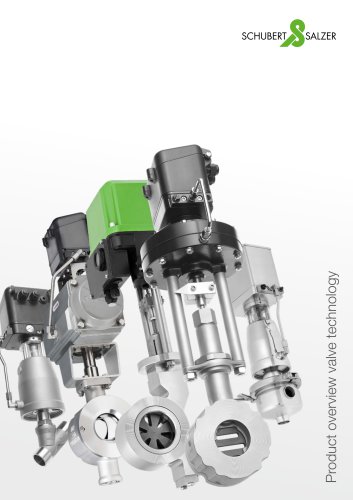
Product Overview Valve Technology
Schubert & Salzer Control Systems GmbH specializes in precise control and on/off valves for industries such as chemical, pharmaceutical, and food and beverage. The company, part of the Schubert & Salzer group, offers German-made products through global subsidiaries and partners.
The company offers a variety of valve technologies including seat valves, sliding gate valves, ball sector valves, segmented disc valves, sanitary valves, pinch valves, positioners, smart communication systems, electric actuators, and customized solutions. They also provide service and training.
- Seat Valves: Known for reliability and compactness, available in stainless steel or red brass with various actuators.
- Angle Seat Valves: Offer long service life and precise control, optimized for the food and beverage sector.
- Sliding Gate Valves: Highlighted for precision and efficiency, suitable for gases, vapors, and liquids.
- Ball Sector Valves: Used for demanding applications, offering minimal wear and precise control.
- Segmented Disc Valves: Provide precise control under extreme conditions, suitable for fluids and vapors.
- Sanitary Valves: Meet high cleanliness standards, suitable for pharmaceutical and biotechnology sectors.
- Pinch Valves: Designed for high hygiene processes, with various models for different applications.
Detailed specifications include nominal sizes, pressure ratings, media temperature ranges, and materials. Sliding gate valves are noted for minimal wear and reduced energy consumption.
Sliding gate valves feature an innovative design that reduces actuating force and energy consumption, offering optimal flow control and environmental benefits.
- IO-Link and IIoT: Enable data exchange for predictive maintenance.
- Electric Actuators: Fast and precise, with high protection classes.
- Valve Manifolds: Reduce piping effort and maintenance time.
- Service and Training: Includes commissioning, maintenance support, and training at the Ingolstadt center or on-site.
Catalog excerpts
Product overview valve technology
Open the catalog to page 1
Tradition since 1883 Precision – Made in Germany As a fast growing high-tech company, Schubert & Salzer Control Systems GmbH develops, produces and distributes highly precise control and on/ off valves which are applied in the process industry. Whether it is in the production of chemical or pharmaceutical products, food and beverage We are part of the Schubert & Salzer group of processing or the production of plastics, steel, companies with 140 years of tradition and exper- paper or glass, as well as in the textile industry – tise in the manufacturing industry. Based in Ingol- in short, wherever...
Open the catalog to page 2
echnology for tomorrow Content Seat valves Page 4 Sliding gate valves Page 10 Ball sector valves Page 18 Segmented disc valves Page 26 Sanitary valves Page 30 Pinch valves Page 32 Smart communication Page 36 Electric actuators Page 38 Customised solutions Page 39 Service and training Page 40
Open the catalog to page 3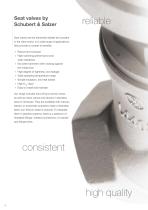
Seat valves by Schubert & Salzer Seat valves are the extremely reliable all-rounders in the valve world. In a wide range of applications, they provide a number of benefits: • High switching performance and wear resistance • No water hammers when closing against the media flow • High degree of tightness, low leakage • Wide operating temperature range • Simple insulation, low heat losses • Easy to install and maintain Our range includes shut-off and control valves as well as check valves and strainer in stainless steel or red brass. They are available with manual, electric or pneumatic actuators...
Open the catalog to page 4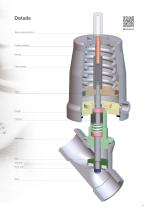
Details Website Spray water protection Position indicator Piston spring Valve stem Disc Seat seal Body seat
Open the catalog to page 5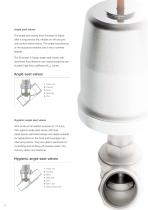
Angle seat valves The angle seat valves from Schubert & Salzer offer a long service life, reliable on-off and precise control performance. The angled positioning of the actuators enables use in very confined spaces. The Schubert & Salzer angle seat valves with optimised flow direction are characterised by particularly high flow coefficient (KVS) values. Angle seat valves 2 Piston rod Packing Body Seat seal Disc Hygienic angle seat valves With an Ra of all wetted surfaces of < 0.8 µm, the hygienic angle seat valves with their dead-space-optimised design are ideally suitable for applications in...
Open the catalog to page 6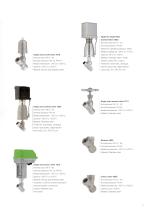
Angle seat on/off valve 7010 Nominal size: DN 8 - 80 Nominal pressure: PN 16, PN 40 Media temperature: -30°C to +200°C, optional -100°C to +220°C Material: Bronze and stainless steel Angle seat control valve 7020 Nominal size: DN 8 - 80 Nominal pressure: PN 40 Media temperature: -30°C to +200°C, optional -100°C to +220°C Material: Stainless steel Positioner: pneumatic, analogue electro-pneumatic, digital electropneumatic, Ex-i, FM, IO-Link Hygienic Angle Seat Control Valve 7025 Nominal size: DN 15 - 50 Nominal pressure: PN 40 Maximum operating pressure: 25bar Media temperature: -30°C to +170°C,...
Open the catalog to page 7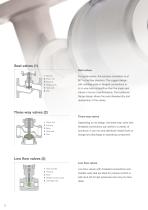
Seat valves (1) Seat valves 1 Bonnet Piston rod Packing Flange body Seat seal Disc For globe valves, the actuator orientation is at 90° to the flow direction. The rugged design with welding ends or flanged connections is in no way less competitive than the angle seat valves in terms of performance. The traditional flange design allows the axial disassembly and Three-way valves (2) Three-way valves 2 Piston rod Packing Body Seat seal Disc Depending on its design, the three-way valve with threaded connections can perform a variety of functions: it can mix and distribute media flows or charge and...
Open the catalog to page 8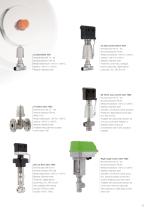
(1) Seat Valve 7017 Nominal size: DN 15 - 50 Nominal pressure: PN 40 Media temperature: -30°C to +200°C, optional -100°C to +220°C Material: Stainless steel (1) Seat Control Valve 7027 Nominal size: DN 15 - 50 Nominal pressure: PN 40, Media temperature: -30°C to +200°C, optional -100°C to +220°C Material: Stainless steel Positioner: pneumatic, analogue electro-pneumatic, digital electropneumatic, Ex-i, FM, IO-Link (1) Globe valve 7032 Nominal size: DN 15 - 150 Nominal pressure: PN 40, ANSI # 150 Media temperature: -30°C to +200°C, optional -100°C to +220°C Material: Stainless steel Available...
Open the catalog to page 9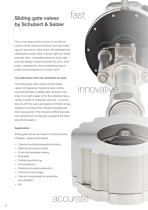
Sliding gate valves by Schubert & Salzer This is how easy control can be. In the field of control valves, Schubert & Salzer has been breaking new ground for many years. We developed the sliding gate control valve: a handy, light and highly accurate valve. It operates based on a principle that had already excited Leonardo Da Vinci. Even today, it satisfies the most challenging requirements that are placed on a control valve. The sliding gate valve series controls liquid, vapour and gaseous media precisely, quickly and economically. A sealing disc (2) fixed in the body (1) at right angles to the...
Open the catalog to page 10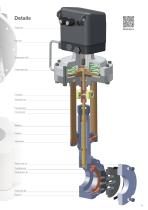
Details Positioner Pilot line Diaphragm shell Diaphragm disc Packing tube Conical seal Valve stem Body cover (1) Coupling ring Moving disc (4) Fixed disc (2) Body (1)
Open the catalog to page 11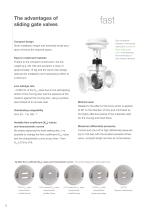
The advantages of sliding gate valves Size comparison between a normal seat valve and a Schubert & Salzer sliding gate valve. In the example, the nominal size of both valves is identical. Compact design Short installation length and extremely small actuators minimize the required space. Easy to install and maintain Thanks to the compact construction, the low weight (e.g. DN 150 with actuation a mere of approximately 15 kg) and the clever disc design reduces the installation and maintenance effort to a minimum. Low leakage rate < 0.0001% of the KVS value due to the self-lapping action of the moving...
Open the catalog to page 12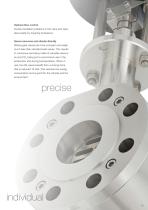
Optimal flow control Avoids cavitation problems in the valve and operates quietly by lowering turbulence. Saves resources and climate-friendly Sliding gate valves are more compact and weigh much less than standard seat valves. This results in conscious use being made of valuable resources and CO2 being put to economical use in the production and during transportation. When in use, the GS valves benefit from a driving force that is reduced 10-fold. This reduces the energy consumption and is good for the climate and the environment.
Open the catalog to page 13All Schubert & Salzer Control Systems GmbH catalogs and technical brochures

- Schubert & Salzer manual valve
- Schubert & Salzer stainless steel valve
- Schubert & Salzer water valve
- Schubert & Salzer ball valve
- Schubert & Salzer pneumatic valve
- Threaded valve
- Electrically operated valve
- Schubert & Salzer flange valve
- Schubert & Salzer regulating valve
- Schubert & Salzer shut-off valve
- Flap valve
- Schubert & Salzer electric valve
- Schubert & Salzer ISO valve
- Pressure limiter
- Schubert & Salzer gas valve
- Valve with handwheel
- Schubert & Salzer pneumatically-operated valve