
- Catalogs
- Schneider Electric
- ICatalogue CT VT

- Products
- Catalogs
- News & Trends
- Exhibitions
ICatalogue CT VT

ICatalogue CT VT
This technical catalogue from Schneider Electric focuses on indoor instrument transformers, specifically current transformers (CTs) and voltage transformers (VTs) for medium voltage distribution. It outlines specifications, applications, and compliance with international standards, particularly IEC standards.
Instrument Transformers
Presentation: Designed for voltages from 0.72 kV to 36 kV and rated currents from 5 A to 4000 A, these transformers conform to IEC standards and are suitable for high short circuit current values.
Applications and Types: Used for protection and metering by providing reduced current or voltage values, the types include current transformers (CTs) and voltage transformers (VTs).
Current Transformers (CTs)
Selection Guide: CTs supply a secondary circuit with a current proportional to the primary circuit, essential for accurate metering and protection.
Technical Description: Featuring a primary and secondary circuit connected via a magnetic core, CTs are characterized by rated voltage, frequency, primary and secondary current, and short-time thermal current.
Characteristics: Selection is based on accuracy class and safety factor, and they should never be left open-circuited to avoid hazardous voltages.
Quality Assurance
Schneider Electric ensures quality through rigorous production procedures and a certified quality system conforming to ISO 9001 standards, including continuous assessment and documentation of quality throughout the production process.
Compliance and Standards
All transformers conform to IEC standards, with options for specific country standards, designed to provide high dielectric strength, mechanical strength, and resistance to aging and tropical climates.
LPCT and VT Specifications
LPCT Specifications: Defined by rated primary current, extended primary current, and accuracy limit primary current or factor, LPCTs maintain a linear response over a wide current range and avoid saturation until beyond the breaking currents. Examples include:
- Metering class 0.5 with a rated primary current of 100 A and extended primary current of 1250 A, offering accuracy of 0.5% over a range of 100 A to 1250 A.
- Protection class 5P with a primary current of 100 A, providing accuracy of 5% over a range of 1.25 kA to 40 kA.
- Insulation voltage and power frequency withstand voltage.
- Rated primary and secondary voltages, with specific configurations for phase/phase and phase/earth connections.
- Accuracy classes for metering (0.2, 0.5, 1) and protection (3P, 6P), defining permissible errors in voltage and phase shift.
Operational Guidelines
VTs should not have their secondary circuits short-circuited to prevent damage. Various connection arrangements are possible, including star and V-connections. The document details the calculation of residual voltage and the importance of accurate metering and protection under fault conditions.
Order Forms and Technical Data
Includes order forms for different types of LPCTs and VTs, specifying parameters such as rated voltage, power frequency withstand, lightning impulse withstand, transformation ratios, and accuracy classes. It also provides dimensions and connection details for various models.
Catalog excerpts

Medium Voltage Distribution Indoor instrument Current transformers Voltage transformers Make the most of your energy
Open the catalog to page 1
Indoor instrument General contents LPCT: Electronic current
Open the catalog to page 3
Instrument transformers COïltGïltS
Open the catalog to page 5
Instrument transformers Presentation The Schneider Electric range of instrument transformers is designed for voltages from 0.72 kVto 36 kV and rated currents from In order to meet requirements for increasingly high short circuit current values in installations, current transformers notably have a short-time thermal current All Schneider Electric instrument transformers are in conformity with IEC ■ Current transformers can specifically relative to recommendations concerning transformer behaviour during transient short circuit conditions concerning enhanced safety electrical equipment for explosive...
Open the catalog to page 6
Instrument transformers Presentation Quality is the result of scheduling and monitoring at each stage, from initial design through to production and testing, and right through to final delivery and after sales This is expressed in terms of execution in conformity with the quality certification. This procedure allows us to supply a product that has all of the specified characteristics and also to provide the customer with a production and execution schedule that guarantees product quality. Certified quality system Schneider Electric's quality guarantee is certified in documents that are available...
Open the catalog to page 7
instrument transformers Applications and types Protection or metering devices have to receive data on electrical values (current or voltage) from the equipment to be protected. Fortechnical, economic and safety reasons, this data cannot be obtained directly on the equipment's MV power supply; we have to use intermediary These devices carry out the functions of: ■ Reducing the size of value to be ■ Providing galvanic separation ■ Supplying the power needed to process the data, or even for the protection device Metering transformer applications In MV electrical distribution, the high current and...
Open the catalog to page 8
CTs: Current Transformers COïltGïltS Using the order forms 16 DIN standard 12 kVCT- single and double secondary 17 DIN standard 24 kV CT - single secondary 18 DIN standard 24 kV CT - double secondary 19 24 kV primary conductor support CT - single secondary 20 24 kV primary conductor support CT - double secondary 21 36 kV primary conductor support CT - single secondary 22 36 kV primary conductor support CT - double secondary 23 17.5 - 24 - 36 kV split-over CT - single and double secondary 24 0.72 kV closed core CT - single and double secondary 25
Open the catalog to page 9
Selection guide Technical description Current transformers (CT) meet standard Their function is to supply the secondary circuit with a current that is proportional to that of the MV circuit on which they are the MV network and subject to the same over-currents as the latter and withstands terminals connected to earth. The secondary must never be in an open circuit (short circuit). Magnetic core Wound type primary current Magnetic core Closed core type current Current transformers Current transformers have two basic functions: ■ adapting the MV current value at the primary to the characteristics...
Open the catalog to page 10
Selection guide Technical description Characteristics (cont.) Short-time thermal current peak value This value is standardized from Ith -1 s at: Accuracy load The value of the load on which is based the metered current accuracy conditions. Apparent power (VA) that the CT can supply on the secondary for the rated secondary current for which the accuracy is guaranteed (accuracy load). Accuracy class Defines the limits of error guaranteed on the transformation ratio and on the phase shift under the specified conditions of power and current. Classes 0.5 and 1 are used for metering class P for protection....
Open the catalog to page 11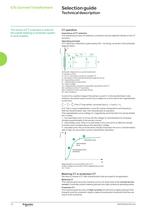
Selection guide Technical description The choice of CT is decisive in order for the overall metering or protection system The operating accuracy of metering or protection devices depends directly on the CT Operating principle A CT often has a load that is quite resistive (Rc + its wiring), as shown in the schematic diagram below. Schematic diagram fora current transformer 12 = Kn 11: secondary current for a perfect CT. Is: secondary current actually flowing through the circuit. E: induced electromotive force. Lm: magnetization inductance (saturable) equivalent to the CT. Rwir: resistance of the...
Open the catalog to page 12
Selection guide Technical description We can define the over-current coefficient of the CT: The lower Ksi, the easier the CT is to produce with a given volume, compatible with being integrated in a MV cubicle. A high Ksi leads to over-dimensioning of the CT and makes it difficult to produce. The CT secondary is used at low impedance (virtually in short circuit). The secondary circuit should never be left open, since this would mean connecting across an infinite impedance. Under these conditions, hazardous voltages for personnel and equipment may exist across the terminals. Terminal marking CT...
Open the catalog to page 13
Selection guide Technical description CT's for metering must have the right accuracy for the rated current. They are characterized by their accuracy class (generally 0.5 or 1) as well as a safety Primary current Secondary current Accuracy power - Accuracy class according to application Error limits according to the accuracy class Accuracy class A metering CT is designed to send as accurate an image as possible of currents below 120% of the rated primary. I EC standard 60044-1 determines the maximum error in the accuracy class for the phase and for the module according to the indicated operating...
Open the catalog to page 14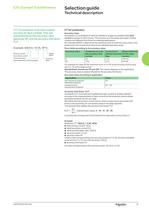
Selection guide Technical description CT's for protection must have suitable accuracy for fault currents. They are characterized by their accuracy class (generally 5P) and the accuracy limit factor Primary current Secondary current Accuracy power - Accuracy class A protection CT is designed to send as reliable an image as possible of the fault current (overload or short circuit). The accuracy and the power are suited to these currents and different from those for metering applications. EC standard 60044-1 determines the maximum error for each accuracy class in the phase and in the module according...
Open the catalog to page 15All Schneider Electric catalogs and technical brochures
 CFT34A
2 Pages
 IMT30A
2 Pages
 15607
156072 Pages
 IMV25
IMV252 Pages
 Evolis 24kV catalogue
80 Pages
 NEX 24 catalogue 2010
56 Pages
 Fuses catalogue 2012
24 Pages
 RM6 Catalogue
76 Pages
 Catalogue Human Machine Interfaces
150 Pages
 Osiswitch XCK_N catalogue
16 Pages
 Catalogue Osisense XG
26 Pages


- Power supply unit
- Flowmeter
- DC power supply
- AC/DC power supply
- Volume flow monitor
- Liquid flow monitor
- Ethernet switch
- Concentration analyzer
- Automation software solution
- Industrial network switch
- Schneider pressure transmitter
- Liquids analyzer
- Windows software
- Cloud-based software
- Analog pressure transmitter
- Managed switch
- Gas flow monitor
- Push-button switch
- Stainless steel flow monitor
- DIN rail mounted network switch