
- Catalogs
- Schneider Electric
- Fuses catalogue 2012

- Products
- Catalogs
- News & Trends
- Exhibitions
Fuses catalogue 2012

Fuses catalogue 2012
The document discusses the applications and selection criteria for medium voltage fuses ranging from 3.6 to 36 kV. It highlights the use of Fusarc CF, Soléfuse, Tépéfuse, and MGK fuses for protecting transformers, motors, capacitors, and voltage transformers. A selection table is provided to guide the choice of fuses based on equipment and voltage ratings.
The fuses are characterized by high breaking capacity, high current limitation, low I2t values, and reliable breaking of critical currents. They are suitable for both indoor and outdoor applications and include a thermal striker. The fuses comply with standards such as IEC 60282-1 and DIN 43625, and are manufactured under ISO 9001 and ISO 14001 quality systems.
The construction of the fuses includes components such as end contact caps, enclosures, cores, fuse elements, extinction powder, and thermal strikers. Each component plays a role in ensuring the fuse's performance and reliability.
The Fusarc CF range is designed to minimize power dissipation and is suitable for use in RMU units with SF6 gas. Time/current fuse curves and current limitation curves are provided to illustrate performance under different conditions.
The fuses are tested in both internal and official laboratories to ensure compliance with standards. Routine testing includes dimensional control, visual inspection, and electrical resistance measurement. The quality assurance system is certified by AENOR, providing additional reliability for Schneider Electric products.
The integration of a thermal striker in the fuses offers protection against temperature rises and unexpected operating conditions, reducing the risk of damage and accidents.
The document lists numerous fuse references with their rated voltage, operating voltage, rated current, maximum and minimum breaking currents, cold resistance, and physical dimensions. These specifications are crucial for ensuring the correct application and performance of the fuses.
The document emphasizes selecting fuses with a rated voltage greater than or equal to the network voltage and a maximum breaking current greater than or equal to the network short circuit current. It provides formulas for calculating appropriate fuse ratings based on transformer power, short circuit voltage, and rated current.
Fuses are manufactured according to standards such as UTE standard C64200 for Soléfuse and DIN standards for Fusarc CF. Recommendations include using fuses with specific characteristics to protect transformers and motors effectively.
The document includes time/current characteristic curves and current limitation curves for different voltage levels, illustrating maximum limited broken current values. Selection tables guide choosing the correct fuse ratings based on operating conditions and equipment specifications.
Key parameters such as rated voltage, current, breaking currents, and cold resistance are highlighted as essential for ensuring proper functioning and safety of electrical systems.
The document outlines the use of fuses in combination with contactors to protect medium voltage motors. Key stresses on fuses include the motor's start-up current, duration, and frequency of start-ups.
Fuse ratings depend on start-up current, duration, and frequency. Charts help determine the appropriate fuse rating based on motor power and voltage.
Fuses for capacitor banks must handle high inrush currents and harmonics. A derating of 30-40% is recommended due to temperature rise from harmonics.
According to IEC 60282-1, all three fuses in a three-phase circuit should be replaced if one blows, unless overcurrent is ruled out.
The document includes an order form for fuses, specifying electrical characteristics, dimensions, and operating conditions.
Catalog excerpts
Medium Voltage Distribution
Open the catalog to page 1
Medium voltage fuses Contents Fuse range selection 2 Fusarc CF, Soléfuse, Tépéfuse, MGK MV limiting fuses with thermal striker Fuse and limitation curves 10 Fuse and limitation curves 12 Metering transformer protection 13 References, characteristics and curves 14 Selection and usage guide General - Transformer protection 15 Transformer protection - Selection table 16 Motor protection - Selection charts 18 ^ Capacitor bank protection 19 Comments on substituting fuses 19
Open the catalog to page 3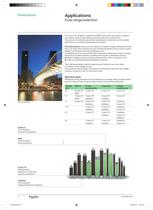
Fuse range selection Public distribution Our Fusarc CF, Soléfuse, Tépéfuse and MGKfuses make up a broad, consistent and uniform range of high breaking capacity fuses and current limitors. They are all of combined type and are manufactured so that they can be installed both indoors and outdoors (depending on the type). Schneider Electric fuses provide protection to medium voltage distribution devices (from 3 to 36 kV) from both the dynamic and thermal effects of short-circuit currents greater than the fuse's minimum breaking current. Considering their low cost and their lack of required maintenance,...
Open the catalog to page 4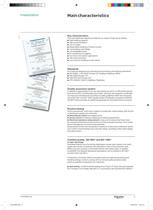
Main characteristics The most significant features provided by our range of fuses are as follows: ■ High breaking capacity ■ High current limitation ■ Dependable breaking of critical currents ■ For indoor and outdoor applications ■ With a thermal striker ■ Low minimum breaking current values. Our fuses are designed and manufactured according to the following standards: Quality assurance system In addition to being tested in our own laboratories as well as in official laboratories such as the CESI, Les Renardiersand Labein, with their own respective certificates, our fuses are manufactured according...
Open the catalog to page 5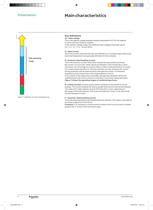
Main characteristics Safe operating Figure 1: definition of a fuse's operating zone. This is the highest voltage between phases (expressed in kV) for the network on which the fuse might be installed. In the medium voltage range, the preferred rated voltages have been set at: This is the current value that the fuse can withstand on a constant basis without any abnormal temperature rise (generally 65 Kelvin for the contacts). I3: minimum rated breaking current This is the minimum current value which causes the fuse to blow and break the current. For our fuses, these values are between 3 and 5 times...
Open the catalog to page 6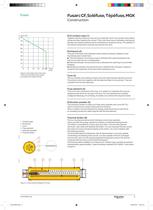
Fusarc CR Soléfuse, Tépéfuse, MGK Figure 2: this graph shows the value of the force provided by the striker according to its length of travel. Together with the enclosure, they form an assembly which must remain intact before, during and after breaking the current. This is why they have to withstand mechanical stresses and sealing stresses due to overpressure caused by arcing. The stability of the internal components must also be ensured overtime. This part of the fuse must withstand certain specific stresses (related to what has already been mentioned): ■ Thermal stresses: the enclosure has...
Open the catalog to page 7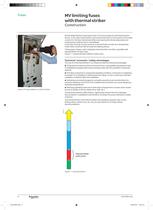
with thermal striker Fusarc CF fuses installed in a CAS 36 cubicle All Schneider Electric fuses (type Fusarc CF) are provided of a thermal protection device. In the case of permanent overcurrents lower than 13 and superior to the rated current (In), the fuse mechanical striker acts opening the device associated and avoiding any incidents due to overheatings. In this way, the fuse not only works as a current limiter but also as a temperature limiter when combined with an external breaking device. These types of fuses, which integrate a thermal striker, are fully compatible with standard Back UP...
Open the catalog to page 8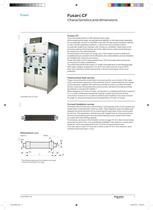
This is Schneider Electric's DIN standard fuse range. When designing this range, we paid particular attention to minimise power dissipation. It is increasingly commonto use RMU units with SF6gasasthe insulating material. In view of these operating conditions, in which the fuse is inserted inside a hermetically sealed fuse chamber, with virtually no ventilation, these fuses avoid premature ageing of themselves and of the whole device which would otherwise be caused by a non-optimised fuse. The enclosure in the Fusarc CF range up to 100 A (rated current) is made from crystallised brown porcelain...
Open the catalog to page 9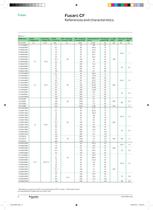
* Resistances are given at ±10% fora temperature of 20°C. Fuses > 100 A rated current, are manufactured in glass fibre (for indoor use).
Open the catalog to page 10
* Resistances are given at ±10% fora temperature of 20 °C. Fuses > 100 A rated current, are manufactured in glass fibre (for indoor use).
Open the catalog to page 11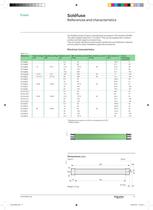
The Soléfuse range of fuses is manufactured according to UTE standard C64200. The rated voltage varies from 7.2 to 36 kV. They can be supplied with or without a striker and their weight is of around 2 kg. They are mainly intended to protect power transformers and distribution networks, and are solely for indoor installations (glass fibre enclosure). Electrical characteristics "Resistances are given at ±10% fora temperature of20°C. ** Without striker.
Open the catalog to page 13
(metering transformer protection) References, characteristics and curves We manufacture Tépéfuse and Fusarc CF type fuses intended for metering transformer protection which have the following references and characteristics: "Resistances are given at ±10% fora temperature of 20°C. Tépéfuse fuses are only made in glass fibre when intended for indoor usage. Fuses for metering transformer protection are made without strikers, according to figures 6 and 7.
Open the catalog to page 15
References, characteristics and curves MGK fuses are intended to protect medium voltage motors at 7.2 kV (indoor application). Electrical characteristics "Resistances are given at ±10% fora temperature of 20°C. Current limitation curve 7.2 kV Maximum value of limited broken current (kA peak) The diagram shows the maximum limited broken current value as a function of the rms current value which could have occurred in the absence of a fuse. Rms value of presumed broken current (kA)
Open the catalog to page 16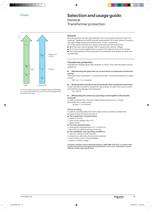
Selection and usage guide Transformer protection Short circuit (1) In this current zone, any overloads must be eliminated by LV protection devices or by a MV switch equipped with According to their specific characteristics, the various types of fuses (Fusarc CF, Soléfuse, Tépéfuse and MGK) provide real protection for a wide variety of medium and high voltage equipment (transformers, motors, capacitors). It is of the utmost importance to always rememberthe following points: ■ Un of the fuse must be greater than or equal to the network voltage ■ 11 of a fuse must be greater than or equal to the...
Open the catalog to page 17All Schneider Electric catalogs and technical brochures
 CFT34A
2 Pages
 IMT30A
2 Pages
 15607
156072 Pages
 IMV25
IMV252 Pages
 Evolis 24kV catalogue
80 Pages
 NEX 24 catalogue 2010
56 Pages
 ICatalogue CT VT
52 Pages
 RM6 Catalogue
76 Pages
 Catalogue Human Machine Interfaces
150 Pages
 Osiswitch XCK_N catalogue
16 Pages
 Catalogue Osisense XG
26 Pages


- Power supply unit
- Flowmeter
- DC power supply
- AC/DC power supply
- Volume flow monitor
- Liquid flow monitor
- Ethernet switch
- Concentration analyzer
- Automation software solution
- Industrial network switch
- Schneider pressure transmitter
- Liquids analyzer
- Windows software
- Cloud-based software
- Analog pressure transmitter
- Gas flow monitor
- Push-button switch
- Managed switch
- Stainless steel flow monitor
- RJ45 network switch