
- Catalogs
- Schmidt & Heinzmann GmbH & Co KG
- SMC PRESS AUTOMATION ENSURES PROCESS STABILITY


SMC PRESS AUTOMATION ENSURES PROCESS STABILITY

SMC PRESS AUTOMATION ENSURES PROCESS STABILITY
The document discusses the advancements in processing Sheet Molding Compounds (SMC) for premium passenger cars, focusing on quality standards, process stability, and economic production. A European molding company, in collaboration with Schmidt & Heinzmann, has implemented press automation to address these challenges.
Material and Application
SMC, made from thermoset resin and glass fibers, is widely used in automotive, commercial vehicles, electronics, and construction due to its durability, low weight, and high surface quality. It is particularly used for car hoods, roofs, and trunk lids.
Automation Implementation
A Tier-1 supplier has optimized production with a new press automation system, including a cutting unit, scales, cooling units, and an outlet conveyor belt, managed by industrial robots. This automation replaces manual processes, enhancing precision and reproducibility.
Technological Highlights
- Dedicated cutting technology with a round knife.
- AutoCut software for easy programming and material-saving operations.
- Weight compensation for ideal molding results.
- Specific gripper design by Schmidt & Heinzmann.
- Fast product changeover without reprogramming.
- Shortest mold opening times for high production output.
Benefits
- Reduction of six operators in a 3-shift production.
- Return on Investment (ROI) in less than 1.7 years.
- High cell availability with a low scrap rate.
Process Details
The SMC material is delivered in jumbo rolls, protected by films. The films are removed before cutting, and the material is fed into the cutting unit. The AutoCut unit is designed for automated production cells, handling complex cuts of SMC and other materials.
Automation Advantages
Automated weight control ensures consistent quality by adjusting cut sizes to maintain stack weight within tolerance. Virtual reality planning optimizes space usage and integrates production cells into existing environments.
Production Process
SMC cuts are formed and cured using a hydraulic press. The process allows for complex geometries and integration of metallic inserts. After pressing, components are cooled to prevent warping and then transported out of the production cell.
Challenges and Solutions
Space limitations required adaptations to the production cell layout. Virtual reality planning and a 3D scan of the customer's building facilitated optimal space usage and integration.
Conclusion
The automated production cell ensures high component quality and low defect rates. The investment in automation provides process stability, reduces risks, and achieves a low defect rate, with an ROI of less than 1.7 years.
Catalog excerpts
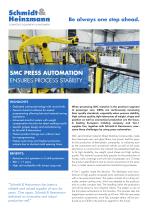
Be always one step ahead. SMC PRESS AUTOMATION ENSURES PROCESS STABILITY HIGHLIGHTS » Dedicated cutting technology with round knife » Generic AutoCut software for easiest programming allowing fast and material-saving operations » Advanced AutoCut system with weight compensation function for ideal molding results » Specific gripper design and manufacturing by Schmidt & Heinzmann » Fastest prodcut change over without need for reprogramming » Fastest cycle times and highest production outputs due to shortest mold opening times When processing SMC material in the premium segment of passenger cars, OEMs are continuously increasing their quality standards, especially when process stability, high surface quality, tight tolerances of weight, shape and position as well as economical production are the focus. A leading European molding company and Tier-1 supplier has, together with Schmidt & Heinzmann, overcome these challenges by using press automation. » Reduction of 6 operators in 3-shift production » ROI < 1.7 years » High cell availability with lowest scrap rate SMC semi-finished material (Sheet Molding Compounds), made from thermoset resin and glass fibers, has proven itself for years for the production of fiber-plastic composites. In industries such as the automotive and commercial vehicle, as well as rail road, electronics or construction, the material has estabished itself due to its high durability, low weight, good shape and high surface quality. This material is particularly popular for the production of hoods, roofs, coverings and trunk lids of passenger cars. To keep the product specifications and to remain economical at the same time, it makes sense to automate the manufacturing processes. “Schmidt & Heinzmann has been a reliable and valued supplier of ours for years. One again, Schmidt & Heinzmann delivered an innovative and robust production cell.“ A Tier-1 supplier made this decision. The developer and manufacturer of high-quality composite parts optimizes his production with a new press automation. The system consists of a cutting unit, scales, several cooling units, which are adapted to the products, and an outlet conveyor belt. The handling within the production cell will be done by two industrial robots. The system is one of the first press automations at this location. This process step has largely been carried out manually up till now. With the new press automation components, trunk lids, amongst others, will be produced as an OEM in the premium segment in the future.
Open the catalog to page 1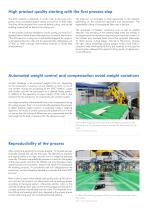
High product quality starting with the first process step The SMC material is delivered, in jumbo rolls, to the press companies, and is protected against drying out by films on both sides. The films will be removed and unwound before cutting, and the flat molding material will be fed into the cutting unit. “In this case the customer decided to use the cutting unit ‘AutoCut’,” explains Martin Stehle, Project Manager from Schmidt & Heinzmann. “This 2D free-form cutting unit is specifically designed for usage in automated production cells and for geometrically challenging cuts of SMC or other mat-type...
Open the catalog to page 2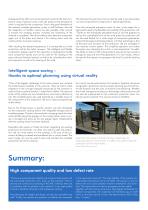
Subsequently the SMC cuts are formed and cured into the final component using a hydraulic press under the pressure and temperature which is required for the component. Due to the good flowability of the material, complex geometries, jumps in wall thickness, ribs and the integration of metallic inserts are also possible. After around 2 minutes the pressing process including the hardening of the material is completed. Then the handling robot takes the component again out of the press and places it for cooling down onto the cooling station to prevent warping. After reaching the desired temperature,...
Open the catalog to page 3
World-class SMC production equipment for manufacturing of glass and carbon fiber SMC material and parts. Automation of processes for FRP product manufacturing. CUTTING & STACKING FIBER PROCESSING High volume manufacturing line for efficient and economic fiber cutting and stacking production. Proven solutions for fiber cutting and fiber spraying. Innovative production cell for dry fiber fabric preforming. Unit for precise bonding of multiple FRP and metal components. Schmidt & Heinzmann GmbH & Co. KG Schmidt & Heinzmann North America Inc. Schmidt & Heinzmann Shanghai Co. Ltd Vichystraße 12 76646...
Open the catalog to page 4All Schmidt & Heinzmann GmbH & Co KG catalogs and technical brochures
 Be always one step ahead
4 Pages


- Cutting system
- Automatic cut-off machine
- Knife cutting system
- Making machine
- Plastic cutting machine
- Automated production line
- Sheet cutting machine
- Deflashing machine
- Forming machine
- Discharge unit
- Brush deburring machine
- Automatic deburring machine
- Continuous making machine
- Manual cutting system
- Automatic discharge unit
- Semi-automatic cutting machine
- Automatic forming machine
- Combined cut-off machine
- Grinding deburring machine
- Blending system