
- Catalogs
- SCHMIDT + HAENSCH
- Automatic Ash-Colour-Turbidity Analyser


- Company
- Products
- Catalogs
- News & Trends
- Exhibitions
Automatic Ash-Colour-Turbidity Analyser

Automatic Ash-Colour-Turbidity Analyser
The Automatic Ash-Colour-Turbidity Analyser is designed to measure the conductivity, colour, and turbidity of sugar solutions. It adheres to the official ICUMSA methods, ensuring reliable and efficient quality control in sugar laboratories.
Specifications
- Conductivity is measured according to the ICUMSA method in a 28 Bx solution.
- Colour accuracy in solution: ± 1 IU (up to 30 IU).
- Turbidity accuracy: ± 10%.
- Ash content accuracy: ± 0.001%.
- Brix solution accuracy: ± 0.1 Bx.
Functionality
The analyser measures the conductivity, the colour of the filtrated sample, and the unfiltrated colour to calculate turbidity. This is crucial for assessing sugar quality, especially in soft drink production where turbidity affects the product's appearance.
System Description
The system is a standalone, PC-controlled unit with a colorimeter, scale, and conductometer. It requires minimal preparation: adding sugar, inserting a filter, and starting the process. The analysis takes approximately 25-30 minutes, after which a new cycle can begin.
Requirements
- Distilled or deionized water.
- Compressed air (4 to 8 bar).
Benefits
This analyser streamlines the daily workload in sugar laboratories by automating key measurements and transmitting results via laboratory data acquisition software, enhancing efficiency and reliability.
Catalog excerpts
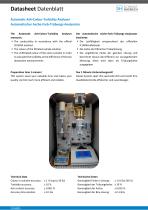
Datasheet Datenblatt Automatic Ash-Colour-Turbidity Analyser Automatischer Asche-Farb-Trübungs-Analysator The Automatic Ash-Colour-Turbidity Analyser measures: The conductivity in accordance with the official ICUMSA method The colour of the filtrated sample solution The unfiltrated colour of the same solution in order to calculate the turbidity as the difference of the two absorption measurements Der Automatische Asche-Farb-Trübungs-Analysator bestimmt: Die Leitfähigkeit entsprechend der offiziellen ICUMSA-Methode Die Farbe der filtrierten Probenlösung Die ungefilterte Farbe der gleichen Lösung und berechnet daraus die Differenz zur vorangehenden Messung, diese wird dann als Trübungsfarbe ausgegeben Preparation time 1 minute! This system saves your valuable time and makes your quality control much more efficient and reliable. Nur 1 Minute Vorbereitungszeit! Dieses System spart ihre wertvolle Zeit und macht Ihre Qualitätskontrolle effizienter und zuverlässiger. Technical Data Colour in solution accuracy: Turbidity accuracy: Ash content accuracy: Accuracy Brix solution: Technische Daten Genauigkeit Farbe in Lösung: Genauigkeit der Trübungsfarbe: Genauigkeit der Asche: Genauigkeit der Brix-Lösung:
Open the catalog to page 1
Datasheet Datenblatt Automatic Ash-Colour-Turbidity Analyser Inorganic components in sugar remaining after complete incineration of organic substances are defined as ash. As a purity criterion for sugar and other products of the sugar industry the conductometric determination of ash is preferred, because it is closely related to sulphated ash. Conductivity can be rapidly measured with reproducible results and is contained in most national and international sugar quality regulations. The Automatic Ash-Colour-Turbidity Analyser of SCHMIDT+HAENSCH measures the conductivity in accordance with the...
Open the catalog to page 2All SCHMIDT + HAENSCH catalogs and technical brochures
 iPR B3
2 Pages
 iPR Ex
2 Pages
 ATR L
ATR L2 Pages
 Autofilt Z
2 Pages
 AutoDosage®
2 Pages
 Saccharomat® Touch
2 Pages
 S+H Refractometer ATR-BR
2 Pages
 Autofilt Z
2 Pages
 Coloromat 100 - V2
2 Pages
 S+H Refractometer ATR-P
2 Pages
 VariRef Series
2 Pages
 Polarimeter Unipol V
2 Pages
 Purity Analyser
3 Pages
 VariDens Series
2 Pages
 Polartronic V
2 Pages
 VariPol Series
2 Pages
 DHR 95
2 Pages
 Saccharoflex 2020
2 Pages
 iPR-series
8 Pages


Archived catalogs
 S+H Wifi Adapter Process
2 Pages
 S+H Autodosage
2 Pages
 Universal Dosage System
2 Pages
 IPR Series
8 Pages
 On-Line Purity Analyser
4 Pages
 Autofilt Z unleaded
2 Pages
 SAMPLIFY P ©
2 Pages
 S+H Polarimeter Unipol 2020
2 Pages
 ATR-P TOUCH
2 Pages


- Display module
- Compressor stage
- Air compressor
- Gas analyzer
- Concentration analyzer
- Automation software solution
- Monitoring analyzer
- Liquids analyzer
- Automatic analyser
- Control software
- Color display panel
- Benchtop analyser
- Lubricated compressor
- Solids analyser
- Touch screen display panel
- Process analyzer
- Volumetric dosing unit
- Continuous analyzer
- Liquids dispensing system
- Filtration unit