
- Catalogs
- Schleich GmbH
- Handheld [PE + Iso + HV + Function]


Handheld [PE + Iso + HV + Function]
![Handheld [PE + Iso + HV + Function]](https://img.directindustry.com/pdf/repository_di/19475/handheld-pe-iso-hv-function-176008_1mg.jpg)
Handheld [PE + Iso + HV + Function]
The document describes the features and applications of Schleich's Handheld compact safety testers, which are designed for electrical safety tests, including PE tests and insulation fault checks. These testers are noted for their portability, ease of use, and integration of multiple testing functions.
Specifications
- Portable and compact design with integrated test socket.
- Operable by both left- and right-handed users with start switches on both sides.
- Ground-continuity test with 10A AC in a 4-wire configuration.
- Insulation-resistance test with evaluation of resistance or current.
- High-voltage test capability up to 2500V DC.
- Serial interface for printer or result transmission via RS232.
- Internal result storage for later transmission.
Applications
- Universal testers for on-site electrical safety tests.
- Suitable for EN60204 tests, excluding high-voltage AC tests.
- Testing lightning conductors at wind-power stations.
- Testing PE and insulation resistance in various equipment, including X-ray machines.
Additional Features
- Optional accessories like transport cases and shoulder straps for improved handling.
- Capability to increase test voltage for insulation-resistance tests to 2500V DC.
- Tests can be performed against a test socket or PE feeding point.
- PE-minimum-current monitoring can be disabled for tests with currents below 10A.
Software Integration
- Compatible with Windows® software PrintCom for storing and reading test results.
Conclusion
Schleich's Handheld testers offer a versatile and efficient solution for electrical safety testing, with a focus on portability, ease of use, and comprehensive testing capabilities.
Catalog excerpts
![Handheld [PE + Iso + HV + Function]-1](https://img.directindustry.com/pdf/repository_di/19475/handheld-pe-iso-hv-function-176008_1m.jpg)
18 www.schleich.com 19 RS232 PC I/O Highlights • • • • • • • • • • • Handheld Handheld Compact safety tester • small and portable • integrated test socket • easy and convenient operation • start switch at both sides for left- and right-handed operation • ground-continuity test with 10A AC in 4-wire confi guration: evaluation of resistance or voltage drop • insulation-resistance test: evaluation of resistance or current • high-voltage test DC with up to 2500V DC • serial interface for printer or result transmission • integrated result storage for a transmission via RS232 interface at a later point • storing and printing test results with PrintCom Refer to: Windows® software PrintCom 58 HV pistols and warning lamps 68 Calibration and black boxes 82 test methods 94 Devices of the Handheld series are universal testers for electrical safety tests, for PE tests and they check for insulation faults. They are available as single and combination testers. With regard to the integration of functions, high power density and miniaturization, Handheld testers are outstanding. This generation of testing devices by Schleich represents compact and precise testers. They are mainly used on site. Therefore, the test electronics are integrated into a sturdy aluminum case. Optional accessories such as transport cases and shoulder straps even improve the handling of the device. Except for the high-voltage test AC, the tester can also be used for EN60204 tests. Without the high-voltage test, it is possible to perform all necessary tests according to the Machine Guideline. Due to the internal data storage, test results do not have to be written down. Handheld PE/IR Handheld PE/IR/SLC/FCT Handheld PE/IR 2500V DC Possible combinations of test methods in a device Handheld testers also allow an increase of the test voltage at the insulation-resistance test to max. 2500V DC. This offers an interesting alternative to the high-voltage test with AC. 1800V ACeff correspond to approx. 2500V DC. The test object is connected via test socket. Using the test probe, the tests can be performed against this socket. Alternatively, the tester can be connected to the enclosure (PE feeding point) of the test object by connection cable. In this case, the tests are performed against this PE point. A special application is testing the lightning conductors at wind-power stations. To perform tests with currents below 10A, the PE-minimum-current monitoring can be turned off. With a reduced test current and a test lead in 4-wire confi guration with a length of 50m, it is possible to test resistances up to 15Ù. If a PC is available, you can use our Windows® software PrintCom to store the test results directly on the PC. Testing PE and insulation resistance Testing the PE at X-ray equipment Testing conductors at wind-power stations EN60204 test at a service cabinet Read-in measured values via PrintCom insulation resistance KV GÙ PE resistance mÙ function 1-phase A substitute leakage current mA ìA high voltage DC KV mA GÙ PE resistance mÙ function 1-phase A substitute leakage current mA ìA high voltage DC KV mA GÙ l insulation resistance KV GÙ switch-over test methods
Open the catalog to page 1All Schleich GmbH catalogs and technical brochures
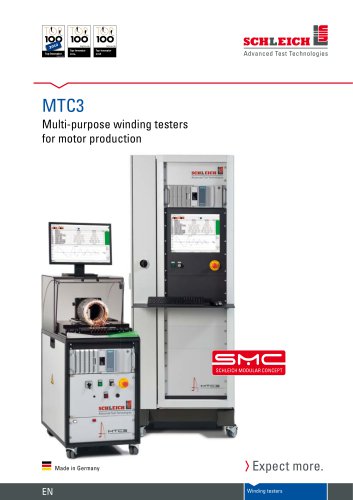 MTC3
MTC331 Pages
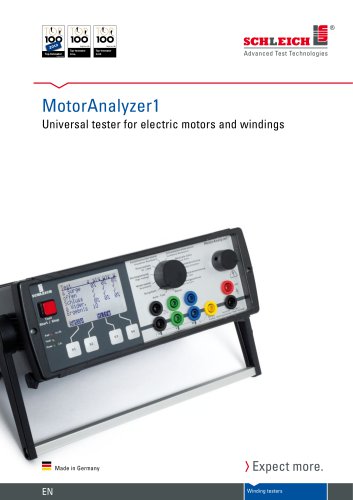 MotorAnalyzer1
8 Pages
 GLP2-BASIC
15 Pages
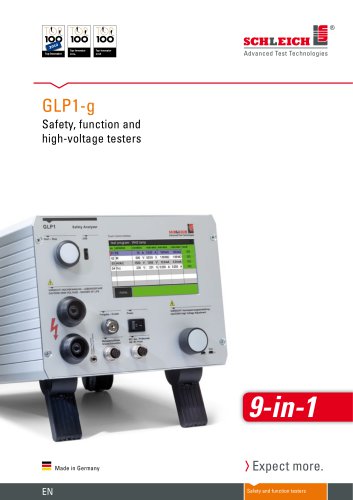 GLP1-g
19 Pages
 MotorAnalyzer2
13 Pages
 Winding Machines
1 Page
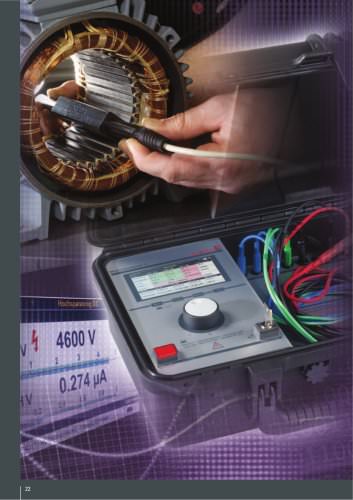 MotorAnalyzer 1
8 Pages




Archived catalogs
 Bonding Machines
1 Page
 GLP1-e - HIPOT TESTER
1 Page
![MTC3 | Surgetester [Surge 6KV + R + HV + Rotation +++]](https://img.directindustry.com/pdf/repository_di/19475/mtc3-surgetester-surge-6kv-r-hv-rotation-176014_1mg.jpg)
![MTC2 | Surgetester - portable [3KV - 6KV - 12KV - 15KV - 24KV - 30KV]](https://img.directindustry.com/pdf/repository_di/19475/mtc2-surgetester-portable-3kv-6kv-12kv-15kv-24kv-30kv-176012_1mg.jpg)
![MotorAnalyzer | Universal motor analyzer [R + HV + Iso + Surge +++]](https://img.directindustry.com/pdf/repository_di/19475/motoranalyzer-universal-motor-analyzer-r-hv-iso-surge-176010_1mg.jpg)
![GLP3 | Combination tester [PE + Iso + Leakage + HV + Function + R + Visual +++]](https://img.directindustry.com/pdf/repository_di/19475/glp3-combination-tester-pe-iso-leakage-hv-function-r-visual-176006_1mg.jpg)
![GLP2-e/i | High voltage testers [up to 100KV AC / up to 40KV DC]](https://img.directindustry.com/pdf/repository_di/19475/glp2-e-i-high-voltage-testers-up-to-100kv-ac-up-to-40kv-dc-176004_1mg.jpg)
![GLP2-e/i | Single-/ Combination [PE + Iso + LC + HT + Function + R + Visual +++]](https://img.directindustry.com/pdf/repository_di/19475/glp2-e-i-single-combination-pe-iso-lc-ht-function-r-visual-176002_1mg.jpg)
![GLP1-e 60204 | EN 60 204 - VDE 0113 tester | [PE + Iso +HV]](https://img.directindustry.com/pdf/repository_di/19475/glp1-e-60204-en-60-204-vde-0113-tester-pe-iso-hv-175998_1mg.jpg)
- Test stand
- Clamping device
- Junction block
- Terminal box
- Switching relay
- Portable tester
- Automatic tester
- Automated test bench
- Industrial tester
- Electromechanical relay
- Automatic test kit
- Voltage testing system
- Clamping device
- DC electromechanical relay
- Industrial test bench
- Hook-up wire
- Light barrier
- Laboratory tester
- Installation tester
- Insulation testing system