
- Catalogs
- Schlegel Electronic Materials
- RF Absorbers


RF Absorbers
1 /32Pages
RF Absorbers
1 /32Pages
Catalog excerpts

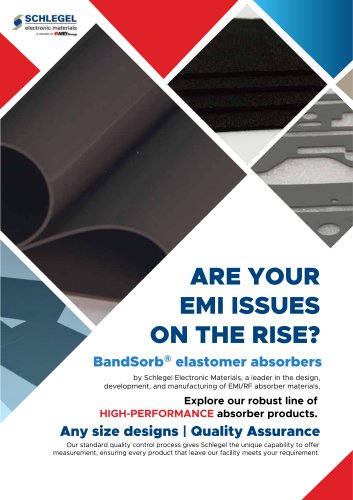
by Schlegel Electronic Materials, a leader in the design, development, and manufacturing of EMI/RF absorber materials, Explore our robust line of HIGH-PERFORMANCE absorber products. Our standard quality control process gives Schlegel the unique capability to offer measurement, ensuring every product that leave our facility meets your requirement.
Open the catalog to page 1
Microwave Absorption Theory 4 Solutions Across a Wide Range of Applications 8 BandSorb® SC/UC Series 9 Materials Selection Guideline
Open the catalog to page 2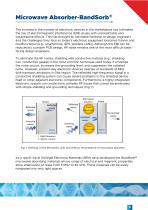
The increase in the number of electronic devices in the marketplace has cultivated the rise of electromagnetic interference (EMI) issues with unpredictable and troublesome effects. This has brought an inevitable hardship to design engineers and the challenges they face as today’s electronic equipment becomes thinner and multifunctional (e.g., smartphone, GPS, wireless LANs). Although the EMI can be reduced by a proper PCB design, RF noise remains one of the most difficult tasks facing design engineers. To eliminate the RF noises, shielding with conductive material (e.g., shielding can, conductive...
Open the catalog to page 3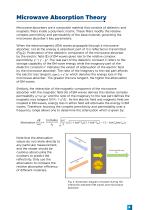
Microwave absorbers are a composite material that consists of dielectric and magnetic fillers inside a polymeric matrix. These fillers modify the relative complex permittivity and permeability of the base material, governing the microwave absorber’s key parameters. When the electromagnetic (EM) waves propagate through a microwave absorber, not all the energy is absorbed; part of it is reflected or transmitted (Fig.2). Polarization of the dielectric component of the microwave absorber by the electric field (E) of EM waves gives rise to the relative complex permittivity, s* = s’ - js”. The real...
Open the catalog to page 4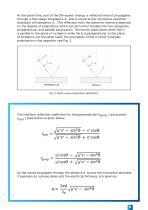
At the same time, part of the EM waves’ energy is reflected when it propagates through a free space impedance Z0 and is struck at the microwave absorber boundary of impedance Z, . The reflection from the dielectric interface depends on the degree of polarization which can be further divided into two categories, perpendicular, and parallel polarization. The former takes place when the H is parallel to the plane of incidence while the E is perpendicular to the plane of incidence. On the other hand, the orientation of the H and E in parallel polarization is the opposite, see Fig. 3. The interface...
Open the catalog to page 5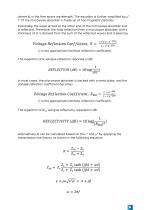
where A0 is the free space wavelength. The equation is further simplified by n* = 1 if the microwave absorber is made up of non-magnetic particles. Eventually, the wave arrives at the other end of the microwave absorber and is reflected. Therefore, the total reflection from a microwave absorber with a thickness of d is derived from the sum of the reflected waves and is given by Voltage Reflection Coefficient, R = (r is the appropriate interface reflection coefficient) The logarithm of R will give reflection reported in dB. In most cases, the microwave absorber is backed with a metal plate, and...
Open the catalog to page 6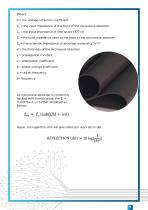
R = the voltage reflection coefficient Zin = the input impedance at the front of the microwave absorber Z0 = the input impedance of free space (377 Q) ZL = the load impedance seen at the back of the microwave absorber Zc = characteristic impedance of absorber material (|i*/e*)1/2 d = the thickness of the microwave absorber y = propagation constant a = attenuation coefficient P = phase-change coefficient a) = radian frequency /= frequency As microwave absorber is commonly backed with a metal plate, the ZL = 0 and the Zin is further simplified as follows. Again, the logarithm of R will give reflection...
Open the catalog to page 7
Solutions Across a Wide Range of Applications SEM developed the BandSorb® series in response to an urgent need for a simple yet reliable device to tackle the EMI problem. With our broad experience and expertise in the field of EMI shielding, plus our extensive collaboration with highly respected universities around the world, we can offer an effective EMI mitigating solution. Besides, our dedicated manufacturing site and R&D team work closely with our customers to provide custom solutions where needed. The BandSorb® absorbers are currently available as polymeric elastomer and dielectric foam...
Open the catalog to page 8
BandSorb® SC/UC Series Magnetically loaded, electrically non-conductive silicone (SC)/silicone free (UC) EMI/RF absorber Schlegel’s new range of elastomer Cavity resonance (BandSorb® SC/UC) Absorbers materials consists of thin, flexible, high-loss, magnetically loaded, electrically non-conductive silicone rubber (SC) / silicone free rubber (UC). Schlegel can provide this material with different configurations for use in the frequency range of 1 GHz up to millimeter waves. With our own dedicated manufacturing site and R&D team, we can work closely with our customers to provide custom solutions...
Open the catalog to page 9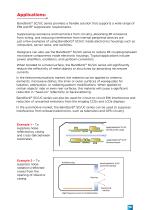
BandSorb® SC/UC series provides a flexible solution that supports a wide range of EMI and RF suppression requirements. Suppressing resonance and harmonics from circuitry, absorbing RF emissions from wiring, and reducing interference from internal peripheral devices are just a few examples of using BandSorb® SC/UC inside electronics housings such as computers, server racks, and switches. Designers can also use the BandSorb® SC/UC series to reduce RF coupling between microwave components inside electronic housings. Typical applications include power amplifiers, oscillators, and up/down converters....
Open the catalog to page 10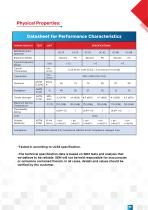
"‘Tested in according to UL94 specification. -The technical specification data is based on SEM tests and analysis that we believe to be reliable. SEM will not be held responsible for inaccuracies or omissions contained therein. In all cases, details and values should be verified by the customer.
Open the catalog to page 11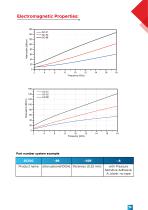
Part number system example: Product name
Open the catalog to page 12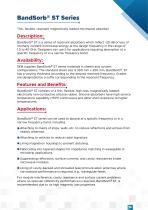
Thin, flexible, resonant magnetically loaded microwave absorber BandSorb® ST is a series of resonant absorbers which reflect -20 dB or less of normally incident microwave energy at the design frequency in the range of 1.5 to 40 GHz. Designers can use it for applications requiring absorption at a specific frequency or in a narrow frequency band. SEM supplies BandSorb® ST series materials in sheets and custom configurations. The standard sheet size is 300 mm x 300 mm. BandSorb® ST has a varying thickness according to the desired resonant frequency. Grades are designated by a suffix corresponding...
Open the catalog to page 13All Schlegel Electronic Materials catalogs and technical brochures
 Schlegel Absorbers
2 Pages
 Thermal Products
2 Pages
 PCB Shields
4 Pages
 Shielded Windows
8 Pages
 FingerStock
14 Pages
 Perma Filters
4 Pages
 EPDM Gaskets
7 Pages
 DOUBLESHIELD PAD
6 Pages
 Fabric over Foam Gaskets
24 Pages
 OP-400
1 Page
 Honeycomb vent panels
10 Pages
 TCR 200
2 Pages
