
- Catalogs
- S.C.A.T. Europe GmbH
- SCAT Europe Safety Solutions Catalogue Chapter HPLC Disposal

SCAT Europe Safety Solutions Catalogue Chapter HPLC Disposal

SCAT Europe Safety Solutions Catalogue Chapter HPLC Disposal
The document from SCAT Europe emphasizes the critical importance of safe waste disposal in laboratories, with a particular focus on HPLC (High-Performance Liquid Chromatography) waste. It underscores the necessity of maintaining a safe environment to uphold high concentration and safety standards in laboratory operations.
Improper disposal of laboratory waste poses significant dangers. The document introduces Safety Waste Caps as a solution, which transform collection containers into closed systems. This prevents hazardous vapors from escaping, ensuring both economical and safe laboratory operations.
The document provides an in-depth discussion on activated carbon, covering its history, manufacturing process, and functionality. Activated carbon is used to adsorb solvent, acid, and alkali vapors, thereby maintaining clean laboratory air. Key specifications include ball-pan hardness, particle diameter, ash content, specific humidity, inner specific surface, bulk density, and adsorption capacity.
Constructed from pure PTFE and PE-HD, these caps are resistant to aggressive chemicals and are flame-resistant according to UL-94 standards, enhancing safety in case of fire. The document details the technical specifications and various models of Safety Waste Caps, including their compatibility with different container threads and connections.
Exhaust filters are crucial for capturing harmful vapors. The document provides information on different sizes and operational lifetimes of these filters, recommending regular exchanges for optimal protection. These filters are optimized for solvent vapor adsorption, playing a vital role in maintaining a safe laboratory environment.
The document concludes by stressing the importance of using SCAT Safety Waste Caps and exhaust filters for the safe disposal of HPLC waste. It offers detailed specifications and options for various laboratory setups, ensuring adaptability and safety.
The document provides comprehensive information about the Universal Waste Hub JAN, a solution for liquid waste disposal, particularly from HPLC units. It highlights the product's features, technical specifications, and ordering information.
The Universal Waste Hub JAN is designed for safe and efficient handling of various liquid wastes. It includes a safety funnel and exhaust filter, preventing harmful vapors from escaping. The product is made from materials tested according to DIN/ISO/ASTM standards, ensuring durability and safety.
The design emphasizes stability and ease of use, featuring a low center of gravity, compact dimensions, and a stable form design. It includes a comfortable "click" closure, a sealing ring for complete sealing, and a dirt-sieve for catching larger particles. The exhaust filter enhances safety with multiple layers of active carbon.
The product includes various fittings, tube connectors, and blind plugs. It supports different sizes and types of collecting containers and features a stable hinge and fire protection elements.
The Universal Waste Hub JAN is available in different models and thread sizes, with some variants offering electrostatic conductive properties. Models are available with or without a thread adapter, and electrostatic conductive models come with a grounding cable and clamp.
Catalog excerpts

REATHE DEEPLY! CAN B WHY SHOULD I WASTE M Y TIME, T WITH THINKING ABOU Keep your Head clear for your daily, Analytical Work. www.scat-europe.com Working in the laboratory requires high concentration and a safe environment. Safety Waste Caps turn every collection container into a closed system according to the latest safety standards. This allows you to concentrate on your tasks undisturbed.
Open the catalog to page 1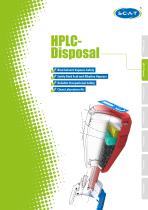
HPLC-Disposal Safety Funnels Bind Solvent Vapours Safely ✔ Safely Bind Acid and Alkaline Vapours ✔ Reliable Occupational Safety ✔ Clean Laboratory Air ✔ Level Control Containers Accessory Add
Open the catalog to page 2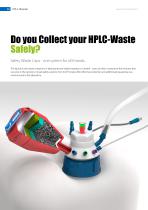
Do you Collect your HPLC-Waste Safely? Safety Waste Caps - one system for all threads. The liquids in the waste containers in laboratories are highly hazardous to health - users are often unaware of the mixtures that can arise in the canisters. Closed safety systems from SCAT Europe offer effective protection and additionally guarantee economical work in the laboratory.
Open the catalog to page 3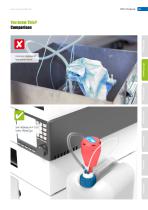
You know This? Comparison HPLC-Supply Improper disposal of laboratory waste. HPLC-Disposal Safety Funnels Level Control Safe disposal with SCAT Safety Waste Cap. Containers Accessory Addendum
Open the catalog to page 4
Activated Carbon: What is Important? SCAT activated carbon protects against solvent, acid and alkali vapours. Basic functionality The beginnings of activated charcoal lie in the use of one of its predecessors in the production chain: charcoal! The first evidence that charcoal was used to purify water dates back to 200 BC. Chr. Columbus charred the insides of wooden barrels to increase the durability of the water being transported. The first industrial use of charcoal was in 1794 in an English sugar refinery. The fluid loaded with the pollutant flows through a layer of activated carbon at a certain...
Open the catalog to page 5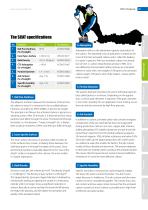
Test Method Inner Spec. Surface Bulk Density Particle Diameter Specific Humidity (% of weight) The inner surface of porous or granular solids includes all of the surfaces they contain, including those between the individual grains or through the edges of the pores. Since all chemical reactions essentially depend on the “size of the attack” surface compared to the volume, the inner surface is of great importance. 6. Ash Content In addition to carbon, activated carbon also contains inorganic components of the raw material that have not evaporated during production. Calcium, iron, zinc, copper,...
Open the catalog to page 6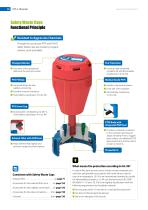
Safety Waste Caps Functional Principle Resistant to Aggressive Chemicals ✔ Through the use of pure PTFE and PE-HD Safety Waste Caps are resistant to organic solvents, acids and alkalis. Change Indicator ⹅ Activation of the operational lifetime at the push of a button PFA Fittings ⹅ Improved design for easy capillary connecting ⹅ Excellent chemical resistance Fire Protection ⹅ Housing made of partially crystalline PP with flammability classification V-0 (UL-94) Medical Grade PTFE ⹅ Excellent chemical resistance ⹅ Food safe, FDA compliant PPS Screw Cap ⹅ Autoclavable / sterilisable up to 200 °...
Open the catalog to page 7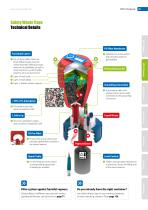
Safety Waste Caps Technical Details Functional Layers ⹅ Stabilizes the active carbon and provides proper air permeability ⹅ Layer 3: binds acids ⹅ For yet more safety, there are three different types of active carbon (layered), offering a broad spectrum of capabilities, as well as more functions, e.g. HPLC buffer solutions are now also bound: PE-Filter Membrane ⹅ Layer 2: binds alkalis ⹅ Layer 1: adsorbs solvent vapours Grounding Connection Safety Funnels ⹅ A grounding cable with a banana plug can be easily connected to this grounding connection ⹅ The ability to bind has been increased by 20%!...
Open the catalog to page 8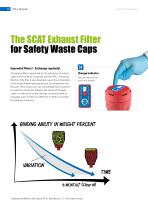
The SCAT Exhaust Filter for Safety Waste Caps Expended filters? - Exchange regularly! The exhaust filter is optimized for the adsorption of solvent vapours from eluents, as typically used for HPLC. The actual lifetime of the filter is also dependent upon the composition of the waste material being produced, its temperature and flowrate. These factors can vary considerably from customer to customer, and/or according to the nature of the application. In order to be on the safe side, we recommend an exchange every 3 (Filter S); 6 (Filter M); 12 (Filter L) months*, for optimum protection. Change...
Open the catalog to page 9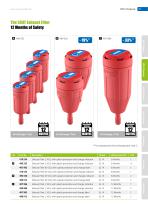
The SCAT Exhaust Filter 12 Months of Safety ߅ HPLC-Disposal Safety Funnels Level Control **As compared to the exchange pack, Size S. Exhaust Filter S, V3.0, with splash protection and change indicator Exhaust Filter S, V3.0, with splash protection and change indicator Exhaust Filter M, V3.0, with splash protection and change label Exhaust Filter M, V3.0, with splash protection and change indicator Exhaust Filter M, V3.0, with splash protection and change indicator Exhaust Filter M, V3.0, with splash protection and change label Exhaust Filter L, V3.0, with splash protection and change indicator...
Open the catalog to page 10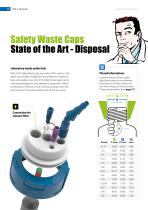
Safety Waste Caps State of the Art - Disposal Laboratory waste under lock. With SCAT Safety Waste Caps you collect HPLC waste in the safest way possible. Suitable for many different containers, tube and capillary sizes, the SCAT Safety Waste Caps can be individually adapted to your laboratory equipment. With a mechanical or electronic level control you always have the best overview. The world’s safest state-of-the-art system. Thread informations Container threads can be roughly determined based on their diameter. Information on the exact determination of the thread can be found under “Thread...
Open the catalog to page 11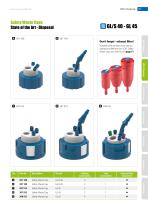
Safety Waste Caps State of the Art - Disposal DonѢt forget - exhaust filter! Suitable exhaust filters with various operational lifetimes for SCAT Safety Waste Caps you will find on page 71. HPLC-Disposal Safety Funnels 308 921 Level Control Containers Accessory Capillary Connections Tube Connections Exhaust Filter Connection
Open the catalog to page 12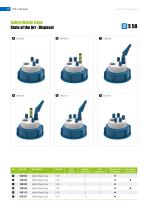
Safety Waste Caps State of the Art - Disposal Level Control Capillary Connections Tube Connections Exhaust Filter Connection Grounding Connection
Open the catalog to page 13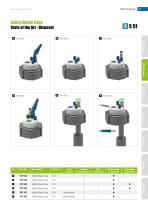
Safety Waste Caps State of the Art - Disposal Safety Funnels Level Control Containers Level Control Capillary Connections Tube Connections Exhaust Filter Connection Grounding Connection
Open the catalog to page 14All S.C.A.T. Europe GmbH catalogs and technical brochures
 Exhaust Filter V3.0
4 Pages
 Quick-Lock Connectors
2 Pages
 Lisa Safety Waste Cap V3.0
8 Pages
 SCAT Active Carbon
1 Page
 S.C.A.T. SafetyCaps 2.0
4 Pages
 Safety can be reordered!
20 Pages
 PROTECTION PAYS OFF!
26 Pages
 SCAT Safety Solutions
192 Pages
 Safety Caps 2.0
4 Pages
 The right Strategy for Liquid Waste.
140 Pages


