
- Catalogs
- SATO America
- CL4 serie printer


CL4 serie printer

1 / 2 PagesView full catalog
CL4 serie printer
Product catalog summary
General Overview: The SATO CL4XXe series is designed for heavy-duty industrial applications, offering high-resolution printing capabilities with resolutions of 203 and 305 dpi. It is Windows compatible and XML-enabled, ensuring easy integration into existing systems. The printer is built for durability and high throughput, featuring a heavy-duty cutter and RFID readiness.
Recommended Applications: The printer is suitable for logistics, warehouse, and transportation sectors, providing efficient tracking and tracing from goods arrival to delivery. In the garment industry, RFID tags enhance traceability and act as theft deterrents. Retail applications include promotional, shelf, and price labeling, as well as stock management and queue busting solutions. Product traceability benefits manufacturers, wholesalers, retailers, and consumers by improving inventory control, quality management, and customer service.
Printing Specifications: The CL4XXe supports direct thermal and thermal transfer printing methods. It offers a maximum print area of 104 mm width and up to 1249 mm length, with a print speed of up to 150 mm/sec. Recommended consumables include SATO-manufactured or certified supplies, with various media types and sizes supported.
Font and Symbologies: The printer supports internal bitmap fonts, outline fonts, and downloadable TrueType fonts. It can print a wide range of barcode symbologies, including linear and 2-dimensional codes like QR Code and Data Matrix.
Interface Characteristics: The printer is equipped with a 32-bit RISC processor and offers optional interfaces such as RS232C, IEEE1284, LAN, WLAN, USB, and more, ensuring versatile connectivity options.
Operating Characteristics: The printer operates within a temperature range of 5° to 40°C and a humidity range of 15-85% RH. It requires power inputs of 115V/220V and has dimensions of 271 mm x 430 mm x 321 mm, weighing 14 kg.
Accessories and Features: Available accessories include a cutter, dispenser, rewinder, real-time clock, and memory expansion. The printer features useful functions like hex dump, custom character design, sequential numbering, and self-diagnosis capabilities for maintenance and error detection.
See more
Catalog excerpts
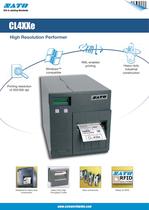
TM XML-enabled printing Heavy-duty industrial construction Windowscompatible Printing resolutionof 203/305 dpi > Designed for heavy-duty construction Heavy Duty High Throughput Cutter Easy connectivity Ready for RFID www.satoworldwide.com >
Open the catalog to page 1All SATO America catalogs and technical brochures
 PW2NX
PW2NX2 Pages
 SG112-ex
2 Pages
 CL6NX Plus
2 Pages
 CL4NX Plus
2 Pages
 LP 100R Laser Printer
2 Pages
 Thermal Ribbons
2 Pages
 Thermal Labels & Tags
2 Pages
 CS-9018
2 Pages
 M8490Se
2 Pages
 M8485Se
2 Pages
 M8465Se
2 Pages
 M8460Se
2 Pages
 S84 Series
2 Pages
 TG3 Series
2 Pages
 X Series
2 Pages
 OS Series
2 Pages
 CG4 Series
2 Pages
 M5900RVe
2 Pages
 GL4e Printer
2 Pages
 CL6e Printer
2 Pages
 Lt408
Lt4082 Pages
 M10e
M10e2 Pages
 TH2
TH22 Pages
 CT4i series
2 Pages
 CL4NX
CL4NX2 Pages
 Handheld Labeler
4 Pages
 SATO Product Catalog 2013
16 Pages


Archived catalogs
 GTe4 serie printer
2 Pages
 GL4 serie printer
2 Pages
 LP 100R
2 Pages
 M84Pro serie printer
2 Pages
 CG2 Series
2 Pages
 M10e printer
2 Pages
 GY4 Series
2 Pages
 LM4 serie printer
2 Pages
 CL6 serie printer
2 Pages
 CL4 RFID printer
2 Pages
 MB400i serie printer
2 Pages
 MB200i serie printer
2 Pages
 CT4i serie printer
2 Pages
 DR3 serie printer
2 Pages
 XL400 serie printer
2 Pages
 CX4 serie printer
2 Pages
 SATO Product Guide
32 Pages
 Hand Labellers
2 Pages
 HT200e printer
2 Pages
 RWG500 printer
2 Pages
 LT printer
2 Pages


Related Searches
- Digital I/O
- Real-time software
- Windows software
- IO module
- Cloud-based software
- Digital IO module
- Network software
- Label printer
- EDM software
- Thermal transfer label printer
- Data management software
- Interface module
- Industrial battery
- Stacker
- Labelling machine for the food industry
- Manual dispenser
- Desktop label printer
- Industrial label printer
- Labeler for the cosmetics industry
- Storage software
*Prices are pre-tax. They exclude delivery charges and customs duties and do not include additional charges for installation or activation options. Prices are indicative only and may vary by country, with changes to the cost of raw materials and exchange rates.
About DirectIndustry
DirectIndustry is a marketplace that offers B2B players a complete experience, from product sourcing to purchase. DirectIndustry is an entity of VirtualExpo Group.
Are you a buyer?
Are you a supplier?