

Electric motors

Electric motors
The document outlines the technical specifications for electric motors, adhering to international standards IEC 72-1 and IEC 34-7. These motors feature sealed, externally ventilated housings and dynamically balanced rotors, operating at a nominal voltage of 230/400 V - 50 Hz with a permissible variation of ±10%.
Constructed with high-quality materials such as pressure-cast aluminum casings and C40 steel shafts, the motors offer IP 55 protection and class F insulation, designed for continuous operation (S1 service). They can withstand temperature limits from 105°C to 180°C based on insulation class.
Conforming to EN 60529 - IEC 34/5 standards, the protection types are indicated by the "IP" code, where the first digit denotes protection against solid objects and the second against water penetration.
The document describes various operational modes, including continuous (S1), limited period (S2), and periodic intermittent operation (S3), each defined by specific load and rest phase characteristics.
Tables provide performance data such as power, voltage, current, speed, efficiency, moment of inertia, rated torque, and weight for different motor types, aiding in motor selection for specific applications.
Dimensions for motor types (B14, B5, B3) include flange size, shaft diameter, and overall length, ensuring compatibility with installation requirements.
Nominal voltage and power, rated torque, and maximum torque are defined, with operating temperatures specified for different motor types.
Motors have IP 55 protection against dust and water, with Class F insulation suitable for continuous operation (S1).
Protection types are indicated by "IP" followed by two digits, with IP55 providing protection against dust deposits and water jets.
Various modes are defined based on load and speed variations, including S1 to S9, each with specific characteristics.
Motors are built to international standards with closed structures and dynamically balanced rotors, allowing for a ±10% nominal voltage variation.
Diagrams for single-phase and three-phase motors detail rotation directions and starting methods, with star-delta starting recommended for larger motors.
Direct Connection Start-Up: Simplest method for low to medium-power motors.
Star-Triangle Start-Up: Used for medium to high-power motors to manage starting currents.
Includes clockwise and anti-clockwise rotations.
Triangle connection for 220 Volt systems and star connection for 380 Volt systems.
Various mounting positions such as B3, B5, V1, V3, indicating installation flexibility.
Catalog excerpts
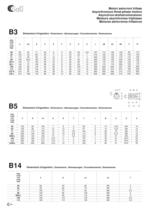
TIPO TYPE TYP A A/2 B C D F E H K L AB AC HD Z Z1 TYPE TIDO > TIPO TYPE TYP P N LA G R T Y I M O S U TYPE TIDO > TIPO TYPE TYP P N LA G1 T TYPE TIPO >
Open the catalog to page 4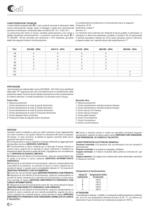
CARATTERISTICHE TECNICHE Le caratteristiche di protezione e funzionamento sono le seguenti:Protezione: IP 55 Isolamento: classe F Servizio: S 1 Le macchine sono costruite con materiali di sicura qualit; in particolare, la carcassa in allumunio pressofuso, gli alberi in acciaio C 40, la copriventola in lamiera stampata e fissata con viti al corpo carcassa, rotore in alluminio e statore isolato con materiali idonei alla classificazione "F". I motori elettrici proposti dalla sono costruiti secondo le dimensioni dellenorme internazionali: flange, alberi e fissaggio a piedi sono dimensionati secondo...
Open the catalog to page 6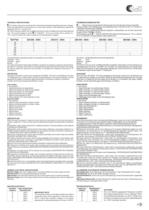
TECHNICAL SPECIFICATIONS TECHNISCHE EIGENSCHAFTEN 's electric motors are manufactured to international standards regarding dimensions: flanges,shafts and attachments to the base are of a size which conform to the dimensions required byregulations IEC 72-1 and IEC 34-7.The motor housing is sealed, and ventilated externally and with a shielded and dynamically balancedrotor. The nominal voltage of motors Elektromotoren sind gem den Abmessungen der internationalen Normen hergestellt:Flansche, Wellen und Fu䟟efestigungen sind entsprechend den in den Normen IEC 72-1 und IEC 34- 7 geforderten Abmessungen...
Open the catalog to page 7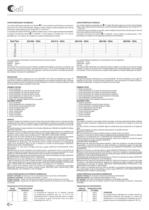
CARACTERISTIQUES TECHNIQUES CARACTERSTICAS T͉CNICAS Les moteurs lectriques proposs par la Soci驩t sont construits conformment aux dimensionspr驩vues par les normes internationales: flasques, arbres et fixation pieds possdent des mesuresconformesਠ celles reprises par les normes IEC 72.1 et IEC 34.7.La carcasse des moteurs est ferme, ventile驠 lextҩrieur avec un rotor cage dynamiquement quilibr੩.La tension nominale des moteurs Los motores elctricos propuestos por estn fabricados seg顺n las normas internacionales:bridas, ejes y fijaciones de los pies tienen las dimensionesa establecidas por las normas...
Open the catalog to page 8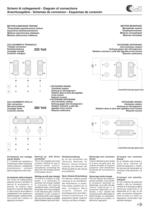
COLLEGAMENTO TRIANGOLO ROTAZIONE ANTIORARIA Triangle connection Anti-clockwise rotation Dreieckschaltung > Drehung gegen den Uhrzeigersinn Couplage triangle Rotation contraire a celle des aiguilles d'une montre Conexin tri᳡ngulo Rotacin antihoraria ROTAZIONE ORARIA > W1UU1VV1W C ZUXVYW 1 RS S R T T 1 ROTAZIONE ORARIA Clockwise rotation > 2 Drehung im Uhrzeigersinn > Linea/Grid/Leitung/Ligne/Lnea Rotation dans le sens des aiguillesd'une montre Rotaci㭳n horaria2 ROTAZIONE ANTIORARIA COLLEGAMENTO STELLA Anti-clockwise rotation Star connection Drehung gegen den Uhrzeigersinn Clockwise rotation Sterneinschaltung...
Open the catalog to page 9All SATI catalogs and technical brochures
 General Catalogue 2013
355 Pages
Archived catalogs
 Sprockets - Plate wheels ASA
13 Pages
 Electric ventilatori
3 Pages
 Timing belts imperial pitch
9 Pages
 Roller Chains
10 Pages
 V belt pulleys
29 Pages
 Timing belt pulleys
9 Pages
 Chain Wheels standard Special
9 Pages


- Power transmission belt
- Flexible coupling
- Rubber strip
- Flange coupling
- Rigid coupling
- Timing belt
- Sleeve coupling
- Synchronous power transmission belt
- Misalignment correction coupling
- Straight-toothed sprocket wheel
- Industrial coupling
- Chain sprocket wheel
- Toothed pulley
- Metal sprocket wheel
- Groove pulley
- Hub sprocket wheel
- Helical-toothed gear
- Bevel gear
- Hub gear
- Timing belt pulley