
- Catalogs
- Sartorius AG
- Filter Papers


- Products
- Catalogs
- News & Trends
- Exhibitions
Filter Papers

Filter Papers
Filter papers are crucial in both laboratory and industrial settings for various filtration tasks. Sartorius offers a diverse range of filter papers, including quantitative, qualitative, technical papers, blotting and chromatography papers, and glass and quartz microfiber filters. Quality is assured through continuous quality control and compliance with ISO 9001 and ISO 14001 standards.
The catalog categorizes filter papers by filtering speed, pore size, and structure, with color-coding for easy selection.
These papers are used for precise analyses, made from 100% cotton linters, ash-free, and wet-strengthened. Applications include ash content determination and filtration of fine precipitates.
Used for analytical purposes without gravimetric analysis, made from refined pulp and linters with high α-cellulose content. Applications include must analysis and wine clarification.
Suitable for analyses requiring low ash content, made from pure cotton linters or a combination with refined pulp. Applications include soil analyses and malt filtration.
Used for routine analyses and technical applications, made from refined pulp and cotton linters. Applications include routine lab work and clarification of liquids.
Details on specifications such as weight, thickness, particle retention, and filtration time are provided, along with ordering information for various sizes and formats.
- Types: Crêped and smooth filter papers with specifications like weight, thickness, and filtration speed.
- Applications: Used for rapid filtration of coarse precipitates and specific applications like cooking oils and sugar solutions.
- Specifications: Made of refined pulp or cotton linters, smooth, and available in various formats.
- Applications: Used for filtration and absorption of liquids like transformer oils and cooking oils.
- Properties: Made of refined pulp or cotton linters, wet-strengthened to prevent fine seed roots from growing through.
- Methods: Includes PP, TP, and BP methods for seed testing.
- Grade 470: Made of cellulose and diatomaceous earth, offering better separation at high flow rates.
- Applications: Used for clarification of beer, wine, and urine during spectrophotometric tests.
- Grade 480: Impregnated with stabilized silicon, hydrophobic, suitable for solvent filtration.
- Applications: Used in clinical labs and for separation of emulsions.
- Materials: Made of rayon or polyester, available in different weights and pore sizes.
- Applications: Used in the food-processing, petrochemical, and metal-processing industries for filtration.
- LabSorb: Highly absorptive paper coated with polyethylene, used for surface protection.
Designed to absorb liquids effectively, with a polyethylene layer to prevent seepage. Useful for recovering valuable or toxic liquids and protecting surfaces from contamination.
Made from pure raw materials, highly absorbent, and available in different weights and thicknesses. Used in various blotting applications.
Optimized for protein blotting systems, available in cellulose nitrate material with pore sizes of 0.22 μm and 0.45 μm.
Made from 100% cotton linters, suitable for blotting, chromatography, and absorption applications.
Available with or without binders, used for air and gas monitoring, and analytical and gravimetric analyses.
Made of high-purity quartz microfibers, suitable for emission monitoring at high temperatures and trace element analysis.
Includes detailed technical specifications for each product and outlines quality control test methods.
- Specifications: Lists various grades of paper with unique identifiers and descriptions.
- Procedures and Measurements: Focus on precise measurement and testing procedures.
- Product Index: Comprehensive list of paper grades for easy reference.
- Contact Information: Provides contact details for Sartorius Lab Instruments GmbH & Co. KG and Sartorius Corporation.
- Legal and Status Information: Specifications are subject to change without notice, with status dated April 2021.
The document is essential for professionals in laboratories or industries requiring specific types of filter and technical papers, providing detailed specifications and easy navigation through the index.
Catalog excerpts
Filter Papers for the Laboratory and Industry
Open the catalog to page 1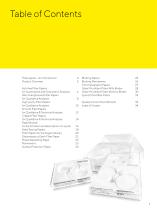
Filter papers – An Introduction Product Overview Ash-free Filter Papers for Quantitative and Gravimetric Analyses Wet-strengthened Filter Papers for Qualitative Analyses High-purity Filter Papers for Qualitative Analyses Smooth Filter Papers for Qualitative & Technical Analyses Crêped Filter Papers for Qualitative & Technical Analyses Paper Boards for the Filtration and Absorption of Liquids Seed Testing Papers Filter Papers for the Sugar Industry Diatomaceous Earth Filter Paper Phase Separating Paper Nonwovens Surface Protection Paper Blotting Papers Blotting Membranes Chromatography Papers...
Open the catalog to page 3
Filter Papers – An Introduction High-grade filter papers are indispensable for routine work in laboratory and industrial applications. Sartorius supplies you with a broad range of filter papers for myriad filtration tasks and supports you in solving all your filtration challenges. With this catalog, we invite you to familiarize yourself with our broad product range. Here, you will find typical examples intended to help you quickly select the filter paper that is right for your application. Our Product range covers: Quantitative, qualitative filter papers Technical papers and boards Blotting and...
Open the catalog to page 4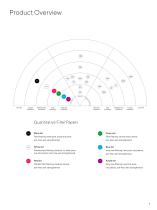
Product Overview Fine crystalline Very fine crystalline Medium-fine crystalline Coarse crystalline Very fine crystalline Fine crystalline Medium-fine crystalline Coarse crystalline Quantitative Filter Papers 388 Fast filtering, wide-pore, loose structure, ash-free, wet-strengthened 389 Slow filtering, narrow-pore, dense, ash-free, wet-strengthened Medium fast filtering, medium- to wide-pore, low-fat content, ash-free, wet-strengthened Blue dot Very slow filtering, fine-pore, very dense, ash-free, wet-strengthened Medium fast filtering, medium density Very slow filtering, very fine-pore, ash-free,...
Open the catalog to page 5
Ash-free Filter Papers for Quantitative and Gravimetric Analyses These filter papers are used for quantitative and gravimetric analyses as well as for pressure or vacuum filtration. They are made out of 100 % cotton linters with an α-cellulose content of > 98 % and are acidwashed to make the papers ashless and achieve high purity. Application Examples For some quantitative analyses, the cake layer has to be mechanically removed from the filter (for example, with a water jet or a spatula). The filter must be wet-strengthened so that it doesn’t break when the cake layer is removed. Gravimetric...
Open the catalog to page 6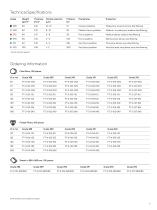
Technical Specifications Grade Coarse crystalline Wide-pore, loose structure, fast filtering Medium-fine crystalline Medium- to wide-pore, medium fast filtering Fine crystalline Medium dense, medium fast filtering Fine crystalline Narrow-pore, dense, slow filtering Very fine crystalline Fine-pore, dense, very slow filtering Very fine crystalline Very fine-pore, very dense, very slow filtering * See test methods, page 33 Ordering Information Filter Discs, 100 pieces Folded Filters, 100 pieces
Open the catalog to page 7
Wet-strengthened Filter Papers for Qualitative Analyses These qualitative filter papers are essentially used for analytical purposes and routine analyses, whenever no gravimetric analyses are required. They are wet-strengthened and can be used for pressure and vacuum filtration. They are made of refined pulp and linters with an > 95 % α-cellulose content, are very pure with an ash content < 0.1 %. Application Examples Application Must analysis Routine filtration for malt analysis Rapid filtration of fine precipitates Analysis of coffee extracts Tannin solutions Made of refined pulp and cotton...
Open the catalog to page 8
Technical Specifications Grade Coarse crystalline Wide-pore, loose structure, fast filtering Medium-fine crystalline Medium- to wide-pore, medium fast filtering Fine crystalline Medium dense, medium fast filtering Fine crystalline Narrow-pore, dense, slow filtering Very fine crystalline Fine-pore, dense, very slow filtering Very fine crystalline Very fine-pore, very dense, very slow filtering * See test methods, page 33 Ordering Information Filter Discs, 100 pieces Folded Filters, 100 pieces
Open the catalog to page 9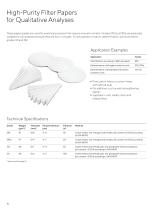
High-Purity Filter Papers for Qualitative Analyses These paper grades are used for analytical purposes that require a low ash content. Grades 292 and 292a are especially suitable for soil analyses because they are low in nitrogen. For phosphate or sodium determination, we recommend grades 131 and 132. Application Examples Application Malt filtration according to EBC standards Determination of nitrogen content in soils Determination of phosphate and sodium content in soils Pure cotton linters or cotton linters with refined pulp additives, such as wet-strengthening No agents Supplied in rolls,...
Open the catalog to page 10
Ordering Information Filter Discs, 100 pieces Folded Filters, 100 pieces Other dimensions are available on req
Open the catalog to page 11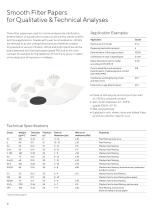
Smooth Filter Papers for Qualitative & Technical Analyses These filter papers are used for routine analyses like clarification, determination of substances, but also as discs with a center hole for technical applications. Grades with a wet burst resistance > 30 kPa are referred to as wet-strengthened and are therefore suitable for pressure or vacuum filtration. White and bright particles can be easily detected with the black paper grade 918, due to the color contrast for example for the detection of fluorine or silicon in water or the detection of mycelium in mildews. Application Examples Application...
Open the catalog to page 12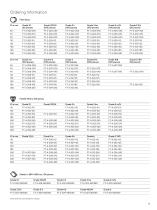
Ordering Information Filter Discs Folded Filters, 100 pieces Other dimensions are available on
Open the catalog to page 13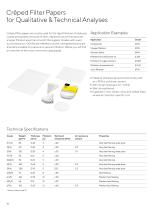
Crêped Filter Papers for Qualitative & Technical Analyses Crêped filter papers are mostly used for the rapid filtration of relatively coarse precipitates; because of their crêped structure they provide a larger filtration area than smooth filter papers. Grades with a wet burst resistance > 30 kPa are referred to as wet-strengthened and are therefore suitable for pressure or vacuum filtration. Below you will find an overview of the most commonly used grades. Application Examples Application Cooking oils Vinegar filtration Galvanic baths Filtration of sugar solutions Filtration of essential oils...
Open the catalog to page 14All Sartorius AG catalogs and technical brochures
 Picus® and Picus® NxT
8 Pages
 Univessel® Glass
40 Pages
 Ambr® Analysis Module
8 Pages
 Resolute® RCC MU
6 Pages
 Flexboy 2D Bags
55 Pages
 iQue® Forecyt®
8 Pages
 iQue® 3
7 Pages
 Sterisart® NF
4 Pages
 Vivaflow®
12 Pages
 Vacusart
2 Pages
 Sterisart® Sterility Testing
6 Pages
 Sterisart ® Family
12 Pages
 Speedcal Mobile
2 Pages
 Sartocheck® 5 Plus Filter Tester
26 Pages
 Quintix® and Secura®
24 Pages
 Rline® Dispenser Module
4 Pages
 Midi Plus Pipette Controller
4 Pages
 MA160 Moisture Analyzer
8 Pages
 Cubis® II
12 Pages
 Claristep® Filtration System
12 Pages
 Arium® Mini
11 Pages
 Midi Plus
4 Pages
 Microbiological QC Solutions
12 Pages
 Practum®
8 Pages
 Entris®
4 Pages
 Cubis® MCM10K3
4 Pages
 Quintix®
12 Pages
 Laboratory Weighing Products
96 Pages
 Laboratory Filtration Products
123 Pages
 Products for Microbiological Control
120 Pages


- Vessel
- Welding system
- Force sensor
- Vacuum generator
- Liquid filter
- Vacuum pump
- Concentration analyzer
- Automation software solution
- Monitoring analyzer
- Liquids analyzer
- Automatic welding machine
- Single-stage vacuum pump
- Process software
- Automatic analyser
- Steel load cell
- Windows software
- Calibration system
- Metal tank
- Benchtop analyser
- Solids analyser