
- Catalogs
- SANYO DENKI EUROPE
- SANMOTION AC Servo Amplifier with Built-In Posiitoning Function

- Company
- Products
- Catalogs
- News & Trends
- Exhibitions
SANMOTION AC Servo Amplifier with Built-In Posiitoning Function

SANMOTION AC Servo Amplifier with Built-In Posiitoning Function
- Positioning controllers are not required, reducing wiring and saving space.
- Supports up to 254 positioning points.
- Optimizes rotary table positioning by calculating the shortest path to the target.
- Allows setting of continuous motion, speed at each point, S-curve acceleration/deceleration, and servo gain.
- Available in various input voltages: 100 VAC, 200 VAC, and 400 VAC.
- Amplifier capacities range from 10 A to 800 A depending on the model.
- Models are available with or without safety features such as Safe Torque Off (STO) and other safety functions.
- General Specifications: Control function is position control using IGBT-based, sinusoidal PWM control. Power supply varies by model.
- Positioning Function Specifications: Supports 1 axis with a maximum of 254 points. Command range is from -2,147,483,648 to +2,147,483,647 in mm or pulse units. Acceleration/deceleration can be linear or S-curve.
- Interface: Parallel type has 28 inputs and 17 outputs, while the serial type uses RS-485 with Modbus RTU protocol.
- Functional Safety Specifications: Safety models comply with IEC 61800-5-2:2016 and EN 61800-5-2:2017 standards, offering various safety functions like STO, SS1, SS2, SOS, SLS, SBC, and SSM.
Catalog excerpts
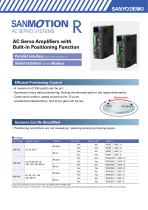
SANYO DENKI • A maximum of 254 points can be set. • Optimizes rotary table positioning, finding the shortest path to the target destination. • Continuous motion, speed at each point, S-curve Shortest path acceleration/deceleration, and servo gain can be set.Systems Can Be Simplified• Positioning controllers are not necessary, reducing wiring and saving space. ■ Lineup (1) Safe Torque Off (STO) is a safety function defined in IEC 61800-5-2:2016 / EN 61800-5-2:2017. (2) Safety models have STO,(1) SS1 (Safe Stop 1), SS2 (Safe Stop 2), SOS (Safe Operating Stop), SLS (Safely-Limited Speed), SBC (Safe Brake Control), and SSM (Safe Speed Monitor).
Open the catalog to page 1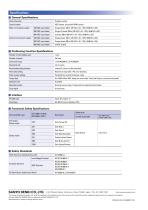
Specifications ■ General Specifications 3ANYO DENKI CQ-, LTD- 3-33-1 Minami-Otsuka, Toshima-ku, Tokyo 170-8451, Japan TEL: +81 3 5927 1020 The names of companies and/or their products specified in this catalog are the trade names, and/or trademarks and/or registered trademarks of such respective companies. San Ace, SANUPS, SANMOTION is a trademark of SANYO DENKI CO., LTD. Specifications are subject to change without notice.
Open the catalog to page 2All SANYO DENKI EUROPE catalogs and technical brochures
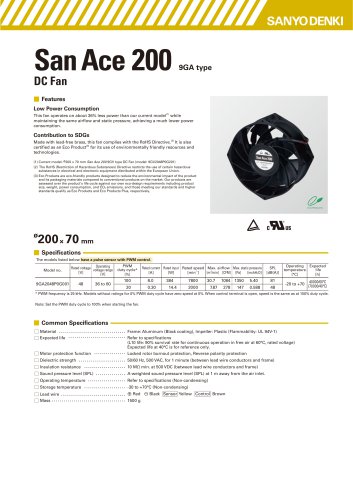 San_Ace_200_9GA_φ200x70
4 Pages
 SAN_ACE_120AD_120x25_ACDC
4 Pages
 San_Ace_40LG_40x28_Long_Life
4 Pages
 STEPPING MOTOR WITH ENCODER
32 Pages
 Company Profile 2023
8 Pages
 SANMOTION G
80 Pages
 San_Ace_140x38_9RA
4 Pages
 San_Ace_160ADW51
4 Pages
 San_Ace_160ADA51
4 Pages
 San_Ace_120ADAW38
4 Pages
 San_Ace_120ADA38
4 Pages
 San Ace 80x38 - 9RA
4 Pages
 San Ace 2022
632 Pages
 SANMOTION F2
84 Pages
 PRODUCT INFORMATION
52 Pages
 San Ace 100W
4 Pages
 San Ace 172AD
4 Pages
 San Ace 120 - 9RA
4 Pages
 San Ace 92 - 9RA
4 Pages
 San Ace 80 - 9RA
4 Pages
 San Ace 60 - 9RA
4 Pages
 San Ace 133W
4 Pages
 SANMOTION_R_3E_AC400V_550W-55kW
128 Pages
 SANMOTION K
28 Pages
 SANMOTION C _ SMC100 _ECAT
12 Pages
 SANMOTION F5
128 Pages
 SANMOTION R
4 Pages
 San Ace Controller
4 Pages
 San Ace 97W
4 Pages
 SANMOTION R 100/200V General Catalog
172 Pages
 SANMOTION_R_AD_48VDC_20-200W
36 Pages
 Model No. PB
104 Pages
 SANMOTION_Linear
4 Pages
 SANMOTION_C_EtherCAT
16 Pages
 SERVOMOTOR_R2_14mm_2W
2 Pages
 DC SERVO SYSTEMS
36 Pages
 3 PHASE STEPPER - SANMOTION F3
12 Pages
 SANUPS HYBRID UPS E11A
8 Pages
 A11J
A11J12 Pages


Archived catalogs
 SANMOTION_C
12 Pages
 San Ace 150W
4 Pages
 San Ace 2018 ver. 2
576 Pages
 2-PHASE STEPPING SYSTEMS
100 Pages
 5-phase stepping MOTOR
128 Pages
 SERVOMOTOR_R2_275mm_37kW
2 Pages
 SANMOTION_R_100-200V_30W-1kW
40 Pages
 SANMOTION_R_3E_AD_100-200V_30W-30kW
160 Pages


- Electromotor
- DC electromotor
- Multipole motor
- 24 V motor
- Propeller fan
- Servo-motor
- 2-pole motor
- High-efficiency electromotor
- Servo-amplifier
- Stepper motor
- High-performance servo motor
- Motor controller
- AC servo-motor
- High-torque motor
- 48 V motor
- Custom motor
- DC servo-amplifier
- On-line UPS
- Cooling fan
- Fieldbus servo-drive