
- Catalogs
- SANYO DENKI America
- Electrolytic Corrosion Proof Fan


Electrolytic Corrosion Proof Fan

Electrolytic Corrosion Proof Fan
SANYO DENKI has been a leader in cooling fan development since 1965, offering a variety of AC and DC fans known for their high performance, reliability, and energy efficiency. These fans are essential for cooling systems with high-density electrical components.
- AC Fans: High performance, reliability, and safety.
- DC Fans: Low power consumption, low vibration, and high reliability.
1. Determine system specifications, including temperature rise and total heating value.
2. Calculate required airflow using the formula: Q' = V / (20 x ΔT).
3. Choose a fan with 1.5 to 2 times the calculated maximum airflow.
4. Confirm the fan selection by calculating the temperature rise when cooled by the fan.
Noise is measured at 1 meter in an anechoic chamber. DC fans have a longer expected life due to lower power consumption and temperature rise, with life expectancy varying with ambient temperature.
Airflow and static pressure are measured using wind tunnels and double chambers, with conversion tables for different units.
IP codes indicate protection levels against solids and water. SANYO DENKI's Splash Proof fans offer high protection.
Fans near high-power circuits may experience electrolytic corrosion. Preventive measures include relocating fans, using EMC guards, and employing fans with ceramic bearings.
DC fans may include pulse sensors for speed detection and locked rotor sensors for status signals. PWM control allows external regulation of fan speed, optimizing airflow and reducing noise.
- Maximum Collector-Emitter Voltage (VCE) for standard fans is +27.6V, and for 48V fans, it is +60V.
- Maximum Collector Current (Ic) is 5mA with specific saturation voltage requirements.
- Output waveform requires a pull-up resistor, stabilizing within 0.5 seconds after power-up.
- Low-speed sensors detect speed drops, indicating cooling degradation.
- PWM control adjusts fan speed by changing the duty cycle of the input pulse signal.
- PWM frequency is 25kHz, with duty cycles affecting fan speed from 20% to 100%.
- Power supply requirements are DC5V±10% and DC12V±20%.
- Insulation resistance is 10 MΩ minimum at 500V DC, and dielectric strength is 1,000V AC for 1 minute.
- Operating temperature ranges from -10℃ to +60℃.
- Recommended screw torques vary by fan size and type.
- Fans can be installed in any direction, with symbols indicating airflow and blade rotation.
- Use self-tapping screws cautiously to avoid frame damage.
- Avoid exceeding specified voltage ranges to prevent performance issues.
- Handle fan motors carefully to avoid damaging ball bearings.
- Ensure proper alignment and torque when using self-tapping screws.
Catalog excerpts
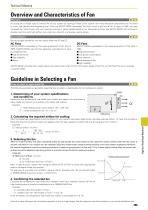
Technical Material Overview and Characteristics of Fan Overview A cooling fan is widely used to extend life of your system by cooling off heat of the system that many electrical components are mounted in a very high density and dissipating heat. Since we SANYO DENKI developed San Ace which is the first AC fan in Japan in 1965, we have increased fan motor lineup until now meeting customer s needs rapidly based on our tremendous career. We SANYO DENKI will continue to develop new fans with high airflow, low noise, low vibration, and energy - saving design. We can roughly devide fan into two types which are AC and DC. SANYO DENKI succeeded in the mass-production of AC fans in 1965. SANYO DENKI was the first Japanese manufacturer to have succeeded at this. ●High performance ●High reliability ●Safety SANYO DENKI succeeded in the mass-production of DC fans in 1982. ●High performance ●Low power consumption ●Low vibration ●Low leakage of flux ●High reliability SANYO DENKI currently has a wider variety of products like Long Life Fan, CPU cooler, Splash Proof Fan, and Oil Proof Fan etc to meet all customer needs. Guideline in Selecting a Fan How to select an appropriate fan The following example is a guideline regarding how to select an appropriate fan for cooling your system System 1. Determining of your system specifications and conditions Determine the temperature rise inside your system and obtain the total heating value inside your system on the basis of its inputs and outputs. Example V : Total heating value of your system(W)=100(W) △T : Inside temperature rise(K)=15(K) After the equipment specifications and conditions of your system have been determined, calculate required airflow to meet the conditions. (Note that the formula shown below only applies when the heat radiation is performed only by cooling air from the fan.) Example Q': Motion airflow(m3/min) V 100(W) ≒0.33(m3/min) Q = = 20×15(K) 20△T 3. Selecting the fan After the motion airflow has been calculated, select an appropriate fan motor based on the value.The motion airflow when the fan motor is actually mounted in your system can be obtained using the airflow-static pressure characteristics curve and system impedance.However, the system impedance cannot be measured without a measuring equipment, so fan with 1.5 to 2 times higher airflow than the actual max airflow should be selected (operating airflow is one-third to two-thirds of maximum airflow). Example Q: Maximum airflow(m3/min) Characteristics of airflow versus static pressure Q =Q×2/3 Q=Q ×3/2=0.33×3/2≒0.5(m3/min) Next, In case that you select a fan having an airflow of 0.5 (m3/min) or more and a appropriate size for the space inside your system. For example, If you need a fan of 60mm square, 25mm thickness and 12V, you should select is 109R0612H402 (maximum airflow = 0.53m3/min). 4. Confirming the selected fan Calculate the temperature rise inside your sysetem when your sysetem having 100 (W) of total heating value is forcefully cooled down by a 109R0612H402 fan. Example Q =Q×2/3=0.53×2/3≒0.353(m3/min) △T =V/20Q =100(W)/20×0.353(m3/min)≒14.2(K) From the above, the temperature rise inside your system is calculated as 14.2(K) . and those of pressure losses of equipment Static pressure System impedance Pressure loss Operating airflow Since the value obtained from the above equation is only a rough target, final fan selection should be based on you
Open the catalog to page 1
Technical Material Characteristics Calculation Method and Description Reliability and expected life Expected life of DC Fans 1,000,000 Expected life 200,000h (L10, 60 ) Expected life 80,000h (L10, 60 ) Rated voltage, continuously run in a free air state, survival rate of 90% Expected life of AC Fans Expected life (h) A cooling fan generally cools itself as well. The temperature rise of the motor is relatively low and the temperature rise of the grease in the bearings is also low, so expected life is longer than general some either motors. Since the service life of bearings is a theoretical value...
Open the catalog to page 2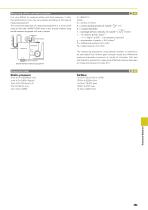
Measuring airflow and static pressure It is very difficult to measure airflow and static pressure. In fact, the performance curve may vary greatly according to the type of measuring equiment. The commonly-used type of measuring equipment is a wind tunnel using a Pitot tube. SANYO DENKI uses a very precise method using double chamber equipped with many nozzles. U-shaped tube Throttle device D A = cross sectional area of nozzle=− 2(m2) 4 D = nozzle diameter ¯ ─ v = average airflow velocity of nozzle= 2g Pn(m/sec) γ ( γ : Air specific gravity kg/m3) (γ=1.2kg/m3 at 20℃ , 1 atmospheric pressure) (...
Open the catalog to page 3
Technical Material Ingress protection ratings (IP code) ■ IP Cod es used by SANYO DENKI express the level of protection that internal electrical components (for fans: electrical components and motor coils) have against solid objects, water, and access to hazardous parts. San Ace Splash Proof fans feature high protection levels. ■ Definition of Ingress Protection (IP Code) Ingress Protection (IP Code) is defined in IEC (International Electrotechnical Commission) 60529* DEGREES OF PROTECTION PROVIDED BY ENCLOSURES (IP Code). *IEC 60529:2001 I P X X -Second digit: Protection against water First...
Open the catalog to page 4
UPS, inverter, rectifier, high-voltage power supply, etc. Cautions for Use of a Cooling Fan in the Vicinity of a Power Switching Circuit (prevention of electrolytic corrosion) If a fan is installed near a large-power or high-voltage switching circuit, the heavy electromagnetic noise resulting from electromagnetic induction in such circuits or the influence of high-frequency noise imposed through the power line of the fan may induce current through the shaft bearing of the fan.Such current may damage the oil film on the bearing and even the friction surface of the bearing.This adverse effect is...
Open the catalog to page 5
Specifications for Sensor/PWM Control Function Pulse sensor (Tach output type) example Pulse sensor outputs two pulse waves per revolution of fan, and it is good to detect fan speed. Pulse sensors can be incorporated in all kinds of DC fans. * Noise from inside the fan or from external devices may effect sensor output. Contact us for more information. The specifications listed below are for the 9G1212H101 model, and vary with the model number used. Please contact your point of sale for details. Output circuit Open collector Specifications Vce=+30V MAX. (For a 48V-rated fan:Vce = + 60V MAX.) Ic=10mA...
Open the catalog to page 6All SANYO DENKI America catalogs and technical brochures
 SANMOTION C S200
16 Pages
 SANUPS A11N-Li
16 Pages
 SANMOTION G
104 Pages
 SANMOTION R
196 Pages
 San Ace Cooling Systems
52 Pages
 San Ace 40L
4 Pages
 San Ace 120AD 9AD type
4 Pages
 San Ace 92 9RA type
4 Pages
 San Ace 92 9GA
5 Pages
 San Ace 140W 9WL
5 Pages
 San Ace 140L 9LG
5 Pages
 San Ace B97 9BMC
2 Pages
 SANMOTION R 3E
172 Pages
 SANMOTION T
36 Pages
 SANMOTION F5
128 Pages
 SANMOTION F2
84 Pages
 SANMOTION C
12 Pages
 DC Fan Catalog
247 Pages
 San Ace 92W
4 Pages
 San Ace B97
2 Pages
 San Ace 172 GP
4 Pages
 San Ace 40
2 Pages
 San Ace 60T
2 Pages
 Blower
20 Pages
 PWM Controller
4 Pages
 SANMOTION MODEL No.PB
2 Pages
 ACDC Fan
5 Pages
 AC San Ace Catalog
56 Pages
 SANMOTION R
40 Pages
 SANMOTION R 400V
36 Pages
 SANMOTION R Medium Capacity
40 Pages
 SANMOTION R ADVANCED MODEL
64 Pages


Archived catalogs
 DC San Ace Catalog
378 Pages
 San Ace Cooling Fan
673 Pages
 San Ace General Catalog
670 Pages
 Long Life Fan Catalog
91 Pages
 Oil Proof Fan Catalog
126 Pages
 Reversible Flow Fan
4 Pages
 San Ace 92W 9WL
3 Pages
 1 to 5kVA Modular UPS: ASE-H
6 Pages
 1 to 20kVA Modular UPS: A11J
12 Pages
 Splash Proof Fan Catalog
126 Pages
 Online UPS: A11H
4 Pages
 Hybrid UPS
8 Pages
 DC_San_Ace
332 Pages
 AC_San_Ace
56 Pages
 PD-D11A
8 Pages


- Servo-motor
- Air blower
- Centrifugal blower
- Single-stage blower
- High-performance servo motor
- AC servo-motor
- Controller servomotor
- Ultra-compact servomotor
- Robotic servo-motor
- Industrial servo motor
- Linear motor
- Servomotor with built-in encoder
- High-precision servomotor
- Single-phase blower
- High-torque servomotor
- High-speed servomotor
- Cooling blower
- EtherCAT positioning controller
- High-speed linear motor
- Compact motion control card