


- Company
- Products
- Catalogs
- News & Trends
- Exhibitions
SRT95C

SRT95C
- Sany's Obligations: Provide quality trucks, accurate information, after-sales service, and operator training.
- Owner's Obligations: Ensure only trained personnel operate the truck, conduct regular safety inspections, and maintain the truck properly.
- Operating Personnel's Obligations: Report abnormalities, follow safety signals, and be aware of hazards.
- Manager's Obligations: Ensure operators are trained, healthy, and licensed, and that signal persons are experienced and capable.
- Warning Signs: Place warning tags on the machine to indicate maintenance is in progress. Ensure all necessary areas are marked to prevent accidental operation.
- Working Area Selection: Choose a clean, flat, and well-ventilated area for maintenance. Remove any hazardous materials and ensure the area is free of tools when not in use.
- Prior-Maintenance Precautions: Understand procedures before starting. Keep the area dry and avoid using water or steam in the cab. Do not perform maintenance while the machine is moving.
- Personal Preparation: Only authorized personnel should perform maintenance. Wear appropriate protective gear, including gloves, goggles, and safety hats, depending on the task.
- Engine and Machine Preparation: Park on solid ground, lower all equipment, and ensure the engine is off before maintenance. Use blocks to prevent movement.
- Engine Running Maintenance: If necessary, have at least two workers present, with one ready to shut down the engine. Avoid contact with rotating parts and ensure communication among workers.
- Tool Usage: Use proper and undamaged tools to prevent accidents.
- Handling High-Pressure Systems: Exercise caution with suspension cylinders and high-pressure hoses. Follow specific procedures to release pressure safely.
- Noise and Air Safety: Use ear protection in loud environments and wear protective gear when using compressed air.
- Welding and Grinding: Only qualified personnel should perform these tasks with appropriate safety equipment.
- Hydraulic System Maintenance: Relieve system pressure before maintenance. Avoid open flames and handle leaks with care.
- Fire and Explosion Prevention: Avoid smoking and open flames near fuel systems. Store flammable materials properly and ensure fire safety equipment is operational.
- Regular Replacement of Safety Parts: Replace safety-related parts regularly to prevent deterioration and potential accidents.
- Waste Disposal: Dispose of waste materials according to environmental regulations to prevent ecological harm.
- Handling Tires: Use special tools and procedures for tire maintenance. Ensure proper inflation and check for defects regularly.
- Storing Tires: Store tires securely to prevent unauthorized access and ensure they are stable and blocked on level ground.
- Move Machine Forward: Ensure no warnings on the monitor, fasten seat belt, and check the float button and parking brake. Release the parking brake and shift lever to the desired position before accelerating.
- Move Machine in Reverse: Shift to 'R' and ensure the dump body is lowered. Exercise caution due to blind spots.
- Stopping Machine: For normal stops, release the accelerator and apply the brake. In emergencies, use the retarder and emergency brake.
- Automatic Transmission: The machine shifts automatically based on speed. Lower the dump body for optimal performance.
- Shifting Up/Down: Accelerate to shift up; release the pedal to shift down. Avoid sudden shifts to prevent shocks.
- Use the transmission retarder to maintain a safe speed. Avoid using the brake pedal unless necessary to prevent overheating.
- Utilize the transmission and rear disk brake retarders for controlled descent. Monitor oil temperatures to avoid overheating.
- Adjust the steering wheel as needed. Reduce speed before curves to maintain control.
- Load sand or soil before large rocks to cushion impact. Ensure even distribution of load.
- Follow flagman signals when dumping. Avoid loading while the dump body is raised.
- Before Storage: Clean and dry all parts, store indoors if possible, fill the fuel tank to prevent rust, lubricate and change oil, coat hydraulic cylinder rods with grease, disconnect battery, apply parking brake, set tire pressure, and fill coolant to prevent rust.
- During Storage: Operate the machine monthly to maintain lubrication and charge the battery. Remove grease from hydraulic rods before operation.
- After Storage: Consult a distributor if rust-prevention was not performed. Clean hydraulic rods, lubricate all points, check for water in oil, and verify oil and water levels before use. Start with a slow travel speed to ensure proper operation.
- Safety Instructions: Includes an overview, personnel requirements, risks, and precautions before and during maintenance.
- Handling Fluids: Guidelines for oil, hydraulic oil, fuel, coolant, and grease management, including filter and electrical system maintenance.
- Lubrication: Details on manual and automatic lubrication systems, recommended greases, and lubrication procedures.
- Wear Parts: Lists wear parts and provides recommendations for fuel, coolant, and lubricants.
- Service Procedures: Initial service intervals at 150, 250, and 2000 hours, and tasks required when necessary, such as cleaning systems, checking fluid levels, and inspecting tires.
- 1. Cooling System Maintenance: Clean the inside of the cooling system every 250 hours or change the antifreeze coolant, whichever comes sooner. Every 2 years or every 4000 hours, whichever comes sooner, is also recommended. Use only the recommended coolant to prevent engine corrosion and freezing. Follow a detailed procedure for draining and refilling the coolant, ensuring the removal of air from the system.
- 2. Window Cleaning Fluid: Regularly check and fill the window cleaning fluid, ensuring no dust contaminates the fluid. Use antifreeze cleaning fluid in freezing temperatures.
- 3. Condenser Cleaning: Clean the condenser weekly using compressed air to maintain air conditioner performance.
- 4. Coolant Level Check: Regularly check the coolant level and ensure no bubbles are present when the engine is running.
- 5. Dump Body Inspection: Inspect for cracks and damage, and make necessary repairs. Check suspension dimensions for both empty and loaded conditions.
- 6. Brake System Bleeding: Bleed both front and rear brakes to remove air from the hydraulic system, ensuring optimal braking performance.
- 7. Tire Selection and Inspection: Select tires based on usage conditions and machine weight. Regularly check tire inflation pressure and inspect for damage.
- 8. Lubrication Sample Extraction: Extract lubrication samples from the main reducer, differential assembly case, and final drive for analysis.
- 9. Pre-Start Checks: Conduct a series of checks before starting, including coolant, oil levels, brake system, and tire pressure.
- 10. Daily and Periodic Maintenance: Perform daily checks on lubrication, electric systems, engine, fuel system, cooling system, transmission, suspension, tires, hydraulic system, and body. Every 50 hours, perform lubrication tasks using a grease pump on specified components.
- Oil Checks: Check oil levels in the main reducer, differential assembly case, and final drive case. Add oil if necessary, ensuring safety precautions are followed to prevent burns from hot oil.
- Rear Axle Plug: Clean and check the rear axle plug for sludge and dust.
- PTO Liquid Level: Check and refill as required.
- Transmission Breather: Clean the breather to remove mud and dirt.
- Water Filter: Replace the water filter using a filter wrench, ensuring no leaks after installation.
- Lubricating Oil: Change the oil in the oil pan and replace the lubricating oil filter cartridge.
- Fuel Filter and Water Separator: Replace these components, ensuring no fuel leaks post-installation.
- Air Cleaner: Check, clean, or replace the air cleaner elements based on the dust indicator reading.
- Fan and Drive Belt: Inspect for damage and ensure proper tension.
- Drive Shaft: Check for looseness or play and contact a distributor for repairs if needed.
- Air Conditioner: Regularly start the compressor and check the coolant level.
- Frame Inspection: Wash and inspect the frame for damage, especially in colored areas.
- Service Brake: Perform functional checks to ensure the service brake is operational.
- 1. Parking Brake Check: Ensure the area around the truck is clear. Position the truck on level ground, depress the service brake, release the parking and emergency brakes, shift to 'D', apply the parking brake, release the service brake, and accelerate to 1350 r/min. If the truck does not move, the parking brake is functional. If issues arise, contact SANYI MINING.
- 2. Emergency Brake Check: Similar to the parking brake check, but apply the emergency brake instead. Follow the same steps to ensure functionality.
- 3. Filter Element Replacement (Every 1000 Hours): Replace hoist oil return, steering oil return, steering oil pipe, braking control valve group, and breath valve filter elements. Ensure O-rings are protected and replaced if damaged. Follow torque specifications for reassembly.
- 4. Hydraulic System Pressure Detection: Check pressures in hoist, steering, and brake systems. Ensure accumulator pre-charge pressures are correct before testing.
- 5. Transmission Oil and Filter Change (Every 1200 Hours): Drain and replace transmission oil and filter. Perform cold and hot oil level checks to ensure proper levels for operation.
- 6. Power Take-Off (PTO) Oil Change: Drain and refill PTO oil, ensuring all plugs are securely tightened.
- 7. Drive Shaft Bolt Torque Check: Check and adjust torque on front and rear drive shaft bolts after initial operation and periodically thereafter.
- 8. Breather Assembly Cleaning: Remove and clean the breather assembly with diesel oil or detergent, then reinstall securely.
- 9. Main Reducer and Differential Assembly Oil Change (Every 1500 Hours): Drain and refill oil in the main reducer, differential assembly, and final drive case. Ensure oil levels are correct.
- 10. Fuel Tank Cleaning (Every 2000 Hours): Drain and clean the fuel tank with diesel oil, then refill with clean fuel. Ensure all components are securely reinstalled.
- 11. Hydraulic Oil Replacement: Use a filter oil tanker or follow specific procedures to refill hydraulic oil, ensuring no contamination occurs.
- 12. Hoist, Cooler, and Oil Return Filter Element Replacement: Replace these filter elements, ensuring O-rings are intact and torque specifications are followed.
- Every 4000 Hours Service: Inspect the water pump for leaks and the vibration damper for fluid loss or damage. Check and adjust wheel bearings, ensuring safety precautions are followed.
- Every 6000 Hours Service: Replace front friction components when wear reaches 5.16mm. Ensure the truck is on level ground and brake oil temperature is below 40°C during checks.
- Every 10000 Hours Service: Contact Cummins service engineer for engine maintenance and potential overhauls.
- Preparation: Ensure the machine is stopped on level ground with the key switch off. Coordinate with others if working in a team and allow the engine to cool before removing the radiator cap.
- Procedure: Gather information about the failure, including symptoms and conditions under which it occurred. Avoid unnecessary disassembly and follow a structured troubleshooting process.
- Common Issues: Check hydraulic oil levels, system leaks, and ensure correct operation of handles. Use the common fault table to narrow down issues.
- Identify potential failure locations by consulting the troubleshooting section of the manual.
- Prepare necessary tools such as a T-connector and hydraulic gauge, and refer to the Parts Book for replacement parts.
- Gather information from the operator about the failure, including any abnormalities before the failure and actions taken during the failure.
- Verify the existence of the failure symptom by operating the machine.
- Develop a service plan, deciding whether repairs will be conducted on-site or in a workshop.
- Ensure power is off before disconnecting or connecting connectors.
- Check all connectors are properly plugged in and reconnect them if necessary.
- Handle electric equipment carefully, checking for changes in instrument readings that may indicate contact failure.
- Avoid working in dusty or adverse weather conditions to prevent contamination.
- Perform disassembly and maintenance in a dustproof workshop to ensure performance post-repair.
- Use clean equipment when filling hydraulic oil and change oil when warm to facilitate sludge removal.
- Conduct flushing operations after maintenance to remove contaminants.
- For engine start failures, check electrical components such as the battery, key switch, and wiring.
- Address overheating by checking coolant levels, fan belts, and radiator cleanliness.
- Low lubricating oil pressure may require adding oil, checking for leaks, or replacing filters.
- For smoke issues, inspect fuel injectors and air cleaners.
- Diagnose electrical faults by checking wire harnesses, sensors, and circuits for faults or disconnections.
- Use the display monitor to identify fault codes and refer to the manual for specific code explanations.
- ECU Input Voltage: Low and high voltage issues are indicated, with DNS (Do Not Shift) as a common response.
- Sensor Failures: Throttle position, engine speed, and turbine speed sensor failures are addressed with default value usage or locking in current range.
- Shift Selector Faults: Issues with primary and secondary shift selectors are noted, often resulting in holding the last valid direction or inhibiting mode changes.
- Temperature and Speed Sensor Issues: Sump fluid temperature and output speed sensor faults are highlighted, with actions like DNS and locking in range.
- Solenoid Failures: Various solenoid failures are listed, with DNS and SOL OFF (solenoid off) as typical responses.
- Includes codes for high rear brake oil temperature, transmission oil filter blockage, and low transmission oil pressure, among others. Each fault requires specific checks or actions, such as stopping the vehicle or reducing speed.
- Removal and Installation: Guidelines for safely removing and installing the battery, emphasizing the order of connecting and disconnecting terminals to prevent sparks.
- Charging: Instructions for charging the battery safely, including voltage and current specifications to avoid overheating or explosions.
- Details on connecting and disconnecting auxiliary cables for engine starting, with warnings about avoiding sparks and ensuring correct connections.
- Steering System: Issues like slow steering, drift, and free-wheeling are addressed with remedies such as replacing pumps or correcting oil supply problems.
- Hoist System: Troubles like high noise and no system pressure are discussed, with solutions including adjusting valve pressures and replacing filters.
- Brake System: Inadequate braking and non-releasing brakes are covered, with checks on system pressure and valve operations recommended.
- 1. Brake System Issues:
- Parking/Emergency Brakes: Issues such as electromagnetic coil damage, solenoid valve damage, and oil leakage can prevent brakes from applying. Remedies include repairing or replacing damaged components and checking for restrictions in lines.
- Front Brake Disc Overheating: Caused by foot pedal valve lock-up or pipeline blockages. Solutions involve checking and cleaning valves or replacing them as needed.
- Rear Brakes Not Releasing: Potential causes include foot pedal valve damage and proportional pressure valve issues. Repair or replacement is recommended.
- 2. Rear Axle and Lubrication Issues:
- Noise and Vibration: Insufficient lubrication or damaged bearings and gears can cause noise. Solutions include checking oil levels, replacing bearings, and adjusting gear alignments.
- Lubricant Loss: Caused by worn seals or loose components. Remedies include replacing seals and tightening nuts and bolts.
- 3. Air Conditioning System Faults:
- Discontinuous Refrigeration: Issues such as ice-blocking, poor contact in switches, and relay problems. Solutions involve replacing components and performing system checks.
- Insufficient Heating: Caused by blocked water pipes or valve issues. Maintenance or replacement of components is necessary.
- No Refrigeration: Potential causes include compressor clutch issues and refrigerant leaks. Solutions include checking connections and replenishing refrigerants.
- 4. General Recommendations:
- Regular maintenance and checks are essential to prevent and address issues promptly.
- Ensure proper lubrication and component alignment to avoid mechanical failures.
- Address electrical and control system issues to maintain operational efficiency.
Catalog excerpts
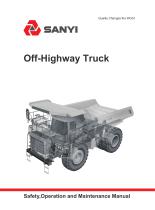
_ Quality Changes the World Off-Highway Truck Safety, Ope rati on and Maintenance Manual
Open the catalog to page 1
SANY MINING EQUIPMENT CO.,LTD ADD: Sany Industry Town,Dongcheng Avenue,Economic and Technological Development Zone,Kunshan,Jiangsu. Tel:0086-10-60738666 Fax: 0086-10-60738831 E-mail:[email protected]
Open the catalog to page 2
SRT95C Off-Highway Truck Safety,Operation and Maintenance Manual WARNING Read and follow the safety precautions and instructions in this manual and on the machine decals. Failure to do can cause serious injury, death or property damage. Keep this manual with the machine for reading and future reference. Safety, Operation and Maintenance Manual
Open the catalog to page 3
Sany Group SANY Mining Equipment CO.,LTD Sany Industry Town,Dongcheng Avenue,Economic and Technological Development Zone,Kunshan,Jiangsu, P.R. of China 215300 http://www.sanyhe.com Tel: 0086-10-60738666 Fax: 0086-10-60738831 © 2014 by Sany Group. All right reserved. No part of this publication may be reproduced,used, distributed or disclosed except during normal operation of the machine as described herein. All information included within this publication was accurate at the time of publication. Product improvements ,revisions, etc., may result in differences between your machine and what is...
Open the catalog to page 4
Exemption Clauses SPECIFIC DECLARATION Off-Highway truck is a critical earth/rock moving machine with high traffic ability,which is mainly distributed to coal, iron ore, limestone, quarry,hydropower... Sany assumes no responsibility for consequences caused by the following factors: ● Misuse of the truck due to failure to observe the information provided hereunder in this manual; ● Unauthorized restructuring or modification to the truck; ● Use of non-genuine parts, or untested or unapproved parts or tools. ● Machine failure or damage resulted from natural disasters (such as earthquake, typhoon,etc.),...
Open the catalog to page 5
Obligations of all operating personnel ● Any abnormalities that could bring improper operation of the dump truck or potential hazards should be reported to your supervisor. The abnormalities should be corrected timely if possible. All workers around the dump truck must know and obey all warning signals, and be alert to safety of oneself and others. All operators must know the operating items and procedures. Be alert to any hazardous situation and immediately inform operator and signalman of the hazards such as high voltage cables, irrelevant people and worse ground condition. The operator must...
Open the catalog to page 6
SANYI Safety, Operation and Maintenance Manual I
Open the catalog to page 7
Table of Contents SRT95C Off-Highway Truck II Safety, Operation and Maintenance Manual ^SANYI
Open the catalog to page 8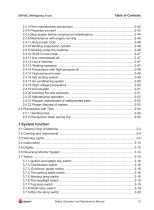
f^SANYi Safety, Operation and Maintenance Manual III
Open the catalog to page 9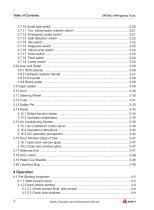
IV Safety, Operation and Maintenance Manual & SANYI
Open the catalog to page 10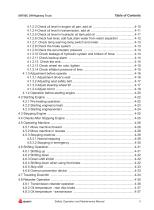
f^SANYi Safety, Operation and Maintenance Manual V
Open the catalog to page 11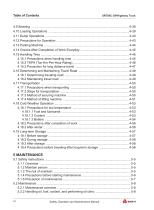
Table of Contents SRT95C Off-Highway Truck VI Safety, Operation and Maintenance Manual & SANYI
Open the catalog to page 12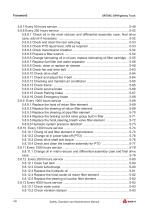
Safety, Operation and Maintenance Manual
Open the catalog to page 14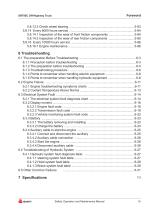
SANYI Safety, Operation and Maintenance Manual IX
Open the catalog to page 15
Safety, Operation and Maintenance Manual
Open the catalog to page 16
f^sANYi Safety, Operation and Maintenance Manual 1-1
Open the catalog to page 17
Safety, Operation and Maintenance Manual
Open the catalog to page 18
1 FOREWORD 1.1 Overview The explanations, values, and illustrations in this manual have been prepared based on the latest information available as of the date of its publication. Continuing improvements in the design of this machine may lead to additional changes that are not reflected in this manual. Consult SANY or your SANY distributor for the latest available information concerning your machine or with questions regarding information contained in this manual. This manual gives details of the operation and methods of inspection and maintenance for this machine that must be obeyed in order...
Open the catalog to page 19
If you sell the machine, be sure to give this manual to the new owner together with the machine, so that all relevant personnel can read it at any time. If this manual is lost or damaged, contact your distributor immediately to arrange for its replacement. To ensure that the correct manual is sent, check the serial number of the machine and inform your SANY distributor. The explanations, values, and illustrations in this manual have been prepared based on the latest information available as of the date of its publication. Continuing improvements in the design of this machine may lead to additional...
Open the catalog to page 20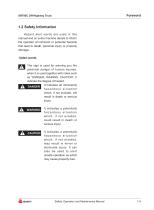
1.2 Safety Information Hazard alert words are used in this manual and on some machine decals to inform the operator of imminent or potential hazards that lead to death, personal injury or property damage. 1)Alert words ● The sign is used for warning you the CAUTION potential danger of human injuries, when it is used together with notes such as “DANGER, WARING, CAUTION”, it indicate the degree of hazard. It indicates an imminently DANGER hazardous situation which, if not avoided, will result in death or serious injury. WARNING It indicates a potentially hazardous situation which, if not avoided,...
Open the catalog to page 21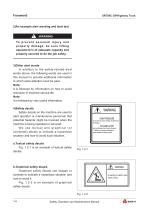
2)An example alert wording and alert text WARNING To p r e v e n t p e r s o n a l i n j u r y a n d property damage, be sure lifting equipment is of adequate capacity and properly secured to do the job safely. 3)Other alert words In addition to the safety-related alert words above, the following words are used in this manual to provide additional information to which extra attention must be paid. Note: It is followed by information on how to avoid reduction of machine service life. Note: It is followed by very useful information. 4)Safety decals Safety decals on the machine are used to alert...
Open the catalog to page 22
1.3 Your Documentation Package The documentation for this machine includes the following items: ● Safety, Operation & Maintenance Manual (SOMM) — This manual is in the operator cab seat pocket. ● Parts Book — This publication consists of parts lists and matching drawings for ordering spare parts as-needed. If it was not already shipped with your machine, the parts book for your machine is available directly from Sany. 1.3.1 Recommendations on using the documentation ● This documentation applies only to this ● ● ● machine and should not be used with any other machines. To ensure that the documentation...
Open the catalog to page 23All SANY catalogs and technical brochures
 SY1250H-120 ton excavator
10 Pages
 SYL956H5
1 Page
 SPR160C-8
2 Pages
 SKT90S
2 Pages
 SAC16000S
43 Pages
 SR265-C10
2 Pages
 SY375H
10 Pages
 SY26U
SY26U7 Pages
 2022 SANY Company profile
43 Pages
 telehandler for sale near me
10 Pages
 breaking_ground SANY magazine
39 Pages
 SANY Group
37 Pages
 HYDRAULIC EXCAVATOR SY215C
10 Pages
 2021 Sany SY215 excavator
10 Pages
 SANY SY365H
10 Pages
 SR235
SR2352 Pages
 SY204C-6Y(V) MIXER TRUCK
2 Pages
 HZS30G BATCHING PLANT
2 Pages
 HBT4010C-5I TRAILER PUMP
2 Pages
 SANY PAVER
11 Pages
 SRC900C
24 Pages
 SANY TRAILER PUMP
14 Pages
 HYDRAULIC EXCAVATOR SY75C
4 Pages
 HZS30V8
8 Pages
 HBT6013C-5
14 Pages
 C8:SYG5360THB 43
13 Pages
 SANY SY16 mini excavator
6 Pages
 SANY SY16 mini excavator
6 Pages
 SANY SY60C 6.1 ton Excavator
4 Pages
 SANY SY55C 5.5 ton Excavator
9 Pages
 SANY SY20C 2 ton Excavator
2 Pages
 SANY STC850 TRUCK CRANE
11 Pages
 STC1000S 100 TONS CRAWLER CRANE
21 Pages
 STC1300C 130T mobile crane
23 Pages
 sany stc1600 160t mobile crane
27 Pages
 SANY STC2200 220TONS TRUCK CRANE
11 Pages
 SCC8300 830 TON CRAWLER CRANE
27 Pages
 sany scc6500e 650t crawler crane
49 Pages
 SANY SCC4000E 400T CRAWLER CRANE
33 Pages
 SANY SCC1800D 180t crawler Crane
27 Pages
 SCC1500D 150 tons crawler crane
21 Pages
 2016 SANY PAVERS
9 Pages
 SLB2000B
9 Pages
 SCM200-3C
4 Pages
 SR200C
29 Pages
 SYT125E2(T6515-8)
2 Pages
 SPC400
9 Pages
 SW405K
4 Pages
 SY480LC-9H
2 Pages
 SY245
SY2454 Pages
 SY35U
SY35U2 Pages
 SY204C-6
11 Pages
 HZS60F
8 Pages
 HG28
HG288 Pages
 LP9018-Left Chassis
8 Pages
 HBT6006A-5
14 Pages
 SYG5418THB 56
13 Pages
 SANY ASPHALT BATCHING PLANT
21 Pages
 SANY MOTOR GRADERS
11 Pages
 SANY ROLLERS
15 Pages
 SANY MORTAR PUMP
2 Pages
 SANY CONCRETE PLACING BOOMS
8 Pages
 SANY CONCRETE BATCHING PLANT
8 Pages
 SANY C6 SERIES LINE PUMP
8 Pages
 SANY C8 truck mixer
11 Pages
 SRT55D
268 Pages
 SRT45
SRT45286 Pages
 Surface Mining Equipment
13 Pages
 ROTARY DRILLING RIG COLLECTION
29 Pages
 SANY SMG SERIES MOTOR GRADER
2 Pages
 SANY SAG SERIES MOTOR GRADER
2 Pages
 SANY STR SERIES ROAD ROLLER
2 Pages
 SANY SSR SERIES ROAD ROLLER
2 Pages
 SANY SPR SERIES ROAD ROLLER
2 Pages
 SANY ROAD PAVER MACHINES
2 Pages
 SYT80(T6013-6) TOWER CRANE
2 Pages
 SANY SRSC45H1 Reach Stacker
20 Pages
 SANY SRSC45H2 Reach Stacker
20 Pages
 SANY SRSC1009-6E Reach Stacker
20 Pages
 SANY SRSC45H8A Reach Stacker
20 Pages
 SANY SRSC45H4 Reach Stacker
20 Pages
 SANY SCC900E Crawler Crane
21 Pages
 SANY SCC1000E Crawler Crane
18 Pages
 SANY SCC1350E Crawler Crane
29 Pages
 SANY SCC1500D Crawler Crane
21 Pages
 SANY SCC1800 Crawler Crane
27 Pages
 SANY SRC350 Rough Terrain Crane
11 Pages
 SANY SRC885 Rough Terrain Crane
24 Pages
 SANY SRC865 Rough Terrain Crane
12 Pages
 SANY SRC840 Rough Terrain Crane
12 Pages
 SANY SY308C-8 Truck Mixer
12 Pages
 SANY P816 Mortar Pump
2 Pages
 SANY P816S Mortar Pump
2 Pages
 SANY HBT12020C-5W Trailer Pump
14 Pages
 SANY SRSC4540H2-70 Reach Stacker
20 Pages
 SANY SRSC45C30A Reach Stacker
20 Pages
 SANY SRSC45C2 Reach Stacker
20 Pages
 SANY SRSC4531 Reach Stacker
3 Pages
 SANY SRSC4533 Reach Stacker
3 Pages
 SANY SCC2600A Crawler Crane
31 Pages
 SANY SCC4000E Crawler Crane
33 Pages
 SANY SCC5000A Crawler Crane
32 Pages
 SANY SCC7500 Crawler Crane
27 Pages
 SANY SCC8100 Crawler Crane
19 Pages
 STC450 45TON TRUCK CRANE
9 Pages
 STC250 25ton truck cranes
9 Pages
 SANY SRC750 ROUGH-TERRAIN CRANE
11 Pages
 SANY SRC550H ROUGH-TERRAIN CRANE
11 Pages
 SRC400 ROUGH-TERRAIN CRANE
20 Pages
 SANY SRSC4535 Reach Stacker
3 Pages
 SANY SRSC4539 Reach Stacker
8 Pages
 SANY SRSC4545 Reach Stacker
11 Pages
 SANY SRSC4545C2 Reach Stacker
16 Pages
 SANY SRSC45C2-P Reach Stacker
16 Pages
 SANY SCC8100-2 Crawler Crane
19 Pages
 SANY SCC8150 Crawler Crane
21 Pages
 SANY SCC8200 Crawler Crane
31 Pages
 SANY SCC8300 Crawler Crane
27 Pages
 SANY SCC10000 Crawler Crane
31 Pages
 SANY SY220C Medium Excavator
2 Pages
 SANY WATE TOWER FIRE TRUCK
14 Pages
 SANY SAC6000 600TON TRUCK CRANE
25 Pages
 SANY SBP30 Batching Plant
2 Pages
 SANY HGY18 Placing Boom
9 Pages
 SANY HBT6016C-5 Trailer Pump
14 Pages
 SANY HBT5008C-5S Trailer Pump
14 Pages
 SANY HBT6016C-5D Trailer Pump
14 Pages
 SANY HBT8018C-5D Trailer Pump
14 Pages
 SANY SCC16000 Crawler Crane
23 Pages
 SANY SCC6500E Crawler Crane
49 Pages
 SANY SCC750E Crawler Crane
28 Pages
 SANY SCC1500E Crawler Crane
56 Pages
 SANY SCC3200 Crawler Crane
52 Pages
 SANY SCC8068 Crawler Crane
20 Pages
 SANY SY155 Weel Excavator
4 Pages
 SANY SY60 Small Excavator
4 Pages
 SANY SY50 Small Excavator
4 Pages
 SANY SY35 3.5 tons excavator
4 Pages
 SDCY80K/100K
3 Pages
 SCP32 0C1
6 Pages
 SRSC45C2.
20 Pages
 SRSC4539 & SRSC4539 -p
8 Pages
 STC1300C
23 Pages
 Concrete+Batching+Plants
6 Pages
 Concrete+Placing+Booms
15 Pages
 TrailerMounted+Concrete+Pumps
13 Pages
 Concrete+Pump+Trucks
16 Pages
 2.0 MW60HZ: SE8720IIIE 60Hz
2 Pages
 Sany empty container handler
12 Pages
 QUAYSIDE CONTAINER CRANE
2 Pages
 PORT TYRE CRANE
2 Pages
 SANY TRUCK CRANE STC 750
12 Pages
 SANY TRUCK CRANE STC 500
10 Pages
 SANY TRUCK CRANE STC 250 H
8 Pages
 SANY TRUCK CRANE STC 250
8 Pages
 SY75C III
8 Pages
 Line pump
11 Pages
 SYG5361THB 48
2 Pages
 SYG5310THB 46
2 Pages
 SYG5310THB 43
2 Pages
 SYG5310THB 40
2 Pages
 SYG5260THB 37
2 Pages
 SY5230THB 28
2 Pages
 HBT60C1413D
1 Page
 HBT90CH2150D
1 Page
 HBT90CH2128D
1 Page
 HBT90CH2122D
1 Page
 HBT60A1406
1 Page
 SYG5502THB+62
1 Page
 SYG5502THB+60
1 Page
 SYG5502THB+58
1 Page
 SYG5418THB+56
1 Page
 SYG5418THB+52
1 Page
 SYG5418THB+50
1 Page
 SYG5361THB+48
1 Page
 SYG5310THB+46
1 Page
 SYG5310THB+43
1 Page
 SYG5320THB+42
1 Page
 SYG5310THB+40
1 Page
 SYG5260THB+37
1 Page
 SY9300TSJ500
2 Pages
 EMPTY CONTAINER HANDLER
1 Page
 Drum Vibratory Roller
2 Pages
 SANY SF558/808/818
10 Pages
 SQ170 Down-The-Hole Drill
6 Pages
 Concrete Truck Mixer
2 Pages
 Line Pump
2 Pages
 Placing Boom
2 Pages
 Concrete Batching Plant
2 Pages
 Asphalt Paver
2 Pages


Archived catalogs
 SANY PAVERS
11 Pages
 PQ160III Motor Grader
2 Pages

- Rail conveyor
- Transport rail conveyor
- SANY crane
- Forklift truck
- SANY mobile crane
- Drilling rig
- SANY excavator
- Walk-behind forklift
- SANY diesel excavator
- SANY lifting crane
- Rotary drilling rig
- SANY crawler excavator
- Materials handling forklift
- SANY construction excavator
- Mobile drilling rig
- SANY construction crane
- Chain conveyor
- SANY boom crane
- Hydraulic crane
- Crawler drilling rig