
- Catalogs
- SANKYO OILLESS INDUSTRY,INC.
- Spring Plunger

Spring Plunger

Spring Plunger
Die Setting Components Overview
This document provides detailed specifications and technical data for various types of spring plungers and spring plugs used in die setting applications. It includes load capacities, dimensions, materials, hardness, surface treatments, and ordering information.
1. Spring Plungers (SPSL and SPSH Types)
Two main types of spring plungers are described: SPSL (Light Load Type) and SPSH (Heavy Load Type). Both types are available in different sizes and thread specifications (M3 to M16) with corresponding pitch values.
- Load Capacities: Load values are given in Newtons (N) and kilogram-force (kgf) for initial and final conditions. For example, SPSL plungers have initial loads ranging from 1.9 N (0.2 kgf) to 29.4 N (3.0 kgf), while SPSH plungers range higher, up to 58.8 N (6.0 kgf).
- Dimensions: Parameters such as travel (S), diameter (D), length (L), and thread size (M × P) are specified. Sizes vary from small (M3 × 0.5 pitch) to larger sizes (M16 × 2.0 pitch).
- Materials and Hardness: Nose material is SK4, thread material is SCM435, with hardness between 36 to 40 HRC.
- Surface Treatment: Options include black chromating and galvanizing for corrosion resistance.
- Additional Features: Loosening lock mechanisms are mentioned for secure installation.
2. Spring Plugs (NH Type)
Spring plugs are made from SAE1065 material and are used in conjunction with spring plungers. They feature a 15° chamfer and precise diameter tolerances (+0.6 mm, +0.3 mm).
- Removal Tool: A dowel pin removing tool is available for easy removal of plungers without the need for drilling plugs to access taps.
3. Ordering and Accessories
- Catalog numbers are provided for each size and type, facilitating ordering.
- Plunger wrenches are referenced on page 46 for installation and removal assistance.
4. Summary of Key Parameters
| Type | Thread Size (M × P) | Travel (S) mm | Load Initial (N/kgf) | Load Final (N/kgf) |
|---|---|---|---|---|
| SPSL (Light Load) | M3 × 0.5 to M16 × 2.0 | 1.5 to 5.0 | 1.9 (0.2) to 29.4 (3.0) | 9.8 (1.0) to 58.8 (6.0) |
| SPSH (Heavy Load) | M5 × 0.8 to M16 × 2.0 | 2.5 to 8.0 | 4.9 (0.5) to 29.4 (3.0) | 9.8 (1.0) to 58.8 (6.0) |
5. Best Practices and Recommendations
- Use the appropriate plunger type (light or heavy load) based on application load requirements.
- Ensure correct thread size and pitch matching for installation.
- Apply recommended surface treatments to enhance durability and corrosion resistance.
- Utilize the dowel pin removing tool for efficient maintenance without damaging components.
This structured data supports selection, ordering, and maintenance of die setting components, ensuring reliable performance in tooling applications.
Catalog excerpts
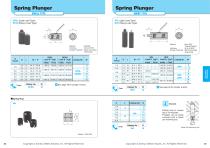
Spring Plunger Spring Plunger SMALL TYPE SHORT TYPE : Nose SK4 Thread SCM435 Hardness : 36 to 40 HRC Surface Treatment : Black chromating Galvanizing SPSL SPSH See page 46 for plunger wrench. Material : SCM435 Hardness : 36 to 40 HRC Surface Treatment : Black chromating Galvanizing SPL (Light Load Type) SPH (Heavy Load Type) SPSL (Light Load Type) SPSH (Heavy Load Type) See page 46 for plunger wrench. •Drilling plug to access tap is not required. •Plungers can be easily removed with a dowel pin removing tool. Dowel Pin Removing Tool
Open the catalog to page 1All SANKYO OILLESS INDUSTRY,INC. catalogs and technical brochures
 PSCL,PSCM
1 Page
 SHPUC
SHPUC3 Pages
 SACE
SACE14 Pages
 TSHC
TSHC2 Pages
 SACLB80
2 Pages
 SUCD
SUCD18 Pages
 SHCP
SHCP1 Page
 SNR41,42,43 Series
1 Page
 SFCU,SFCUB
1 Page
 CBSL,CBSPL
1 Page
 MCUW,MCUF,MCUS
1 Page
 TWP
TWP1 Page
 Parallel Link Unit
1 Page
 Single Link Unit
1 Page
 Spherical Bush Set
1 Page
 Cam Slide Guide (L Type)
1 Page
 Cam Stroke Plate
1 Page
 Roller Cam Unit
2 Pages
 Roller Cam Unit
2 Pages
 Side Gauge
1 Page
 DA Gauge
1 Page
 Spring Plunger
1 Page
 Feed Sensor
1 Page
 Locating Cone
1 Page
 Shoulder Bolt
1 Page
 Slide Plate Blank Type
1 Page
 Guide Bushing
2 Pages
 Ejector Guide Bushing
1 Page
 Ejector Guide Pin
2 Pages
 Automatic Blanking Die
4 Pages
 Die Materials
2 Pages
 Aerial Cam Unit For Pierce
18 Pages
 Slide Plate VSM SP2,ST
1 Page
 Lifting Hook(Eye Bolt)
1 Page
 Shim Plate
1 Page
 Ball Guide Bushing
1 Page




Archived catalogs
 General Description of Cam Unit
20 Pages
 LARGE TYPE FOR PIERCE AND FLANGE
15 Pages
 Ball Plunger
1 Page


- Measuring device
- Lifting system
- Metal chain
- Industrial measuring module
- Plain bearing
- Mechanical buffer
- Anti-vibration damper
- Metal plain bearing
- Plastic buffer
- Metal bushing
- Cutting tool
- Guide rail
- Self-lubricating plain bearing
- Plastic plain bearing
- Compact buffer
- Rubber absorber
- Steel rail
- Steel plain bearing
- Slide rail