
- Catalogs
- SANKYO OILLESS INDUSTRY,INC.
- Lifting Hooks Lug / Regular Type

Lifting Hooks Lug / Regular Type

1 / 1 PageView full catalog
Lifting Hooks Lug / Regular Type
Product catalog summary
Die Setting Components Overview
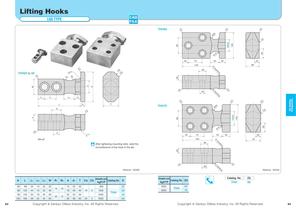
This document section details specifications and dimensions for die setting components, specifically the THH series (THH25 to THH70) made from SS400 material. It includes catalog numbers, dimensional parameters, and allowable load capacities for various component sizes.
This document section details specifications and dimensions for die setting components, specifically the THH series (THH25 to THH70) made from SS400 material. It includes catalog numbers, dimensional parameters, and allowable load capacities for various component sizes.
Material and Component Types
- Material: SS400 steel.
- Components covered: Die setting components and lug-type lifting hooks.
- Lifting hooks require welding around the circumference after tightening mounting bolts to ensure secure attachment.
- Material: SS400 steel.
- Components covered: Die setting components and lug-type lifting hooks.
- Lifting hooks require welding around the circumference after tightening mounting bolts to ensure secure attachment.
Dimensional Specifications
The document provides detailed dimensional parameters for components THH60 and THH70, including:
- Diameter (D): 60 mm for THH60, 70 mm for THH70.
- Various length parameters (L, L1, L2, L3) and radii (R1, R2) are specified.
- Chamfering radius (R) is indicated for edges.
- Hole diameters (φd, φd1) and widths (W, Ca, Cb) are detailed.
- Thickness (T) and other critical dimensions are tabulated.
These dimensions ensure proper fit and function within die setting assemblies.
The document provides detailed dimensional parameters for components THH60 and THH70, including:
- Diameter (D): 60 mm for THH60, 70 mm for THH70.
- Various length parameters (L, L1, L2, L3) and radii (R1, R2) are specified.
- Chamfering radius (R) is indicated for edges.
- Hole diameters (φd, φd1) and widths (W, Ca, Cb) are detailed.
- Thickness (T) and other critical dimensions are tabulated.
These dimensions ensure proper fit and function within die setting assemblies.
Allowable Load Capacities
- Load capacities are specified in kgf per single piece (kgf/1P).
- For smaller sizes (THH25 to THH50), allowable loads range from 800 kgf to 3500 kgf.
- Larger components (THH60 and THH70) support higher loads of 6000 kgf and 8000 kgf respectively.
- These values guide safe operational limits to prevent mechanical failure.
- Load capacities are specified in kgf per single piece (kgf/1P).
- For smaller sizes (THH25 to THH50), allowable loads range from 800 kgf to 3500 kgf.
- Larger components (THH60 and THH70) support higher loads of 6000 kgf and 8000 kgf respectively.
- These values guide safe operational limits to prevent mechanical failure.
Recommendations and Notes
- After mounting bolts are tightened on lifting hooks, welding around the hook circumference is mandatory to secure the component.
- Chamfering is applied to edges to reduce stress concentrations and facilitate assembly.
- The parameter h equals d, indicating a design relationship between height and diameter.
- After mounting bolts are tightened on lifting hooks, welding around the hook circumference is mandatory to secure the component.
- Chamfering is applied to edges to reduce stress concentrations and facilitate assembly.
- The parameter h equals d, indicating a design relationship between height and diameter.
Summary Table Highlights
- The table lists catalog numbers alongside dimensions and allowable loads.
- Dimensions such as A, L1, L2, L3, W, R1, R2, d, d1, T, Ca, and Cb are critical for component selection.
- Load ratings increase with component size, reflecting structural capacity.
- The data supports engineers in selecting appropriate die setting components based on mechanical requirements.
- The table lists catalog numbers alongside dimensions and allowable loads.
- Dimensions such as A, L1, L2, L3, W, R1, R2, d, d1, T, Ca, and Cb are critical for component selection.
- Load ratings increase with component size, reflecting structural capacity.
- The data supports engineers in selecting appropriate die setting components based on mechanical requirements.
See more
Catalog excerpts
Lifting Hooks ^ After tightening mounting bolts, weld the Copyright © Sankyo Oilless Industry, Inc. All Rights Reserved. Copyright © Sankyo Oilless Industry, Inc. All Rights Reserved.
Open the catalog to page 1All SANKYO OILLESS INDUSTRY,INC. catalogs and technical brochures
 PSCL,PSCM
1 Page
 SHPUC
SHPUC3 Pages
 SACE
SACE14 Pages
 TSHC
TSHC2 Pages
 SACLB80
2 Pages
 SUCD
SUCD18 Pages
 SHCP
SHCP1 Page
 SNR41,42,43 Series
1 Page
 SFCU,SFCUB
1 Page
 CBSL,CBSPL
1 Page
 MCUW,MCUF,MCUS
1 Page
 TWP
TWP1 Page
 Parallel Link Unit
1 Page
 Single Link Unit
1 Page
 Spherical Bush Set
1 Page
 Cam Slide Guide (L Type)
1 Page
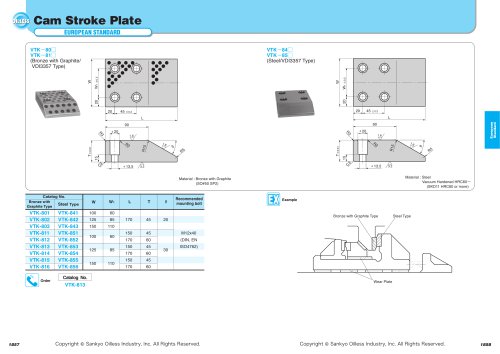 Cam Stroke Plate
1 Page
 Roller Cam Unit
2 Pages
 Roller Cam Unit
2 Pages
 Side Gauge
1 Page
 DA Gauge
1 Page
 Spring Plunger
1 Page
 Spring Plunger
1 Page
 Feed Sensor
1 Page
 Locating Cone
1 Page
 Shoulder Bolt
1 Page
 Slide Plate Blank Type
1 Page
 Guide Bushing
2 Pages
 Ejector Guide Bushing
1 Page
 Ejector Guide Pin
2 Pages
 Automatic Blanking Die
4 Pages
 Die Materials
2 Pages
 Aerial Cam Unit For Pierce
18 Pages
 Slide Plate VSM SP2,ST
1 Page
 Lifting Hook(Eye Bolt)
1 Page
 Shim Plate
1 Page
 Ball Guide Bushing
1 Page




Archived catalogs
 General Description of Cam Unit
20 Pages
 LARGE TYPE FOR PIERCE AND FLANGE
15 Pages
 Ball Plunger
1 Page


Related Searches
- Measuring device
- Lifting system
- Metal chain
- Industrial measuring module
- Plain bearing
- Mechanical buffer
- Anti-vibration damper
- Metal plain bearing
- Plastic buffer
- Metal bushing
- Cutting tool
- Guide rail
- Self-lubricating plain bearing
- Plastic plain bearing
- Compact buffer
- Rubber absorber
- Steel rail
- Spring plunger
- Steel plain bearing
- Slide rail
*Prices are pre-tax. They exclude delivery charges and customs duties and do not include additional charges for installation or activation options. Prices are indicative only and may vary by country, with changes to the cost of raw materials and exchange rates.
About DirectIndustry
DirectIndustry is a marketplace that offers B2B players a complete experience, from product sourcing to purchase. DirectIndustry is an entity of VirtualExpo Group.
Are you a buyer?
Are you a supplier?