
- Catalogs
- SANKYO OILLESS INDUSTRY,INC.
- Ejector Guide Bushing for High Temperature

Ejector Guide Bushing for High Temperature

Ejector Guide Bushing for High Temperature
Ejector Related Parts for High Temperature Applications
1. Ejector Guide Bushing for Direct Ejector Pin
This section details specifications for ejector guide bushings designed for high-temperature environments. The bushings are made from copper powder sintering (SO#200H) to withstand elevated temperatures.
- Dimensions and Tolerances: Diameter (d) with F6 tolerance, outer diameter (D) with h6 tolerance, and length (L) with ±0.2 mm tolerance.
- Size Range: Pin diameters from 10 mm to 30 mm, with corresponding outer diameters and lengths specified.
- Sliding Direction: Indicated for proper installation and operation.
2. Adjusting Rod Set (AHS)
The adjusting rod set consists of two components: the adjusting rod and the lock nut.
- Material: Copper powder sintering for bushings; S45C steel (refined to HRC 23-28) with black oxide surface treatment for rods and nuts.
- Dimensions: Various metric thread sizes (M14×1.5 to M36×1.5) with detailed measurements for diameter, length, and thread pitch.
- Adjusting Allowance: ±3 mm to accommodate precise fitting.
3. Direct Ejector Pin
Specifications for direct ejector pins include:
- Material: S45C steel with black oxide surface treatment for corrosion resistance.
- Dimensions: Pin diameters from 16 mm to 40 mm, with corresponding hexagonal socket head bolt sizes for fixing.
- Installation: Pins are fixed using hexagonal socket head bolts with specified thread sizes and lengths.
- Operating Temperature: Suitable for ambient temperatures ranging from 0 to 400°C.
- Installation Criteria: Tapped hole depth (Ha) and adjusting criteria (Hb) with ±3 mm center tolerance for ejector plate installation.
4. Installation and Operational Notes
- Ensure correct sliding direction for bushings to maintain performance.
- Adjusting rods and lock nuts allow fine-tuning of ejector pin positioning within ±3 mm tolerance.
- Materials and surface treatments are selected to ensure durability and performance under high-temperature conditions.
- Hexagonal socket head bolts are specified for secure fixing of ejector pins to ejector plates.
Summary of Critical Parameters
| Component | Material | Size Range (mm) | Tolerances | Surface Treatment | Operating Temp. |
|---|---|---|---|---|---|
| Ejector Guide Bushing | Copper powder sintering (SO#200H) | Pin diameter: 10-30 | d: F6, D: h6, L: ±0.2 mm | Not specified | High temperature (up to 400°C) |
| Adjusting Rod Set | S45C steel (HRC 23-28) | Thread sizes M14×1.5 to M36×1.5 | ±3 mm adjusting allowance | Black oxide | High temperature |
| Direct Ejector Pin | S45C steel | Pin diameter: 16-40 | Specified bolt sizes for fixing | Black oxide | 0 to 400°C |
Catalog excerpts
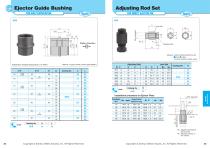
Ejector Guide Bushing Sliding Direction D(Pin diameter) Material : S45C( Refining HRC23 to 28) ( I C45 A 1045) Surface treatment: Black oxide Installation procedure on Ejector Plate Hexagonal Socket Direct Ejector Ma depth Head Bolt for Fixing Pin D h Lock Nut D(Pin diameter ) Ejector Related Parts D(Pin diameter) Material : Copper powder sintening(SO#200H) Operation ambient temperature: 0 to 400˚C Ha : Tapped hole depth of ejector plate Hb : Adjusting criteria ( 3 mm center)
Open the catalog to page 1All SANKYO OILLESS INDUSTRY,INC. catalogs and technical brochures
 PSCL,PSCM
1 Page
 SHPUC
SHPUC3 Pages
 SACE
SACE14 Pages
 TSHC
TSHC2 Pages
 SACLB80
2 Pages
 SUCD
SUCD18 Pages
 SHCP
SHCP1 Page
 SNR41,42,43 Series
1 Page
 SFCU,SFCUB
1 Page
 CBSL,CBSPL
1 Page
 MCUW,MCUF,MCUS
1 Page
 TWP
TWP1 Page
 Parallel Link Unit
1 Page
 Single Link Unit
1 Page
 Spherical Bush Set
1 Page
 Cam Slide Guide (L Type)
1 Page
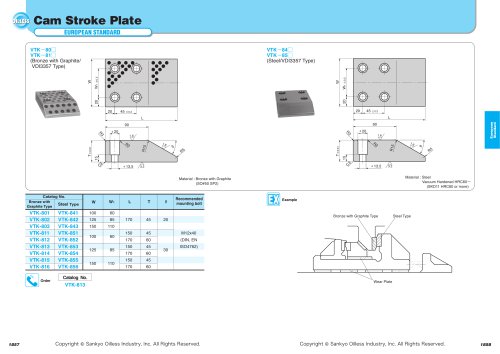 Cam Stroke Plate
1 Page
 Roller Cam Unit
2 Pages
 Roller Cam Unit
2 Pages
 Side Gauge
1 Page
 DA Gauge
1 Page
 Spring Plunger
1 Page
 Spring Plunger
1 Page
 Feed Sensor
1 Page
 Locating Cone
1 Page
 Shoulder Bolt
1 Page
 Slide Plate Blank Type
1 Page
 Guide Bushing
2 Pages
 Ejector Guide Bushing
1 Page
 Ejector Guide Pin
2 Pages
 Automatic Blanking Die
4 Pages
 Die Materials
2 Pages
 Aerial Cam Unit For Pierce
18 Pages
 Slide Plate VSM SP2,ST
1 Page
 Lifting Hook(Eye Bolt)
1 Page
 Shim Plate
1 Page
 Ball Guide Bushing
1 Page




Archived catalogs
 General Description of Cam Unit
20 Pages
 LARGE TYPE FOR PIERCE AND FLANGE
15 Pages
 Ball Plunger
1 Page


- Measuring device
- Lifting system
- Metal chain
- Industrial measuring module
- Plain bearing
- Mechanical buffer
- Anti-vibration damper
- Metal plain bearing
- Plastic buffer
- Metal bushing
- Cutting tool
- Guide rail
- Self-lubricating plain bearing
- Plastic plain bearing
- Compact buffer
- Rubber absorber
- Steel rail
- Spring plunger
- Steel plain bearing
- Slide rail