


- Company
- Products
- Catalogs
- News & Trends
- Exhibitions
Type 33-1 Safety Shut-off Valve (SSV) · Type 33-7 Safety Excess Pressure Valve (SEV)

Type 33-1 Safety Shut-off Valve (SSV) · Type 33-7 Safety Excess Pressure Valve (SEV)
Catalog excerpts

T 2551 EN Type 33-1 Safety Shut-off Valve (SSV) · Type 33-7 Safety Excess Pressure Valve (SEV) Self-operated Pressure Regulators Typetested by TÜV (for water) Application Pressure regulators for set points from 1 to 10.5 bar (SSV) and 1 to 11 bar (SEV) · Valve sizes DN 65 to 250 Pressure rating PN 16 to 40 · Suitable for water and other liquids up to 150 °C, air and non-flammable gases up to 80 °C The pressure regulators consist of a valve, actuator, and attached pilot valve. The differential pressure across the regulator is used as auxiliary energy to operate the valve. To open the regulator, this pressure must be at least as high as the minimum differential pressure ∆pmin specified in Table 1. The pilot valve determines the function of the regulator depending on how it is hooked up. Its output control pressure and the pressure to be kept constant are transmitted through control lines to the diaphragm of the actuator. Special features •• Low-maintenance proportional regulators requiring no auxiliary energy •• High dynamic response and small offset, i.e. excellent control accuracy due to the attached pilot valve •• Wide set point range and convenient set point adjustment at the pilot valve Fig. 1: Type 33-1 Pressure Reducing Valve •• Single-seated valve with upstream and downstream pressures balanced by a metal bellows •• The regulators comply with AGFW (German District Heating Association) regulations. AGFW document FW 504 (Type 33-1) and AGFW document FW 506 (Type 33-7) up to DN 150 Versions The pressure regulators consist of a valve with soft-seated plug and a valve body made of cast iron, spheroidal graphite iron (DN 65 to 150) or cast steel as well as an actuator with EPDM rolling diaphragm with an actuator area of A = 640 cm². Type 33-1 · Safety shut-off valve (SSV) (Fig. 1) with pressure reducing valve for controlling the downstream pressure p2 to the adjusted set point · Typetested according to AGFW document FW 504 Type 33-7 · Safety excess pressure valve (SEV) (Fig. 2) for controlling the upstream pressure p1 to the adjusted set point Typetested according to AGFW document FW 506 Fig. 2: Type 33-7 Excess Pressure Valve SAMSON AKTIENGESELLSCHAFT · Weismüllerstraße 3 · 60314 Frankfurt am Main, Germany Phone: +49 69 4009-0 · Fax: +49 69 4009-150
Open the catalog to page 1
Principle of operation The medium flows through the valve in the direction indicated by the arrow. The position of the plug determines the flow rate across the area released between plug (3) and valve seat (2). The valve is fully balanced. The pressure upstream of the plug (3) is transferred through a hole in the plug stem and acts on the outside of the bellows (5), whereas the pressure downstream of the plug acts on the inside of the bellows. As a result, the forces acting on the valve plug are balanced out. Regardless of whether a pressure reducing valve (Type 33-1) or excess pressure valve...
Open the catalog to page 2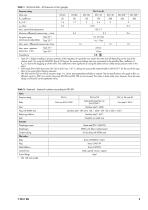
Table 1: Technical data • All pressures in bar (gauge)
Open the catalog to page 3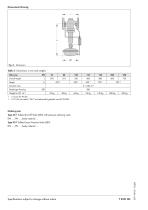
Dimensional drawing Table 3: Dimensions in mm and weights 2) +10 % for cast steel 1.0619 and spheroidal graphite iron EN-JS1049 Ordering text Type 33-1 Safety Shut-off Valve (SSV) with pressure reducing valve DN ..PN ..body material ... Type 33-7 Safety Excess Pressure Valve (SEV) DN ., PN ., body material . Specifications subject to change without notice
Open the catalog to page 4All SAMSON catalogs and technical brochures
 TROVIS 5590 Web Module
2 Pages
 Room Controller TROVIS 5572
2 Pages
 Room Panel TROVIS 5570
2 Pages
 Line Splitter TROVIS 5486
2 Pages
 Type 9 Temperature Regulator
6 Pages
 Type 8 Temperature Regulator
6 Pages
 Type 5 D Boiler Controller
2 Pages
 Rotary Plug Valve Type 62.7
7 Pages
 Actuator Type S
3 Pages
 Actuator Type MZ
4 Pages
 Actuator Type MN
3 Pages
 Actuator Type MD
3 Pages
 Actuator Type R
3 Pages
 Actuator Type AT
4 Pages
 Rotary Plug Valve Type 82.7
7 Pages
 Rotary Plug Valve Type 73.7
7 Pages
 Rotary Plug Valve Type 73.3
7 Pages
 Rotary Plug Valve Type 72.4
7 Pages
 Rotary Plug Valve Type 72.3
8 Pages
 SAMSON Positioners
28 Pages













Archived catalogs
 T21 11
6 Pages




- SAMSON stainless steel valve
- Water valve
- Ball valve
- SAMSON pneumatic valve
- Threaded valve
- Electrically operated valve
- SAMSON regulating valve
- SAMSON flange valve
- Electric valve
- Gas solenoid valve
- Process software
- Directional control valve
- Gas valve
- Direct-operated solenoid valve
- Pneumatically-operated valve
- Terminal box
- Single-stage pressure regulator