


- Company
- Products
- Catalogs
- News & Trends
- Exhibitions
Type 2333 Pressure Reducing Valve with pilot valve Type 2335 Excess Pressure Valve with pilot valve

Type 2333 Pressure Reducing Valve with pilot valve Type 2335 Excess Pressure Valve with pilot valve
Catalog excerpts
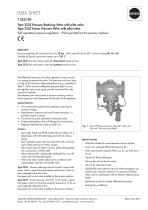
T 2552 EN Type 2333 Pressure Reducing Valve with pilot valve Type 2335 Excess Pressure Valve with pilot valve Self-operated pressure regulators · Pilot operated by the process medium Application Pressure regulators for set points from 2 to 28 bar · Valve sizes DN 65 to 400 · Pressure rating PN 16 to 40 Suitable for liquids, gases and vapors up to 350 °C Type 2333: the valve closes when the downstream pressure rises Type 2335: the valve opens when the upstream pressure rises The differential pressure across the regulator is used as auxiliary energy to operate the valve. This pressure must be at least as high as the minimum differential pressure Δpmin specified in Table 1. If this minimum differential pressure does not exist, the regulator opens only partly and the maximum flow rate cannot be reached. The attached pilot valve (either a pressure reducing valve or excess pressure valve) determines the function of the regulator. Special features •• Low-maintenance proportional regulators requiring no auxiliary energy •• High dynamic response and small system deviation, i.e. excellent control accuracy •• Convenient set point adjustment at the pilot valve •• Single-seated globe valve with flanged end connections •• Regulator delivered as ready-to-install unit Versions –– Type 2422 Valve (modified), balanced by a bellows or a diaphragm, with soft-seated plug and internal closing spring –– Each regulator comes with one pilot valve with a strainer and a fixed restrictor or Venturi nozzle –– Valve body made of either cast iron, spheroidal graphite iron, cast steel or CrNiMo steel –– Valves balanced by a diaphragm preferable for use with water and non-flammable gases –– Version for steam (valves balanced by a bellows) with compensation chamber and needle valve Type 2333 · Pressure reducing valve for liquids, vapors and gases. Used to control the downstream pressure p2 to the set point adjusted at the pilot valve. Equipped with a pilot valve suitable for the process medium. Type 2335 · Excess pressure valve (Fig. 1) for liquids, vapors and gases. Used to control the upstream pressure p1 to the set point adjusted at the pilot valve. Equipped with a pilot valve suitable for the process medium Fig. 1: Type 2335 Excess Pressure Valve (DN 150) with a Type 44-7 Pilot Valve (modified) Special versions –– With flow divider for noise reduction (not for liquids) –– Lower min. required differential pressure Δp –– With internal parts made of FKM, e.g. for use with mineral oils –– Version for flammable gases –– Version free of non-ferrous metal –– Version for deionized water –– Additionally with solenoid valve for either emergency operation over a remote control unit or pressure limitation when used in combination with an electric safety pressure limiter –– Reinforced version for higher differential pressures –– Reduced KVS coefficient SAMSON AKTIENGESELLSCHAFT · Weismüllerstraße 3 · 60314 Frankfurt am Main, Ger
Open the catalog to page 1
Principle of operation (see Fig. 2) The medium flows through the globe valve in the direction indicated by the arrow. The position of the plug determines the flow rate across the area released between plug (3) and valve seat (2). The travel position of the pilot valve (5) determines the pressure conditions across the valve. The various forces (the upstream pressure p1 acting on the plug surface, the control pressure pS acting on the bellows surface and the force of the set point spring) are compared. In the Type 2333 Pressure Reducing Valve, a rise in downstream pressure p2 causes the pilot valve...
Open the catalog to page 2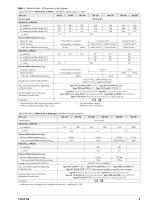
Table 1: Technical data · All pressures in bar (gauge) Type 2422 Valve · Balanced by a bellows · Suitable for liquids, gases or vapors Valve size Pressure rating Standard KVS coefficients KVS coefficient KVS coefficient (with flow divider ST 1) KVS coefficient (with flow divider ST 3) Minimum differential pressure Δpmin Version for water Max. perm. differential pressure ∆pmax Reduced KVS coefficient KVS coefficient KVS coefficient (with flow divider ST 1) KVS coefficient (with flow divider ST 3) xFZ value Minimum differential pressure Δpmin Version for water/air Max. perm. differential pressure...
Open the catalog to page 3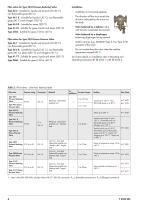
Pilot valves for Type 2333 Pressure Reducing Valve Type 44-2 • Suitable for liquids and mineral oil (150 °C), non-flammable gases (80 °C) Type 44-1 B • Suitable for liquids (150 °C), non-flammable gases (80 °C) and nitrogen (150 °C) Type 44-0 B • Suitable for steam (200 °C) Type 41-23 • Suitable for gases, liquids and steam (350 °C) Type 2405 • Suitable for gases (-20 to +60 °C) Pilot valves for Type 2335 Excess Pressure Valve Type 44-7 • Suitable for liquids and mineral oil (150 °C), non-flammable gases (80 °C) Type 44-6 B • Suitable for liquids (150 °C), non-flammable gases (80 °C), steam (200...
Open the catalog to page 4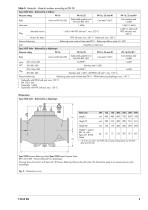
Table 3: Materials • Material numbers according to DIN EN 1 Optionally with EPDM soft seal, max. 150 °C. 2) DN 125 to 250 3) Optionally 1.4409 4) Optionally with PTFE soft seal, max. 150 °C. Type 2422 Valve ■ Balanced by a diaphragm 1) +10 % for cast steel 1.0619 (PN 25) and spheroidal graphite iron EN-GJS-400-18-LT (PN 25) Type 2333 Pressure Reducing Valve/Type 2335 Excess Pressure Valve DN 125 to 400 ■ Version balanced by a d iaphragm Drawing shows the version with Type 44-1 B Pressure Reducing Valve as the pilot valve. The dimensions apply to an excess pressure valve accordingly.
Open the catalog to page 5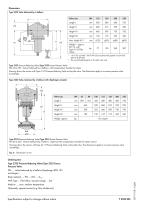
1) +10 % for cast steel 1.0619 (PN 25) and spheroidal graphite iron EN-GJS-400-18-LT (PN 25) 2) The overall height depends on the pilot valve used Type 2333 Pressure Reducing Valve/Type 2335 Excess Pressure Valve DN 65 to 250 ■ Version balanced by a bellows, with compensation chamber for steam Drawing shows the version with Type 41-23 Pressure Reducing Valve as the pilot valve. The dimensions apply to an excess pressure valve accordingly. Type 2333 Pressure Reducing Valve/Type 2335 Excess Pressure Valve DN 65 to 250 ■ Version balanced by a bellows ■ Optional with compensation chamber for steam...
Open the catalog to page 6All SAMSON catalogs and technical brochures
 TROVIS 5590 Web Module
2 Pages
 Room Controller TROVIS 5572
2 Pages
 Room Panel TROVIS 5570
2 Pages
 Line Splitter TROVIS 5486
2 Pages
 Type 9 Temperature Regulator
6 Pages
 Type 8 Temperature Regulator
6 Pages
 Type 5 D Boiler Controller
2 Pages
 Rotary Plug Valve Type 62.7
7 Pages
 Actuator Type S
3 Pages
 Actuator Type MZ
4 Pages
 Actuator Type MN
3 Pages
 Actuator Type MD
3 Pages
 Actuator Type R
3 Pages
 Actuator Type AT
4 Pages
 Rotary Plug Valve Type 82.7
7 Pages
 Rotary Plug Valve Type 73.7
7 Pages
 Rotary Plug Valve Type 73.3
7 Pages
 Rotary Plug Valve Type 72.4
7 Pages
 Rotary Plug Valve Type 72.3
8 Pages
 SAMSON Positioners
28 Pages













Archived catalogs
 T21 11
6 Pages




- SAMSON stainless steel valve
- Water valve
- Ball valve
- SAMSON pneumatic valve
- Threaded valve
- SAMSON regulating valve
- SAMSON flange valve
- On/off valve
- Electric valve
- Gas solenoid valve
- Process software
- Directional control valve
- Gas valve
- Direct-operated solenoid valve
- Pneumatically-operated valve
- Terminal box
- Single-stage pressure regulator