


- Company
- Products
- Catalogs
- News & Trends
- Exhibitions
Steam Pressure Reducing Valve Type 39-2

Steam Pressure Reducing Valve Type 39-2
The Type 39-2 Steam Pressure Reducing Valve is designed to regulate steam pressure downstream to a set point ranging from 0.02 bar to 16 bar. It is suitable for steam temperatures up to 350 °C and is available in nominal sizes DN 15 to DN 50 with nominal pressures PN 16 and PN 25.
Special Features
- Low-maintenance, self-operated P-regulators requiring no auxiliary energy.
- Interchangeable actuator and springs.
- Single-seated valve with a balanced valve plug and frictionless plug stem sealing using a stainless steel bellows.
- All wetted parts are free of non-ferrous metals.
Versions and Accessories
- Valve body options include cast iron, spheroidal graphite iron, or cast steel.
- Special low-noise operation version available with St I flow divider.
- Accessories include screw fittings for control line connection and condensation chambers.
Principle of Operation
The valve controls the flow rate by adjusting the position of the valve plug, which is influenced by the downstream pressure transmitted to the operating diaphragm. The valve plug position is adjusted based on the spring force, which can be modified using the set point adjustment.
Installation Guidelines
- Install in horizontal pipelines with a slight downward slope for condensate drainage.
- Ensure the flow direction matches the arrow on the valve body.
- Actuator should be suspended downwards.
- Pressure tapping should be approximately one meter downstream of the valve.
Technical Specifications
- Temperature range and permissible pressures are defined by the pressure-temperature diagram.
- Maximum permissible differential pressure is 25 bar.
- Set point ranges vary from 0.02 to 16 bar.
- Leakage rate is ≤ 0.05% of the KVS coefficient.
Materials
- Valve body materials include cast iron, spheroidal graphite iron, and cast steel.
- Stainless steel is used for the seat, plug, and bellows.
- Graphite with metal core is used for the sealing ring.
Dimensions and Weights
Dimensions and weights vary based on nominal size and set point range, with detailed specifications provided in the dimensional drawing and tables.
Catalog excerpts
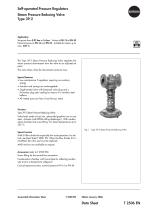
Self-operated Pressure Regulators Steam Pressure Reducing Valve Type 39-2 Application Set points from 0.02 bar to 16 bar · Valves in DN 15 to DN 50 Nominal pressure PN 16 and PN 25 · Suitable for steam up to max. 350 °C The Type 39-2 Steam Pressure Reducing Valve regulates the steam pressure downstream from the valve to an adjusted set point. The valve closes when the downstream pressure rises. Special features • Low-maintenance P-regulators requiring no auxiliary energy • Actuator and springs are exchangeable • Single-seated valve with balanced valve plug and a frictionless plug stem sealing by means of a stainless steel bellows • All wetted parts are free of non-ferrous metal Versions Type 39-2 Steam Pressure Reducing Valve: Valve body made of cast iron, spheroidal graphite iron or cast steel · Actuator (with EPDM rolling diaphragm) · With condensation chamber and screw fitting · For steam temperatures up to 350 °C. Special version With St I flow divider for especially low-noise operation. For details, see Data Sheet T 8081 EN. When the flow divider St I is retrofitted, the valve seat must be replaced. Fig. 1 · Type 39-2 Steam Pressure Reducing Valve ANSI versions are available on request. Accessories (refer to T 2595 EN) Screw fitting for the control line connection Condensation chamber with funnel tube for collecting condensate and as a temperature safeguard Conical expansion piece, nominal pressure PN 16 or PN 40 Associated Information Sheet
Open the catalog to page 1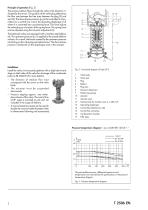
Principle of operation (Fig. 2) The process medium flows through the valve in the direction indicated by the arrow. The position of the valve plug determines the flow rate between the free area between the plug (3) and seat (2). The downstream pressure (p2) to be controlled is transmitted via a control line (14) to the operating diaphragm (13) where it is converted into a positioning force. This force adjusts the valve plug as a function of the spring force. The spring force can be adjusted using the set point adjustment (6). The balanced valves are equipped with a stainless steel bellows (4)....
Open the catalog to page 2
Table 1 · Technical data · All pressures in bar (gauge) Nominal size Nominal pressure Temperature range Valve plug Actuator with condensation chamber Max. perm. differential pressure ∆p Set point ranges Leakage rate Valve spring force F and actuator area A See Table 4 · Dimensions in mm and weights Table 2 · Materials · Material number according to DIN EN Valve Nominal pressure Spheroidal graphite iron EN-JS1049 (GGG-40.3) Stainless steel Stainless steel Sealing ring Graphite with metal core Actuator Diaphragm cases EPDM with fabric reinforcement · Max. perm. ambient temperature 80 °C Table 3...
Open the catalog to page 3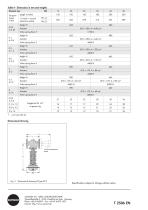
Nominal size Length L (valve) L1 (valve + conical expansion piece) Height H Valve spring force F Height H Actuator Valve spring force F Height H Valve spring force F Height H Actuator Valve spring force F Height H Valve spring force F Height H Actuator Valve spring force F Height H Valve spring force F Dimensional drawing Specifications subject to change without notice. SAMSON AG • MESS- UND REGELTECHNIK WeismullerstraBe 3 • 6 0314 Frankfurt am Main • Germany Phone: +49 69 4009-0 • Fax: +49 69 4009-1507 Internet: http://www.samson.de
Open the catalog to page 4All SAMSON catalogs and technical brochures
 TROVIS 5590 Web Module
2 Pages
 Room Controller TROVIS 5572
2 Pages
 Room Panel TROVIS 5570
2 Pages
 Line Splitter TROVIS 5486
2 Pages
 Type 9 Temperature Regulator
6 Pages
 Type 8 Temperature Regulator
6 Pages
 Type 5 D Boiler Controller
2 Pages
 Rotary Plug Valve Type 62.7
7 Pages
 Actuator Type S
3 Pages
 Actuator Type MZ
4 Pages
 Actuator Type MN
3 Pages
 Actuator Type MD
3 Pages
 Actuator Type R
3 Pages
 Actuator Type AT
4 Pages
 Rotary Plug Valve Type 82.7
7 Pages
 Rotary Plug Valve Type 73.7
7 Pages
 Rotary Plug Valve Type 73.3
7 Pages
 Rotary Plug Valve Type 72.4
7 Pages
 Rotary Plug Valve Type 72.3
8 Pages
 SAMSON Positioners
28 Pages













Archived catalogs
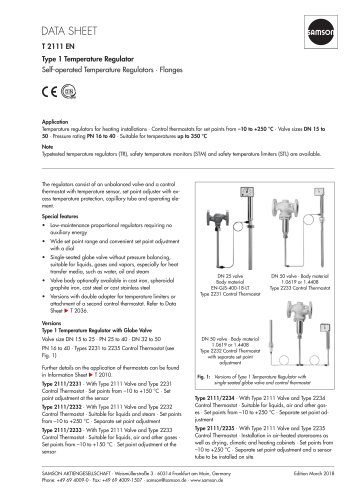 T21 11
6 Pages




- SAMSON stainless steel valve
- Water valve
- Ball valve
- SAMSON pneumatic valve
- Threaded valve
- Electrically operated valve
- SAMSON regulating valve
- SAMSON flange valve
- On/off valve
- Electric valve
- Gas solenoid valve
- Process software
- Directional control valve
- Gas valve
- Direct-operated solenoid valve
- Pneumatically-operated valve
- Terminal box
- Single-stage pressure regulator