


- Company
- Products
- Catalogs
- News & Trends
- Exhibitions
Pneumatic Actuators Type 2780-1 Type 2780-2

Pneumatic Actuators Type 2780-1 Type 2780-2
- Diaphragm cases made of die-cast aluminum.
- Easily reversible direction of action.
- Integral positioner attachment available in Type 2780-2.
- Type 2780-1: Pneumatic actuator.
- Type 2780-2: Pneumatic actuator with direct positioner attachment.
- Actuator area: 120 cm².
- Rated travel: 6, 12, or 15 mm.
- Max. supply pressure: 4 bar.
- Fail-safe action: Reversible (stem extends or retracts).
- Signal pressure range: 0.4 to 1 bar (Type 2780-1), 0.4 to 2 bar (Type 2780-2).
- Ambient temperature: –35 to +80 °C.
- Materials: Housing made of Aluminum GD-AlSi12, Diaphragm made of NBR, Springs made of Spring wire C.
- Weight: Type 2780-1 is 2 kg, Type 2780-2 is 3.2 kg.
- Actuator stem extends: Spring force moves the stem to the lower end position when air supply fails.
- Actuator stem retracts: Spring force retracts the stem when air supply fails.
Catalog excerpts
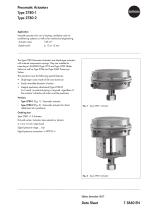
Pneumatic Actuators Type 2780-1 Type 2780-2 Application Versatile actuators for use in heating, ventilation and airconditioning systems as well as for mechanical engineering. Actuator area: 120 cm² Rated travel: The Type 2780 Pneumatic Actuators are diaphragm actuators with internal compression springs. They are suitable for mounting on SAMSON Type 3213 and Type 3222 Globe Valves as well as Type 3226 and Type 3260 Three-way Valves. The actuators have the following special features: •• Diaphragm cases made of die-cast aluminum •• Easily reversible direction of action •• Integral positioner attachment (Type 2780-2) As a result, no external piping is required, regardless of the actuator's direction of action and the positioner. Versions –– Type 2780-1 (Fig. 1) · Pneumatic actuator –– Type 2780-2 (Fig. 2) · Pneumatic actuator for direct attachment of a positioner Ordering text Type 2780-1/-2 Actuator Fail-safe action: Actuator stem extends or retracts 6, 12 or 15 mm rated travel Signal pressure range … bar Signal pressure connection 1/8 NPT/G 1/8
Open the catalog to page 1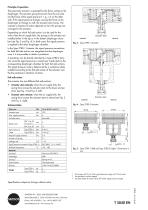
Principle of operation The pneumatic actuator is operated by the forces acting on the diaphragm. The actuator spring force acts from the one side and the force of the signal pressure F = pst x A on the other side. If the signal pressure changes causing the force on the diaphragm to change as well, the actuator stem moves. The actuator's direction of action depends on how the springs are arranged in the actuator. Depending on which fail-safe action is to be used for the valve when the air supply fails, the springs in the actuator are installed either in the top or in the bottom diaphragm chamber...
Open the catalog to page 2All SAMSON catalogs and technical brochures
 TROVIS 5590 Web Module
2 Pages
 Room Controller TROVIS 5572
2 Pages
 Room Panel TROVIS 5570
2 Pages
 Line Splitter TROVIS 5486
2 Pages
 Type 9 Temperature Regulator
6 Pages
 Type 8 Temperature Regulator
6 Pages
 Type 5 D Boiler Controller
2 Pages
 Rotary Plug Valve Type 62.7
7 Pages
 Actuator Type S
3 Pages
 Actuator Type MZ
4 Pages
 Actuator Type MN
3 Pages
 Actuator Type MD
3 Pages
 Actuator Type R
3 Pages
 Actuator Type AT
4 Pages
 Rotary Plug Valve Type 82.7
7 Pages
 Rotary Plug Valve Type 73.7
7 Pages
 Rotary Plug Valve Type 73.3
7 Pages
 Rotary Plug Valve Type 72.4
7 Pages
 Rotary Plug Valve Type 72.3
8 Pages
 SAMSON Positioners
28 Pages













Archived catalogs
 T21 11
6 Pages




- SAMSON stainless steel valve
- Water valve
- Ball valve
- SAMSON pneumatic valve
- Threaded valve
- Electrically operated valve
- SAMSON regulating valve
- SAMSON flange valve
- On/off valve
- Electric valve
- Gas solenoid valve
- Process software
- Directional control valve
- Pressure limiter
- Gas valve
- Direct-operated solenoid valve
- Pneumatically-operated valve
- Terminal box
- Single-stage pressure regulator