


- Company
- Products
- Catalogs
- News & Trends
- Exhibitions
M3 Michel Mortier

M3 Michel Mortier
Career Overview of Michel Mortier
Michel Mortier (1925-2015) was a versatile French designer whose work spanned furniture design, interior architecture, artistic direction, graphic design, journalism, and education. Educated at the École Nationale Supérieure des Arts Appliqués in Paris, Mortier developed a minimalist style emphasizing elegance, simplicity, and subtle color and material use. Early in his career, he managed furniture departments in Belgium and later directed Marcel Gascoin's agency in Paris, collaborating with notable designers like Pierre Paulin and Joseph-André Motte.
Key Contributions and Collaborations
During the 1950s, Mortier designed lighting and furniture for manufacturers such as Disderot, Lucien Carrier, Airborne, and Walter Knoll. His notable creations include the ergonomic Triennale chair and the cubist Hexagone armchair. In 1954, he co-founded the Atelier de Recherche Plastique (ARP) with Motte and Guariche, focusing on innovative furniture design and production, including modular office furniture for EDF that anticipated open-plan office concepts. The ARP dissolved in 1957, after which Mortier pursued independent artistic direction and interior design projects.
Design Style and Influences
Mortier’s design philosophy was shaped by Danish cabinetmaking traditions, the French Union of Modern Artists (UAM), and movements such as Bauhaus and De Stijl. His work is distinguished by intelligent spatial use, minimalism, and refined choices in color and materials, establishing him as a leading decorator of his generation.
International Work and Later Career
In 1964, Mortier relocated to Montreal with François Lamy to prepare for Expo 67, designing the Youth Pavilion among other projects. Returning to France in 1968, he became artistic director at Mobilier International and later founded his own agency. His 1970s portfolio included private homes, corporate offices, and airport restaurants.
Teaching and Recognition
Committed to education, Mortier taught at prestigious institutions in Paris and Montreal during the 1960s and 1970s. His awards include a gold medal at the 1954 Triennale di Milano, the 1963 René-Gabriel prize for innovative and affordable design, and official architect certification in 1977.
The M3 Lamp: Design and Reissue
The M3 lamp, designed in 1952 for Disderot, exemplifies Mortier’s minimalist and elegant style with a bicolored lacquered metal lampshade and a curved brass tubular base. Sammode has reissued the M3 lamp, preserving the original design while incorporating modern technology and manufacturing methods. The lamp is produced in France, showcasing Sammode’s expertise in metalwork and lighting precision.
Technical Specifications of the M3 Lamp
- Base dimensions: 275 mm (length) x 307 mm (width) x 265 mm (height)
- Lampshade dimensions: 190 mm (length) x 146 mm (width)
- Total height: 338 mm
- Materials: Steel tubular structure and lampshade
- Available colors: Black, Grey, Vermilion Red, Chalk; custom colors available on request
- Lamp type: E27 bulb (non-dimmable)
- Electrical class: II
- Includes 2.5 m cable
- Manufactured in France
Summary of Mortier’s Lighting Innovations
Beyond the M3, Mortier designed innovative lighting fixtures in the 1960s under the Édition Rotaflex label and later for Verre Lumière, including the mushroom and skittle lamps. His early designs often featured multifunctional lighting modes, such as the M4 suspension lamp offering direct, indirect, and reflected lighting.
Conclusion
Michel Mortier’s legacy is defined by elegant, functional design that balances innovation with timeless aesthetics. The Sammode reissue of the M3 lamp honors Mortier’s original vision and reflects a shared commitment to quality craftsmanship and innovation in lighting design.
Company Overview and Contact Information
Sammode, founded in 1927, is a French lighting design and manufacturing company known for its expertise and use of durable, timeless materials.
- Architecture and Design Professionals: Email: [email protected] | Phone: +33 (0) 143 14 84 90
- Resellers and Individuals: Email: [email protected] | Phone: +33 (0) 143 144 145
- Head Office and Showroom (by appointment): 24 rue des Amandiers, 75020 Paris
Website: sammode.lighting
Design and Production Credits
- Art Direction: Normal Studio
- Graphic Design: Building Paris
- Texts: Christian Simenc
- Photography: Morgane Le Gall
- Production: Aurélie des Robert
- Archival Documents: Archives Michel Mortier
- Printing: Stipa (France)
Additional Notes
The document is current as of January 2022. Acknowledgments are extended to designers and collections contributing to showroom aesthetics, including furniture, carpets, wallpaper, and bedding.
Catalog excerpts
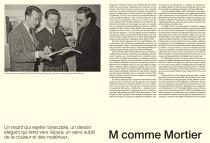
L’Atelier de Recherche Plastique (ARP). The Plastic Research Studio : Pierre Guariche, Joseph-André Motte, Michel Mortier. Un esprit qui rejette l’anecdote, un dessin élégant qui tend vers l’épure, un sens subtil de la couleur et des matériaux. Tenter de condenser l’existence de Michel Mortier (19252015) sous une unique casquette est un exercice voué à l’échec, tant l’homme avait de cordes à son arc. Le design bien sûr, mais aussi l’architecture intérieure, la direction artistique, le graphisme ou le journalisme, sans oublier l’enseignement. C’est sur les conseils de l’architecte Marcel Lods...
Open the catalog to page 3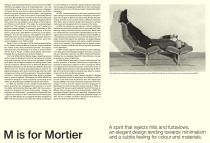
Trying to squeeze Michel Mortier’s entire existence (19252015) into one pigeon hole is an impossible task — the man simply had too many strings to his bow. He was a designer, of course, but he was also an interior architect, an artistic director, a graphic designer and a journalist — not forgetting his teaching work. It was on the advice of architect Marcel Lods that Michel Mortier enrolled at the École Nationale Supérieure des Arts Appliqués, (College of Applied Arts) in Paris, where he was taught by Louis Sognot, René Gabriel and Étienne-Henri Martin. The latter, he acknowledged, taught him...
Open the catalog to page 4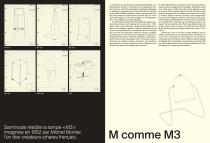
La lumière est un domaine pour lequel Michel Mortier a, en permanence, affiché un vif intérêt et une imagination horspair. À preuve : cette étonnante ligne d’appareils d’éclairage en plastique imaginée dans les années 1960 et produite sous le label « Édition Rotaflex ». Idem, une décennie plus tard, cette fois pour la firme Verre Lumière, avec un « luminaire-champignon », une « lampe-quille » ou un lampadaire fait d’une multitude de lames d’altuglas. Au début des années 1950, Michel Mortier dessine une série de luminaires qu’il baptise d’un simple « M » : « M1 », « M2 », « M3 », et ainsi de suite....
Open the catalog to page 5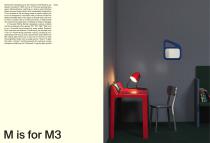
Sammode is bringing out a new version of the M3 lamp, originally invented in 1952 by one of France’s leading designers: Michel Mortier. Lighting is a field in which Mortier always showed huge interest and unparalleled imagination. This is evident in the stunning range of plastic lighting fixtures he designed in the 1960s and produced under the Édition Rotaflex label. Then again, a decade later, this time for Verre Lumière, with a “mushroom lamp”, a “skittle lamp” and a floor lamp made with a multitude of strips of Altuglas. In the early 1950s, Mortier designed a series of lights that he christened...
Open the catalog to page 6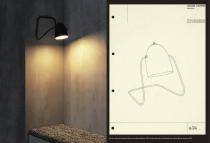
Dessin original de l’applique M3, archives Michel Mortier, 1952. Original drawing of the M3 wall lamp, Michel Mortier archives, 1952.
Open the catalog to page 10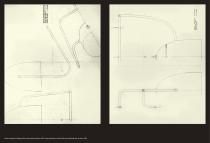
Dessin original de l’applique M3, archives Michel Mortier, 1952. Original drawing of the M3 wall lamp, Michel Mortier archives, 1952.
Open the catalog to page 11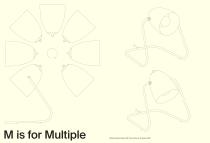
Rotation libre de l’ogive à 355°. Free rotation of the shade of 355
Open the catalog to page 12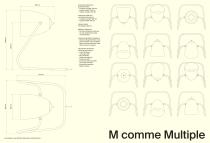
Dimensions piétement / Base dimensions : — Longueur / Length : 275 mm — Largeur / Width : 307 mm — Hauteur / Height : 265 mm Dimensions abat-jour / Lampshade dimensions : — Longueur / Length : 190 mm — Largeur / Width : 146 mm Hauteur totale / Total height : 338 mm Matériaux / Materials : — tructure tubulaire et abat-jour S en acier / Steel tubular base and lampshade. Couleurs disponibles / Available in : — oir, Gris, Rouge Vermillon, Craie. N Autres couleurs : nous consulter / Black, Grey, Vermilion Red, Chalk. Other colours on request. Informations techniques / Technical informations :...
Open the catalog to page 13
Les luminaires Sammode sont congus et fabriques en France, depuis 1927 Retrouvez toutes nos gammes sur studio.sammode.com Vous pourrez apprecier I'etendue de notre savoir-faire, la force de nos engagements et la qualite de nos materiels, durables et intemporels. Contact professionnels architecture et design : [email protected] T+33 (0) 143 14 84 90 Contact revendeurs & particuliers : [email protected] T+33 (0) 143 144 145 Siege social & showroom professionnel (sur rendez-vous) 24 rue des Amandiers 75020 Paris 0 © sammode.lighting Sammode luminaires have been designed and manufactured in France...
Open the catalog to page 14All SAMMODE catalogs and technical brochures
 Sammode × Yann Kersalé
15 Pages
 Sammode —Pierre Guariche
58 Pages
 MOD Modular spot lighting system
15 Pages
 Design Collections
2 Pages
 Sammode Studio Design Collection
29 Pages
 Long-life lighting for industry
12 Pages
 Swimming pools
20 Pages
 Sacred buildings
20 Pages
 Museum
20 Pages
 Night architecture
20 Pages
 Offices and coworking spaces
16 Pages
 Railway lighting
16 Pages
 Port installations
16 Pages
 machine & process Lighting
16 Pages
 Lighting for high temperatures
53 Pages
 Water treatment
12 Pages
 Meat Processing
16 Pages
 Malting Plants
12 Pages
 Dairy and cheese industries
16 Pages
 EMERGENCY Lighting
12 Pages


- LED lighting
- Light fixture
- Industrial lighting
- Waterproof lighting
- Outdoor lighting
- Polycarbonate lighting
- IP66 lighting
- Ceiling-mounted lighting
- Tubular lighting
- Surface-mounted lighting
- Emergency lighting
- IP69K lighting
- Maintenance-free lighting
- High-efficiency lighting
- Machine lighting
- Rugged lighting
- Suspended lighting
- High lighting
- Explosion-proof lighting
- IP68 lighting