- Catalogs
- Sacemi Gamar srl
- ELECTRIC MOTORS

ELECTRIC MOTORS
ELECTRIC MOTORS
SACEMI-GAMAR srl, established from a merger in 2009, is a prominent player in the electric pumps and motors market, emphasizing product quality and customer satisfaction with a variety of customized solutions.
The document details the new international efficiency classes for electric motors as per IEC 60034-30-1; 2014, including IE1 (Standard Efficiency) to IE4 (Super Premium Efficiency). Updated methods for measuring efficiency are also discussed.
Specifications for mechanical and electrical tolerances are provided, ensuring compliance with international standards such as IEC 60072-1 and IEC 60034-1.
The document describes general motor features, mounting arrangements, and standard operating conditions to ensure optimal performance.
Information on bearing types, radial and axial thrusts, noise levels, and vibration specifications are included, adhering to standards like EN 60034-9 and EN 60034-14.
Various duty types (S1 to S8) and engineering formulae for motor drives are explained, including calculations for power input and moment of inertia.
Guidelines for using inverter-driven motors are provided, emphasizing compliance with IEC standards for insulation and performance.
Detailed specifications for different motor types, including asynchronous and self-braking motors, are provided, with efficiency ratings and technical data.
Guidelines for motor use and maintenance are outlined to ensure longevity and performance, including installation, electrical connections, and periodic check-ups.
Typical applications include woodworking machines and machinery requiring high starting torque. Recommendations for motor selection and installation are provided to optimize performance.
The motors conform to various Community Directives and standards, ensuring electromagnetic compatibility and adherence to efficiency classifications.
Catalog excerpts
ELECTRIC MOTORS ENGLISH
Open the catalog to page 1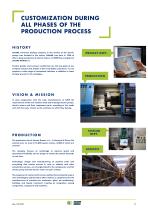
CUSTOMIZATION DURING ALL PHASES OF THE PRODUCTION PROCESS HISTORY SACEMI, historical leading company in the market of the electric pumps was founded in the sixties, GAMAR was born in 1996 to offer a large production of electric motors. In 2009 they merged into SACEMI-GAMAR srl. Product quality and customer satisfaction are the key goals of our company mission and, thanks to the remarkable experience, we can propose a wide range of customized solutions in addition to those already present in the catalogue. VISION & MISSION In close cooperation with the main manufacturers to fulfill the requirements...
Open the catalog to page 5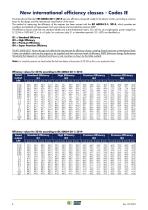
The international Standard IEC 60034-30-1; 2014 sets new efficiency classes (IE code) for the electric motors, providing a common basis for the design and the international classification of the same. The method of measuring the efficiency of the engines has been revised with the IEC 60034-2-1; 2014, which provides test conditions and methods of measurement much more precise and accurate than previous 2007. The efficiency classes under the new standard relates only to the three-phase motors, 50 o 60 Hz, at a single-speed, power range from 0,12 kW to 1000 kW, 2, 4, 6 or 8 pole, for continuous...
Open the catalog to page 6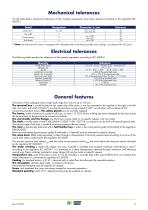
On the table below mechanical tolerances of the coupling components have been reported according to the regulation IEC t!General features The motors of this catalogue have a high shaft range from 56 mm up to 160 mm. The terminal box is usually located on the upper side of the motor; it may be requested to be supplied on the right or the left side. On motor with shaft of 56-63-71 mm the terminal box can be rotated of 180°, on all others with a release of 90°. Concerning standard motors, the cables glands are not normally supplied. The frame, made of aluminium casing for all sizes, on sizes 112-132-160...
Open the catalog to page 7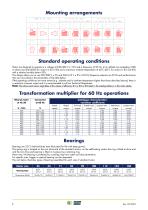
Standard operating conditions Motor are designed to operate at a voltage of 230/400 V ± 10% and a frequency of 50 Hz, at an altitude not exceeding 1000 m above sea level (4000 for motors in IE2 e IE3) and a maximum ambient temperature of 40°C (60°C for motors in IE2 and IE3) with a relative humidity below 90%. This design allows you to use 220/380 V ± 5% and 240/415 V ± 5% at 50 Hz frequency extension to 60 Hz and performances that vary according to the parameters of the table below. If the operating conditions are more severe (e.g.: altitude and/or ambient temperature higher than those described...
Open the catalog to page 8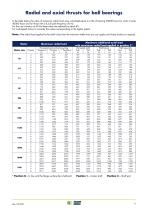
life of bearing 20000 hours for motor 2 pole In the table below the value of maximum radial load were calculated equal to a 40000 hours and for those with a 4,6,8 pole frequency 50 Hz. For the use of motors at 60 Hz these value are reduced by about 6%. For multi-speed motors to consider the values corresponding to the higher speed. Note: if the radial load applied to the shaft is less than the maximum table more you can apply axial loads (values on request). * Position 0 = In line with the flange surface (bar shaft-end) Position 1 = Center shaft
Open the catalog to page 9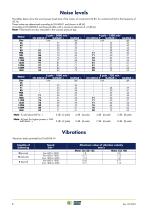
The tables below show the sound power levels (Lw) of the motors of construction IM B3, for no-load and fed to the frequency of 50 Hz. These values are determined according to EN 60651 and shown in dB (A). According to EN 60034-9 are those set table with a maximum tolerance of +3 dB (A). Note: These levels are also indicated in the acoustic pressure (Lp).
Open the catalog to page 10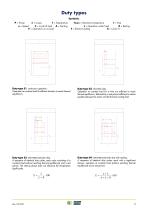
P = Power e = Losses T = Temperature Tmax = Maximum temperature t = Time n = Speed C = Cycle of load A = Starting L = Operation under load R = Resting V = Operation on no load F = Electric braking X = Cyclic % Duty-type S1: continuous operation. Operation at constant load of sufficient duration to reach thermal equilibrium. Duty-type S2: short-time duty. Operation at constant load for a time not sufficient to reach thermal equilibrium, fallowed by a rest period sufficient to restore equality between the motor and the thermal cooling fluid. Duty-type S3: intermittent periodic duty. A sequence...
Open the catalog to page 11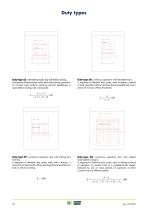
Duty types Duty-type S5: intermittent periodic duty with electric braking. A sequence of identical duty cycles, each with a stat-up, operation at constant load (without reaching thermal equilibrium), a rapid electric braking and a rest period. Duty-type S7: continuous operation duty with starting and braking. A sequence of identical duty cycles, each with a start-up, a period of constant load (without reaching thermal equilibrium) and an electric braking. Duty-type S6: continuous operation with intermittent load. A sequence of identical duty cycles, each including a period of load operation (without...
Open the catalog to page 12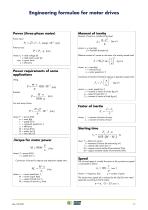
Engineering formulae for motor drives Power (three-phase motor) Moment of inertia a cylindrical flywheel: Power input P1 = 3 ⋅ U ⋅ I ⋅ cosϕ ⋅ 10 Potenza resa where: m = mass (kg) d = flywheel diameter (m) Effective moment of inertia on the motor of a linearly moved load: rated voltage (V) rated load current (A) power factor efficiency Power requirements of some applications where: m = mass (kg) v = velocity (m/s) n = motor speed (min-1) Conversion of moment of inertia for step-up or step-down speed ratio: motor speed (min-1) motor torque (Nm) speed of load (min-1) torque of load at n1 (Nm) motor...
Open the catalog to page 13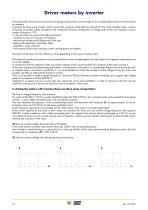
Driver motors by inverter The optimization of production processes and energy saving invite us increasingly to use variable speed induction motors driven by inverters. In general the drive using inverter, which converts the constants of the electrical network (V, Hz) in the variable values, involves not purely sinusoidal supply of engines and introduces harmonic components of voltage and current and requires a power margin of about on 15%. It’ must also take into account the following factors: - Increase in losses as a function of frequency - Mechanical resistance and balancing of the rotor -...
Open the catalog to page 14
Asynchronous three-phase motors
Open the catalog to page 15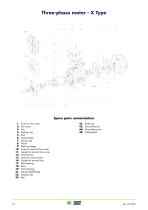
Spare parts nomenclature 25. Shaft cap 42. Terminal board 46. Grounding screw 48. Cable gland 10. Screw for terminal box cover 11. Gasket for terminal box cover
Open the catalog to page 16All Sacemi Gamar srl catalogs and technical brochures
 COMPANY PROFILE
22 Pages
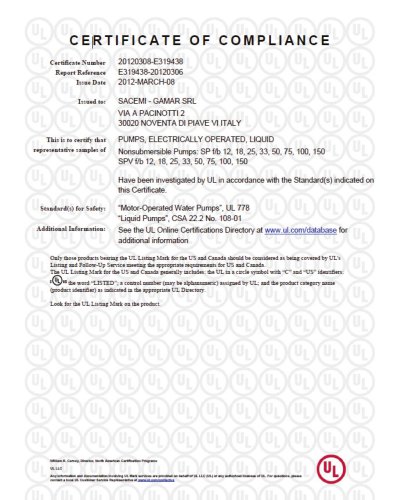 CERTIFICATE OF COMPLIANCE
1 Page
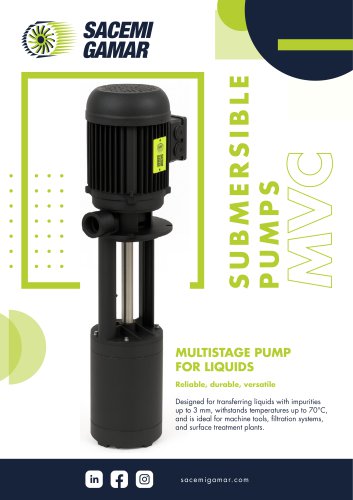 SUBMERSIBLE PUMPS
2 Pages
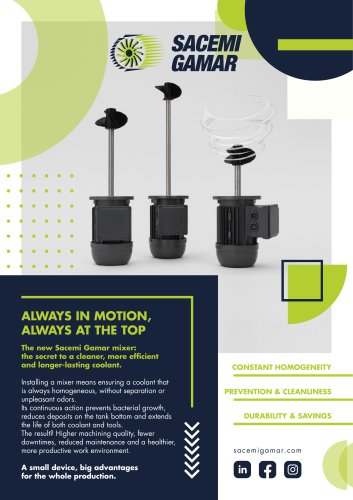 MIXER
MIXER1 Page
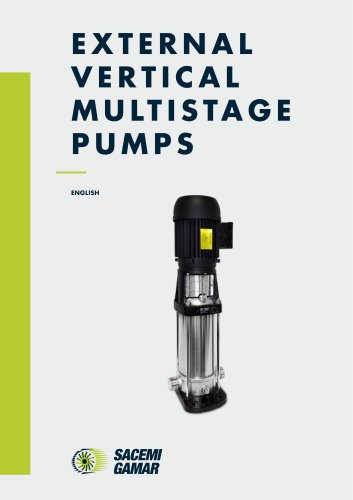 EXTERNAL VERTICAL MULTISTAGE PUMPS
28 Pages
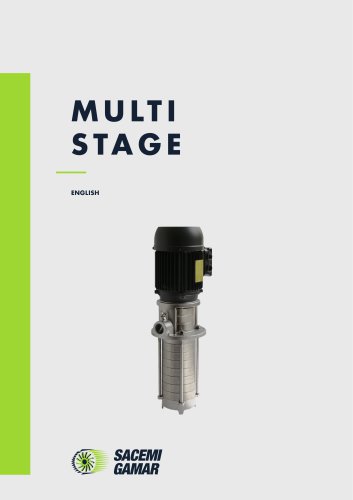 MULTI STAGE
56 Pages
 IMMERSION PUMPS
45 Pages
 ELECTRIC PUMPS
80 Pages