
- Catalogs
- Rulli Rulmeca
- BULK Handling rollers


BULK Handling rollers

BULK Handling rollers
Rulmeca Holding S.p.A., founded in 1962 and based in Almè, Italy, is a prominent manufacturer of conveyor rollers, motorized pulleys, and components for the bulk handling industry. Operating in 85 countries, Rulmeca serves sectors like mining, cement, steel, and recycling, focusing on innovation, environmental responsibility, and customer collaboration.
This section details the project and design criteria for belt conveyors, covering technical symbols, key components like rollers, belt speed, and width, and design criteria such as tangential force and belt tension. It also includes roller design criteria and accessories like belt cleaners and conveyor covers.
Rulmeca provides various rollers for industry applications, detailing technical design, ordering codes, and specialized rollers with rubber rings for impact and self-cleaning.
This section covers pulley dimensions and applications, emphasizing shaft dimensions, order codes, and special pulleys and tension units.
Details include selection criteria based on load and arrangement, with configurations like self-centralizing and suspended sets.
Information includes selection criteria for cleaners with tungsten-carbide and polyurethane blades, and order codes for spare parts.
The section introduces styles and characteristics of covers, detailing steel and PVC series, inspection doors, and fixing accessories.
Rulmeca's products enhance the performance, safety, and reliability of bulk handling systems, combining traditional values with modern technology.
The document provides specifications for belt conveyor components, including dimensions, load capacities, and tension values.
Design criteria emphasize understanding construction characteristics and forces, discussing factors like load volume and material characteristics.
Main components include rollers, drums, and belts, highlighting low maintenance requirements with high-quality materials.
Belt conveyors offer reduced personnel and energy consumption, long maintenance intervals, and lower operational costs.
Figures illustrate conveyor arrangements, aiding in visualizing configurations and applications.
Drive pulleys, return pulleys, and tension units are discussed, explaining their functions and design considerations.
Effective cleaning systems are crucial for maintaining productivity, with covers protecting materials from environmental factors.
Formulas for calculating conveyed volume and weight are provided, with tables detailing material properties and belt speed impacts.
Criteria include belt speed, width, and troughing set angle, with tables for maximum advised speeds and minimum belt width.
Loaded volume calculations are detailed, with tables to determine if belt width satisfies project data requirements.
Specifications and calculations for effective loaded volume, inclination and feed correction factors, troughing sets, and transition distance are provided.
Calculations for tangential force and power requirements are outlined, with coefficients for resistance and friction.
Criteria include belt width relative to material size and roller inclination for efficient operation.
Specifications and calculations for tangential forces, coefficients, belt tension, and pulley dimensions are detailed.
Formulas for module of resistance and shaft diameter calculations are provided, emphasizing deflection limits.
Roller design factors like balance and tolerances are discussed, with tables for roller diameter selection.
Static and dynamic load calculations are detailed, with impact roller design considerations.
Tables provide coefficients for load calculations, with graphs illustrating load forces and roller characteristics.
Recommendations for material impact considerations and design features like impact rollers are provided.
Calculations for drop energy and dynamic force, belt cleaning systems, and belt inversion are detailed.
An example project outlines speed, belt width, and conveyor design calculations based on material characteristics.
Calculations for tangential force and absorbed power are detailed, with tension calculations for equilibrium maintenance.
Belt selection is based on maximum working tension, with recommendations for recalculating tensions if resistance changes.
Specifications for drive pulley shaft diameter and tension calculations are provided.
Specifications for return pulley shaft diameter and tension calculations are detailed.
Summary of conveyor system specifications, including material speed, belt width, and power requirements.
Rulmeca rollers are designed for long service life, with features like precision bearings and self-lubrication.
Selection depends on conveyed material and environment, with recommendations for protective coatings.
Guidelines for selecting roller diameters based on belt speed, with tables for maximum speeds and recommended diameters.
Load calculations and roller type selection are detailed, with corrective coefficients for operating conditions.
Tables list factors affecting roller selection, aiding in load calculations.
An example for selecting troughing sets and rollers for a conveyor transporting crushed limestone is provided.
Ordering codes for rollers are explained, with tables for designs and materials.
The document serves as a guide for selecting and calculating roller types and sizes for conveyor systems.
Specifications for standard rollers produced according to European standards are outlined, with customization options.
The PSV series includes various roller types with specific spindle designs and dimensions.
Examples of standard and special design ordering are provided.
Tables show the relationship between belt width, roller dimensions, and load capacity.
Data on roller diameters, bearings, and load capacities are provided.
The document guides selecting and ordering rollers based on industrial requirements.
Specifications for roller series, ordering procedures, load capacity, material construction, standards, and recommendations are detailed.
Specifications for bearings and rollers, including dimensions and materials, are outlined.
Examples of ordering standard designs are provided.
Tables detail load capacity and dimensions for belt rollers.
PL/PLF series rollers are designed for corrosive environments.
Tables show resistance of materials to chemical agents.
PL roller design features are detailed, emphasizing corrosion resistance.
Production series for PL and PLF rollers are outlined.
Sealing systems and protection features are described.
Specifications and ordering information for roller series are provided.
Specifications for roller series, including dimensions and load capacities, are outlined.
Roller construction and design features are detailed.
Examples of standard design orders are provided.
Rollers are tested for quality and performance.
Rollers are suitable for various conveyor systems.
Specifications and guidelines for roller types and configurations are provided.
Specifications for roller diameters, spindle sizes, and load capacities are listed.
Instructions for ordering rollers are provided.
European norms for roller dimensions and materials are referenced.
Recommendations for using guide rollers and selecting impact rollers are given.
Tables provide data on roller dimensions and load capacities.
Importance of selecting appropriate roller types and configurations is highlighted.
Specifications and guidelines for troughing sets in belt conveyor systems are provided.
Troughing sets support loaded and unloaded belt sections, with impact sets for handling material load.
Selection factors include load capacity, belt speed, and environmental conditions.
Return sets support the empty belt, with recommendations for cleaning systems and self-centralizing sets.
Guide for selecting transoms based on load capacity and roller diameter is provided.
Order codes for transoms and brackets are outlined.
Production programme for transoms and brackets is detailed.
Specifications and guidelines for self-centralising transoms are provided.
Specifications for transom models and ordering information are outlined.
Methods for Model F and Model R transoms are described.
Examples of ordering codes for transom models are provided.
Self-centralising troughing sets and cantilevered sets are discussed.
Features of self-centralising transoms and cantilevered sets are highlighted.
Advantages and configurations of garland systems are discussed.
Garland systems are suitable for high-speed conveying and impact absorption.
Different garland system types and their specifications are outlined.
Ordering examples and specifications for garland systems are provided.
Measurements for fixation distances and suspension systems are detailed.
Suspensions and connecting links for movement flexibility are described.
Pulley specifications and order codes are outlined.
Introduction to belt cleaners and their importance is provided.
Information on belt cleaners and their specifications is provided.
Introduction to belt cleaners with tungsten-carbide and polyurethane blades is provided.
Criteria for selecting belt cleaners are outlined.
Different types of belt cleaners and their specifications are detailed.
Specifications for each type of cleaner are provided.
Recommendations for selecting and maintaining belt cleaners are given.
Specifications and guidelines for polyurethane scrapers are provided.
Different scraper models and their specifications are outlined.
Material and environmental considerations for scrapers are detailed.
Installation and maintenance instructions for scrapers are provided.
Information on steel and PVC covers is provided.
Specifications for galvanisation and covering options are outlined.
Characteristics of products made from galvanised sheet steel are detailed.
Cover types and ordering codes are provided.
Fixing systems and ordering codes are described.
Ventilated and removable cover features are outlined.
Additional cover features and ordering instructions are provided.
Specifications for conveyor belt covers and impact bars are outlined.
Installation procedures for covers and impact bars are detailed.
Features of impact bars and their benefits are outlined.
Benefits of using impact bars are listed.
Ordering instructions and compliance details are provided.
Contact details for Rulmeca offices and agents worldwide are provided.
Catalog excerpts

ROLLERS AND COMPONENTS FOR BULk HANDLING All dimensions indicated in this catalogue are subject to working tolerances and, althuogh the drawings are faithfully produced they are not necessarily binding. Rulmeca Holding S.p.A reserves the right to modify any product without notice. Rulmeca Holding S.p.A. Via A. Toscanini, 1 I-24011 Almè (BG) Italy Tel. +39 035 4300111 Fax +39 035 545700 [email protected] Please contact your local Rulmeca Company, you will find our contact details in our web site: www.rulmeca.com Moving ahead. BULK HANDLING ROLLERS AND COMPONENTS FOR BULk HANDLING Translation, reproduction and adaption rights, total and/or partial, by any means (microfilms and photostatic copies included) are reserved for all Countries. Moving ahead. Copyright © May 2015 RULMECA HOLDING SpA 9th Editio
Open the catalog to page 1
Rulmeca – Moving ahead. Since its foundation in 1962, Rulmeca, headquartered in Bergamo (Almé), Italy, has grown to become one of the world’s leading manufacturers of conveyor rollers/idlers, motorized pulleys, fabricated pulleys and other components for the bulk handling industry. 1,200 employees in twenty-two production and sales companies around the globe serve clients in 85 countries. Today, Rulmeca Group’s global business incorporates the product brands Rulmeca, Precismeca and Melco. All three of them specialize in the supply of long-lasting premium belt conveyor components. Rulmeca Group...
Open the catalog to page 2
TABLE OF CONTENTS 1 Technical Information page 9
Open the catalog to page 3
5 Belt cleaners and scrapers page 265 5.4.8 Codes SPU Spare Parts & Accessories - PU Series Scrapers ... 288
Open the catalog to page 4
Todays movement of goods and bulk materials demands state of the art methods. In this field Rulmeca have the reputation to be one of the largest and most qualified producers in the world of rollers and equipment for all types of conveyors and automatic materials handling systems. The development of the Company has reached impressive and significant levels. Using advanced information technology and computer aided design the functions of the management, commercial, administration, project design, production and quality control blend together in an efficient, functional, and harmonious way. The...
Open the catalog to page 6
Modern, Flexible Technology Automation
Open the catalog to page 7
Fields of application: - Coal - Steel - Energy - Chemical - Fertiliser - Glass - Cement - Mineral extraction Examples of the most important industries where Rulmeca has supplied rollers and components for the conveying of Bulk materials. In these fields belt conveyors distinguish themselves for their flexibility, practicality and economic application.
Open the catalog to page 8
1 Technical Information project and design criteria for belt conveyors
Open the catalog to page 10
Technical Information project and design criteria for belt conveyors Summary 1 | [Technical information page 9
Open the catalog to page 11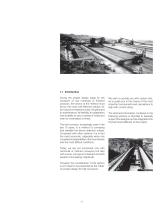
1.1 Introduction During the project design stage for the transport of raw materials or finished products, the choice of the method must favour the most cost effective solution for the volume of material moved, the plant and its maintenance, its flexibility for adaptation and its ability to carry a variety of loads and even be overloaded at times. The belt conveyor, increasingly used in the last 10 years, is a method of conveying that satisfies the above selection criteria. Compared with other systems it is in fact the most economic, especially when one considers its adaptability to the most diverse and...
Open the catalog to page 12
Technical Information project and design criteria for belt conveyors a pitch of troughing sets A length of roller spindle ag distance between the pulley flange and support a pitch of impact sets ao pitch of carrying sets at pitch of transition sets au pitch of return sets B length of roller shell C distance between roller supports Ca static load on the carrying set ca load on central roller of the carrying set Ca1 dynamic load on the carrying set cd dynamic load on the bearing Cf constant of elasticity of the frame/impact roller ch flats of roller shaft Co...
Open the catalog to page 13
The symbol for kilogram (Kg) is intended as a unit of force. Ivm load volume corrected to 1 m/s in relation to the inclination and irregularity of the feed Ivt load volume theoretic to 1 m/s J moment of inertia of section of material oamm admissible stress Lb dimensions of material lump Mif ideal bending moment pd dynamic falling force pi impact force of falling material pic force impact on central roller Ppri weight of lower rotating parts Pprs weight of upper rotating parts qb weight of belt per linear metre qbn weight of belt density qG weight of material...
Open the catalog to page 14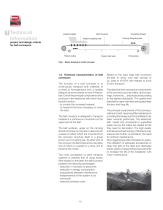
Belt conveyor Loading hopper Unloading hopper Carryng troughing sets Impact troughing sets project and design criteria for belt conveyors Return pulley Return idler sets Drive pulley Fig.1 - Basic drawing of a belt conveyor 1.3 Technical characteristics of belt conveyors The function of a belt conveyor is to continuously transport bulk materials of a mixed or homogeneous sort, a variable distance of some metres to tens of kilometres. One of the principal components of the conveyor is the elastomer belt which has a double function: - to contain the conveyed material - to transmit the force necessary...
Open the catalog to page 15
All these factors combine to limit operational costs, especially where excavation work occurs, or underpasses below hills, roads or other obstacles. A smooth belt conveyor may travel up slopes up to 18° and there is always the possibility to recover energy on down hill sections. Projects have therefore been realised where conveyor system lengths may be up to 100 Km long with single sections of conveyor of 15 Km. Utilising the characteristics of flexibility, strength and economy of purpose the belt conveyor is the practical solution to conveying bulk and other materials. Continuous developments...
Open the catalog to page 16
Information project and design criteria for belt conveyors 1.4 Rulmeca key components for belt conveyors Fig. 3 illustrates the basic components of a typical belt conveyor. In practice, according to the variety of uses, it is possible to have many other diverse combinations of load and unload areas, elevations, and other accessories. Drive head May be of traditional design or with motorised drum unit. - Traditional Comprises a drive group consisting of a drive drum of a diameter appropriately sized to the load on the belt, and an idler drum at the opposing end. The power is supplied by a direct...
Open the catalog to page 17All Rulli Rulmeca catalogs and technical brochures
 RDR_BL3_Catalogue
52 Pages
 UNIT Handling rollers
232 Pages
 Unit Handling Drum Motors
116 Pages
 DriveRoller
48 Pages
 Bulk Handling Motorized Pulleys
104 Pages
 pipe
pipe4 Pages
 1000HD
1 Page
 500L, 500M & 500H
1 Page
 220M & 220H
1 Page
 ARRANGEMENT TROUGHING SETS
2 Pages
 CHOICE TROUGHING SETS.
2 Pages
 ORDERING CODE
4 Pages
 SELECTION METHOD
6 Pages


Archived catalogs
 Bulk handling flyer
4 Pages
 Covers
19 Pages
 Valmec
11 Pages
 Motorized Pulleys
8 Pages
- Transport rail conveyor
- Horizontal conveyor
- Power transmission belt
- Rubber strip
- V power transmission belt
- Unloading conveyor
- Metal conveyor roller
- Curved conveyor
- Vertical conveyor
- Steel conveyor roller
- Slip-on conveyor roller
- Plastic conveyor roller
- Motorized roller
- Stainless steel conveyor roller
- Conveyor drum motor
- Tubular conveyor
- Belt-driven conveyor roller