
- Catalogs
- RUF. BRIQUETTING SYSTEMS
- RUF Foundry Projects


- Company
- Products
- Catalogs
- News & Trends
- Exhibitions
RUF Foundry Projects

RUF Foundry Projects
- Cast Iron Foundries: A German automotive supplier uses briquettes in a cupola furnace for efficient melting and higher profits.
- Automotive Industry: Companies like ES Automobilguss and Mahle Vöcklabruck GmbH use RUF systems for processing cast iron chips, leading to cost savings and improved efficiency.
- Copper Foundries: Sächsisches Metallwerk and Zollern Laucherthal replace copper cathode sheets with briquettes, reducing costs and simplifying processes.
- Aluminium Foundries: Hammerer Aluminium Industries GmbH and a Japanese wheel manufacturer use briquetting for high metal yields and efficient melting.
Catalog excerpts
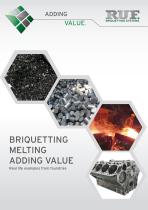
BRIOUETTING SYSTEMS ADDING VALUE Real life examples from foundries
Open the catalog to page 1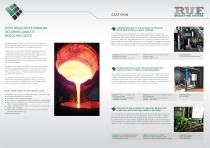
CAST IRON KEEP RESOURCES INHOUSE SECURING QUALITY REDUCING COSTS Ruf Maschinenbau GmbH & Co. KG is a family run business, which made the decision over thirty years ago to focus on the development and production of briquetting systems. Today there are more than 3,700 Ruf briquetting systems in operation, spread across more than 100 countries. They c ompress fine particle materials like chips, sludge and dust, which are the residuals of industrial processing. We roduce briquetting systems with throughputs between p 30 and 4,800 kg/hour for the briquetting of cast iron, steel, a luminium and...
Open the catalog to page 2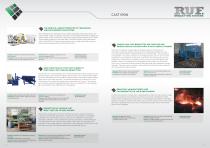
CAST IRON THE WORLD‘S LARGEST PRODUCER OF CRANKCASES USES RUF BRIQUETTING SYSTEMS The components are manufactured in a highly automated production process. The chips created, which are coated in emulsions, are briquetted and these briquettes are melted in the cupola furnace with a proportion of the charge make-up of up to 20%. The briquetting capacity in the main plant is 20,000 tons/year, and at the branch plant it is 18,000. All of the purchased systems are running successfully and have amortised themselves within a short period of time. Customer: Supplier to the automotive industry, Latin...
Open the catalog to page 3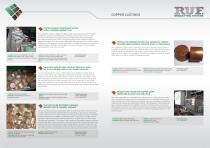
COPPER CASTINGS COPPER FOUNDRY PROCESSES IMPURE SCRAP THROUGH BRIQUETTING The customer produces copper cast alloys using various processes like horizontal continuous casting, sand casting and centrifugal casting. Chips produced from in-house mechanical processing as well as purchased chips (high percentage) have been briquetted since 2007. The starting point of 3-4% residual moisture is r educed to approx. 1% in this process. Briquettes make storage much simpler, enable p roblem-free charging and increase metal yield. An added advantage of the reduced residual moisture content is the avoidance...
Open the catalog to page 4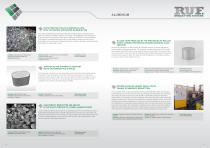
CHIPS FROM HIGH VALUE ALUMINIUM ALLOYS WITH TIN CONTENT ARE MELTED AS BRIQUETTES Dry chips created during production have been compressed to briquettes since 2011 on a system providing a capacity of 55 kg/h. The briquettes have a density of 2 kg/l and can be recycled at a rate up to a maximum of 25% of a charge make-up. The charge is complemented with ingots in the empty furnace. Decisive for the p rofitability is the economic utilisation of the tin content in the alloy, which has led to amortisation in well under a year. Customer: Automotive and mechanical engineering supplier, Middle East...
Open the catalog to page 5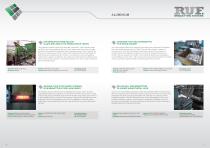
CHIP BRIQUETTES FROM DIE-CAST ALLOYS ARE USED IN THE PRODUCTION OF INGOTS The customer produces ingots from secondary Aluminium. Chip briquettes make up 30% of the charge make-up, the rest is bolt material and scrap from extruded p rofiles. After pressing the briquettes have a residual moisture level of around 3%. The level is reduced even further to about 1% through drying (just by ambient air) before they are transported to the furnace. The customer is using a briquetting system with a capacity of 450 kg/h. The system was commissioned in 2002 and has been running to the customer‘s complete...
Open the catalog to page 6
BRIQUETTING SYSTEMS
Open the catalog to page 7All RUF. BRIQUETTING SYSTEMS catalogs and technical brochures
 RUF Company Profile Brochure
16 Pages
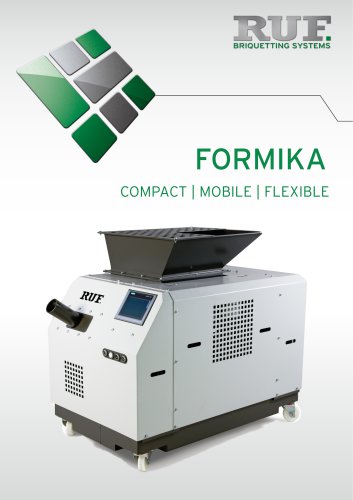 FORMIKA
4 Pages
 image-brochure
16 Pages
 Image brochure RUF EN
16 Pages
 Brochure en
2 Pages
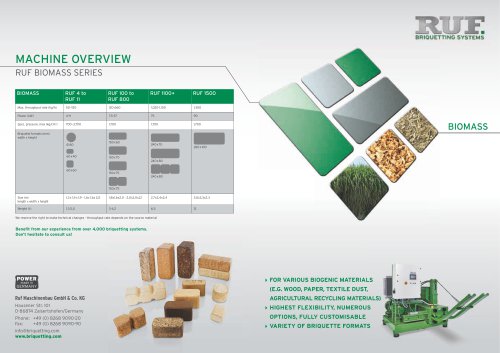 RUF_Briquetting of Biomass
2 Pages
 RUF Recycling Projects
8 Pages
 RUF Briquetting Systems
8 Pages




- Rail conveyor
- Transport rail conveyor
- Tipping station
- Feed conveyor
- Automatic conveyor
- Conveyor for the recycling industry
- RUF briquette press
- Lifting tipping station
- RUF chip briquette press
- RUF automatic briquette press
- Chip conveyor
- Hydraulic briquette press
- Conveyor for the metallurgical industry
- Conveyor for the wood industry
- RUF metal chip briquette press
- Wood conveyor
- Z type conveyor
- RUF cylindrical briquette briquette press
- RUF biomass briquette press
- Container tipping station