


RUD Lifting Points US-Version

RUD Lifting Points US-Version
Catalog excerpts

LIFTING POINT Solutions for demanding lifting tasks,
Open the catalog to page 1
CONTENT.Lifting point power. WELCOME TO THE WORLD OF RUD&CALDWELL 4-5 PRACTICAL KNOWLEDGE: THE VARIETY OF RUD LIFTING POINTS 6-7 WHAT TYPES OF LIFTING POINTS ARE AVAILABLE? 8-9 ROTATING AND TURNING LOADS WITH LIFTING POINTS 10-11 INSTALLATION OF LIFTING POINTS 12-13 WLL BOLTABLE LIFTING POINTS 14-19 WLL WELDABLE LIFTING POINTS 20-21 OVERVIEW OF BOLTABLE LIFTING POINTS 22-23 VLBG-PLUS / VLBG / VLBG-Z 32-37 OVERVIEW OF WELDABLE LIFTING POINTS 54-55 VLBS / VLBS-U / VLBS-U-LT/ VLBS-P 56-59 VRBS-FIX / VRL-FIX / VASK-FIX 60-63
Open the catalog to page 3
WELCOME TO THE WORLD OF RUD & CALDWELL. Your innovative Partner in North America! RUD group and Caldwell Inc. channel their market power and pool their expertise in lifting/lashing equipment, material handling, and mechanical engineering. Customers in the USA and Canada profit from a complete spectrum of product from a single source, as well as from even more quality, service, and customer focus. The RUD lifting and lashing means as well as the lifting points set innovative standards that characterize the entire lifting industry. Whether for welding or bolting, more than 700 tested lifting and...
Open the catalog to page 4
LOAD SECURING. During the transportation of machines or components, high forces often act on the load. For safe transportation, it is important to apply the necessary retaining forces reliably in order to keep the load on the load bed. LIFTING MEANS. RUD lifting means have been guaranteeing safety during the lifting and moving of loads for many decades. Thanks to its unique product and material portfolio, RUD can supply the matching solution for every purpose of application. This wide range of lifting means is guaranteed by the material qualities ICE (Grade 120) and VIP (Grade 100).
Open the catalog to page 5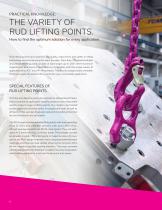
PRACTICAL KNOWLEDGE: THE VARIETY OF RUD LIFTING POINTS. How to find the optimum solution for every application. RUD lifting points have stood for top quality, ergonomics and safety in lifting technology and load securing for many decades. More than 700 tested boltable and weldable lifting point variants in load ranges up to 250 t meet maximum requirements in all areas of application in combination with the unique variety of application of our ICE- and VIP-lifting means. Thanks to its unique variety of models, RUD can supply the perfect lifting point for every conceivable application. SPECIAL...
Open the catalog to page 6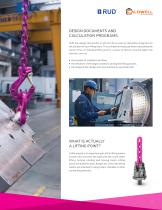
0 RUD (cXldwell LIFTING SOLUTIONS DESIGN DOCUMENTS AND CALCULATION PROGRAMS. RUD has design documents in 2D and 3D as well as calculation programs for the solution of your lifting tasks. This is important because when calculating the correct WLL of individual lifting points, a series of factors must be taken into account, such as: ■ the number of strands to be lifted, ■ the influence of the angle conditions during the lifting process ■ the shape of the design part (symmetrical or asymmetrical). A lifting point is an important part of the lifting means system and connects the load with the crane...
Open the catalog to page 7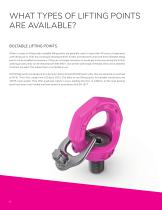
WHAT TYPES OF LIFTING POINTS ARE AVAILABLE? BOLTABLE LIFTING POINTS. When it comes to lifting loads, boltable lifting points are generally used. In more than 40 years of experience with lifting points, RUD has continually developed them further and decisively improved them. Boltable lifting points can be installed as necessary. If they are no longer necessary or would get in the way during the further working process, they can be removed with little effort. Due to their wide range of threads, they can be attached to almost any load. This makes them very flexible in use. RUD lifting points are...
Open the catalog to page 8
WELDABLE LIFTING POINTS. Weldable lifting points are used in approximately 25 % of the constructions. Weldable RUD lifting points (weld-on points) are permanently connected to the load. The advantage: There is no need to unscrew the lifting point, e. g. when rotating and turning loads. A clear plus in terms of safety. RUD weldable lifting points are designed for a dynamic load of at least 20,000 load cycles, they are tested at an overload of 50 %. Their WLL range from 630 kg to 100 t, allowing them to offer quadruple safety in every loading direction. In addition, all the load-bearing parts have...
Open the catalog to page 9
Special RUD lifting points for rotating and turning have special application advantages and therefore a considerable added value. They are equipped with a ball bearing, making them the perfect choice for these applications. The advantage: Thanks to the ball bearing, the forces resulting from lifting are converted shock-free into a rotating movement. Such shock-free rotation under load is not possible without ball bearings, because impact to the complete system cannot be avoided. Read how to use the lifting point properly below. ROTATING AND TURNING: POINTS TO WATCH FOR WHEN SELECTING THE LIFTING...
Open the catalog to page 10
LIFTING SOLUTIONS GENERAL SELECTION CRITERIA FOR LIFTING POINTS. 1. Determine the overall weight of the load. 2. Then determine the number of lifting points to be used according to the possible installation position. 3. In accordance with the operating instructions, observe the reduction factors resulting from the tilt angle and the temperature influences. 4. Select the correct lifting point according to the type of use with a WLL that exceeds the weight determined under point 3. HOW MANY LIFTING POINTS CAN BE USED ON A LOAD? ■ You can attach up to four lifting points on a construction, which...
Open the catalog to page 11
INSTALLATION OF LIFTING POINTS. Whether boltable or weldable: Please observe the following: Design the lifting point so that the exerted forces can be absorbed by the base material without deformation. For boltable variants, the load and material must be suitable for bolting the lifting point in up to the contact surface. Attach the lifting point as follows to avoid impermissible stresses such as twisting or turning of the load: - Single strand attachment: vertically above the load centre. - Double strand attachment: above and on both sides of the centre of gravity. - Three- or four-strand attachment:...
Open the catalog to page 12All RUD catalogs and technical brochures
 INSIDER
24 Pages
 Driving innovation
24 Pages
 Neo
Neo4 Pages
 From one expert to another
24 Pages
 We share the load.
36 Pages
 From one expert to another
24 Pages
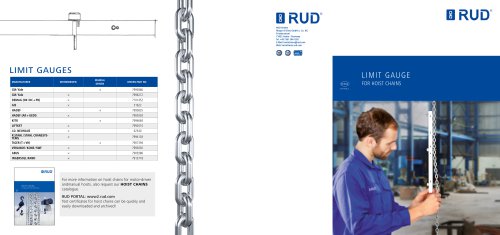 LIMIT GAUGES
2 Pages
 DRIVE TECHNOLOGY
19 Pages
 Conveyor systems
39 Pages
 Hoist chains - Industrial Chains
16 Pages
 RUD MOULD HANDLING SOLUTIONS
13 Pages


Archived catalogs
 Military Technology
7 Pages
 RUD ACP-TURNADO
32 Pages
 RUD OPTILASH (FIX / CLICK)
4 Pages
 RUD Lifting Points
128 Pages
 RUD Lifting Means System
132 Pages
 RUD INOX-ABA
6 Pages
 RUD Chains for professional use
64 Pages
 BULKOS
16 Pages
 CRATOS - Energy
12 Pages
 Substrate feeder
4 Pages
 Forked Link Chain FORKY
8 Pages
 Snow Chains Catalog 2014/2015
43 Pages
 Foundry-Chains
2 Pages
 PSA catalog
2 Pages
 RUD Lifting points catalogue
56 Pages
 RUD Lifting Power
10 Pages
 ICE-LBG-SR VLBG
38 Pages
 Lifting means VIP
56 Pages
 The best in chain technology
40 Pages
 Lifting Power
2 Pages
 ICE series
2 Pages
 RUD_Flyer
2 Pages


