


Optimal load securing with ICE and VIP-Lashing means

1 / 26 PagesView full catalog
Optimal load securing with ICE and VIP-Lashing means
Product catalog summary
Introduction
This document underscores the critical importance of proper load securing in road transport, emphasizing it as a legal requirement under EN 12195 standards. It is directed at individuals responsible for transporting goods, including casual transporters, to prevent accidents and legal complications.
This document underscores the critical importance of proper load securing in road transport, emphasizing it as a legal requirement under EN 12195 standards. It is directed at individuals responsible for transporting goods, including casual transporters, to prevent accidents and legal complications.
Specifications and Standards
The document discusses the EN 12195-1:2011 standard, noting its contradictions with practical tests. It suggests adherence to DIN EN 12195-1:2004 and VDI 2700 standards for adequate safety.
The document discusses the EN 12195-1:2011 standard, noting its contradictions with practical tests. It suggests adherence to DIN EN 12195-1:2004 and VDI 2700 standards for adequate safety.
Load Securing Procedures
Load securing involves stowing loads and securing them against movement, falling, and noise. The document warns against intuitive securing and stresses the need for precise calculations to understand the forces involved.
Load securing involves stowing loads and securing them against movement, falling, and noise. The document warns against intuitive securing and stresses the need for precise calculations to understand the forces involved.
Types of Lashing
- Vertical Lashing: Used for broad loads, requiring high friction and specific angles, involving high pulling forces on the lashing means and points.
- Diagonal Lashing: Preferred over vertical lashing as it requires less pre-tension, with specific angle considerations to avoid extreme loads during braking or cornering.
Calculation Examples
The document provides calculation examples to illustrate the forces involved in load securing, including vertical and diagonal lashing scenarios, emphasizing the importance of angle considerations and friction.
The document provides calculation examples to illustrate the forces involved in load securing, including vertical and diagonal lashing scenarios, emphasizing the importance of angle considerations and friction.
Recommendations
It recommends using high-quality lashing chains, such as the ICE lashing chain, for improved pulling force and handling. Adherence to VDI 2701 guidelines for lashing means quality and identification is advised.
It recommends using high-quality lashing chains, such as the ICE lashing chain, for improved pulling force and handling. Adherence to VDI 2701 guidelines for lashing means quality and identification is advised.
Conclusion
Proper load securing is crucial for safety and legal compliance in road transport. The document provides detailed guidance on lashing methods and calculations to ensure effective load securing.
Proper load securing is crucial for safety and legal compliance in road transport. The document provides detailed guidance on lashing methods and calculations to ensure effective load securing.
Overview
The document discusses the importance of pre-tension force in lashing systems for load securing, highlighting challenges in maintaining consistent tension due to friction losses and load settling. It introduces RUD's innovative solutions, including high-strength lashing chains and digital identification systems.
The document discusses the importance of pre-tension force in lashing systems for load securing, highlighting challenges in maintaining consistent tension due to friction losses and load settling. It introduces RUD's innovative solutions, including high-strength lashing chains and digital identification systems.
Specifications
RUD lashing chains are specified for high pre-tension force and suitability for vertical lashing. A table of lashing chain capacities and friction coefficients for different materials is provided, emphasizing correct chain selection based on load weight and angles.
RUD lashing chains are specified for high pre-tension force and suitability for vertical lashing. A table of lashing chain capacities and friction coefficients for different materials is provided, emphasizing correct chain selection based on load weight and angles.
Procedures
Recommendations include using two tensioning elements or increasing the number of lashing means to ensure consistent pre-tension force. The use of edge protection devices to minimize friction losses and specific lashing techniques like X-lashing and V-lashing for optimal load securing is advised.
Recommendations include using two tensioning elements or increasing the number of lashing means to ensure consistent pre-tension force. The use of edge protection devices to minimize friction losses and specific lashing techniques like X-lashing and V-lashing for optimal load securing is advised.
Innovations
RUD's Lashing Card and RUD-ID-SYSTEM® are highlighted as innovative tools for identifying and managing lashing and lifting means, using RFID technology for efficient inspection and administration.
RUD's Lashing Card and RUD-ID-SYSTEM® are highlighted as innovative tools for identifying and managing lashing and lifting means, using RFID technology for efficient inspection and administration.
Technological Advancements
The ICE lashing chain is introduced as lighter and stronger than traditional chains, offering up to 60% more lashing capacity. The ICE-CURT tensioner is noted for its anti-loosening device and theft protection features.
The ICE lashing chain is introduced as lighter and stronger than traditional chains, offering up to 60% more lashing capacity. The ICE-CURT tensioner is noted for its anti-loosening device and theft protection features.
Standards and Compliance
Compliance with EN 12195-3 standards for lashing chains is stressed, along with the importance of using approved lashing points on vehicles, as per EN 12640 and EN 474-1 standards.
Compliance with EN 12195-3 standards for lashing chains is stressed, along with the importance of using approved lashing points on vehicles, as per EN 12640 and EN 474-1 standards.
Recommendations
For heavy transports, the use of VIP lashing chains with balancer rolls is suggested to avoid static over-determination. Inclined lashing methods for container securing on multi-bucket system vehicles are recommended to ensure safety and compliance.
For heavy transports, the use of VIP lashing chains with balancer rolls is suggested to avoid static over-determination. Inclined lashing methods for container securing on multi-bucket system vehicles are recommended to ensure safety and compliance.
Specifications
The document outlines specifications for various lashing chains, including grades VIP-100 and ICE-120, detailing chain diameter, lashing capacity (LC), and reference numbers.
The document outlines specifications for various lashing chains, including grades VIP-100 and ICE-120, detailing chain diameter, lashing capacity (LC), and reference numbers.
Procedures
Instructions are provided for using endless chains when adequate lashing points are unavailable, emphasizing proper attachment of lashing hooks and the use of shackles.
Instructions are provided for using endless chains when adequate lashing points are unavailable, emphasizing proper attachment of lashing hooks and the use of shackles.
Norms and Standards
Compliance with EN 12195-3 and DIN EN 29367-2 standards is highlighted, including the use of patented identification tags and safety latches.
Compliance with EN 12195-3 and DIN EN 29367-2 standards is highlighted, including the use of patented identification tags and safety latches.
Recommendations
Using endless chains for non-standard lashing points and ensuring correct chain connection is advised. Specific chain types and configurations for different loads and conditions are recommended.
Using endless chains for non-standard lashing points and ensuring correct chain connection is advised. Specific chain types and configurations for different loads and conditions are recommended.
Key Data from Tables
Tables provide detailed specifications for various chain types, including lashing capacity, chain length, and weight. For example, the ICE-VSK-KK-6 chain has a lashing capacity of 3600 daN and a weight of 1.2 kg per piece.
Tables provide detailed specifications for various chain types, including lashing capacity, chain length, and weight. For example, the ICE-VSK-KK-6 chain has a lashing capacity of 3600 daN and a weight of 1.2 kg per piece.
Critical Information
Safety is emphasized throughout, with warnings against improper loading of hooks and the importance of using the correct chain size and quality class. The advantages of specific chain configurations and adherence to technical modifications are highlighted.
Safety is emphasized throughout, with warnings against improper loading of hooks and the importance of using the correct chain size and quality class. The advantages of specific chain configurations and adherence to technical modifications are highlighted.
See more
All RUD catalogs and technical brochures
 INSIDER
24 Pages
 Driving innovation
24 Pages
 Neo
Neo4 Pages
 From one expert to another
24 Pages
 We share the load.
36 Pages
 From one expert to another
24 Pages
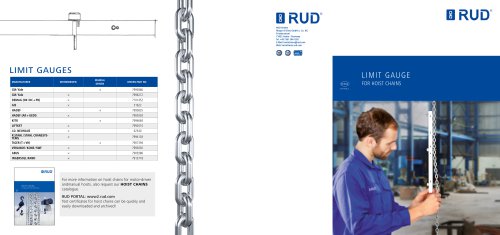 LIMIT GAUGES
2 Pages
 DRIVE TECHNOLOGY
19 Pages
 Conveyor systems
39 Pages
 Hoist chains - Industrial Chains
16 Pages
 RUD MOULD HANDLING SOLUTIONS
13 Pages


Archived catalogs
 Military Technology
7 Pages
 RUD ACP-TURNADO
32 Pages
 RUD OPTILASH (FIX / CLICK)
4 Pages
 RUD Lifting Points
128 Pages
 RUD Lifting Means System
132 Pages
 RUD Lifting Points US-Version
68 Pages
 RUD INOX-ABA
6 Pages
 RUD Chains for professional use
64 Pages
 BULKOS
16 Pages
 CRATOS - Energy
12 Pages
 Substrate feeder
4 Pages
 Forked Link Chain FORKY
8 Pages
 Snow Chains Catalog 2014/2015
43 Pages
 Foundry-Chains
2 Pages
 PSA catalog
2 Pages
 RUD Lifting points catalogue
56 Pages
 RUD Lifting Power
10 Pages
 ICE-LBG-SR VLBG
38 Pages
 Lifting means VIP
56 Pages
 The best in chain technology
40 Pages
 Lifting Power
2 Pages
 ICE series
2 Pages
 RUD_Flyer
2 Pages


*Prices are pre-tax. They exclude delivery charges and customs duties and do not include additional charges for installation or activation options. Prices are indicative only and may vary by country, with changes to the cost of raw materials and exchange rates.
About DirectIndustry
DirectIndustry is a marketplace that offers B2B players a complete experience, from product sourcing to purchase. DirectIndustry is an entity of VirtualExpo Group.
Are you a buyer?
Are you a supplier?