


RS PRO Sensors Thermocouple Guide

RS PRO Sensors Thermocouple Guide
This document is a comprehensive guide for selecting thermocouples and platinum resistance thermometers (PRTs), detailing specifications, procedures, and recommendations for various applications. It covers sensor cables, insulation materials, thermocouple accuracies, and tolerance classes according to international standards.
The guide compares insulation materials such as PVC, PFA, PTFE, glass fibre, and ceramic fibre, each with specific temperature ranges. For example, PVC is suitable for -10°C to 105°C, while ceramic fibre can withstand up to 1000°C.
Thermocouples are categorized by accuracy and temperature range per IEC 60584-1: 2013 standards. Type J thermocouples, for instance, have a Class 1 accuracy of ±0.004 .t or ±1.5°C within -40°C to +750°C.
The document compares thermocouples, PRTs, and thermistors in terms of accuracy, stability, temperature range, thermal response, and cost. Thermocouples are noted for their wide temperature range and low cost, while PRTs offer excellent stability and accuracy.
Different thermocouple junctions, such as exposed, insulated, and earthed, are discussed. Exposed junctions are recommended for non-corrosive gases, while insulated and earthed junctions are better for corrosive media.
Guidelines for using thermocouples in immersion and surface temperature measurements are provided, emphasizing correct immersion depth to avoid errors due to stem conduction.
Sheath materials are compared based on maximum continuous temperature and application suitability. Refractory oxide and silicon carbide are highlighted for high-temperature resistance and mechanical strength.
The guide concludes with a comparison between RTDs and thermocouples, noting that the choice depends on application and instrumentation requirements. RTDs are praised for precision and stability, while thermocouples are valued for their wide temperature range and cost-effectiveness.
- RTDs: Known for accuracy, stability, and resolution, but more expensive with a limited temperature range.
- Thermocouples: Rugged, versatile, available in smaller diameters, and cover a wider temperature range, though less accurate and more prone to drift.
Features include long stable life, small size, rapid response, mechanical strength, and high insulation resistance. They are water, oil, and gas-tight, easy to install, and adaptable.
Detailed tables provide specifications for various thermocouple types, including probe diameter, length, sheath material, temperature range, and stock numbers.
Includes fabricated thermocouples with features like stainless steel over-braided cables and miniature plug terminations.
Thermocouple extension leads are available with miniature or standard connectors, in various lengths and insulation types.
Available in PFA and PTFE insulated versions, designed for quick response.
Includes stainless steel penetration probes and air probes for liquid and semi-solid temperature measurement.
- Types and Specifications: Details various temperature sensors, including right-angled probes and surface probes, with maximum temperatures ranging from 400°C to 900°C.
- Thermocouple Welder & Digital Thermometer: The L60 Thermocouple Welder is for creating commercial-grade thermocouple junctions, and the L200 digital thermometer offers 8-channel temperature measurement and logging.
- Frequently Asked Questions: Addresses common inquiries about temperature sensors, including differences between mineral insulated and fabricated sheaths, accuracy levels, and sensor selection criteria.
- Choose sensors based on required accuracy, response speed, and process temperature.
- Ensure sensor loop resistance does not exceed 100 Ohms to avoid measurement errors.
- Consider using a 4-20mA transmitter for longer cable runs.
- Select appropriate materials for thermocouple sheaths based on the application environment.
Catalog excerpts

THERMOCOUPLE SELECTION GUIDE
Open the catalog to page 1
Buy this and more at rspro.com THERMOCOUPLE & PLATINUM RESISTANCE THERMOMETRY - AT A GLANCE Selecting sensor cables: Guide to insulation & covering Colour codes: thermocouple connectors, extension and compensating wires and cables Which insulation material? Useable temperature range Application notes Good general purpose insulation for ‘light’ environments. Waterproof and very flexible. PTFE (taped & wrapped) Resistant to oils, acids other adverse agents and fluids. Good mechanical strength and flexibility. PTFE better for steam/elevated pressure environments. Resistant to oils, acids other adverse...
Open the catalog to page 2
Buy this and more at rspro.com COMPARISON OF SENSOR TYPES PLATINUM RESISTANCE THERMOMETER Thermoelement, two dissimilar metals/alloys Platinum-wire wound or flatfilm resistor Ceramic (metal oxides) Long term Stability Variable, Prone to ageing Temperature range Sheathed – slow Exposed tip – fast 0.1 to 10 secs typical Wirewound – slow Film – faster 1-50 secs typical generally fast 0.05 to 2.5 secs typical Constant current required Most types non-linear Fairly linear Short cable runs satisfactory 3 & 4 wire – low. 2 wire – high Rarely susceptible Potentiometric input. Cold junction compensation...
Open the catalog to page 3
DIFFERENT THERMOCOUPLE JUNCTIONS Sheathed Thermocouples – Measuring Junctions Many alternative sheath materials are used to protect thermoelements, three alternative tip configurations are usually offered: An exposed (measuring) junction is recommended for the measurement of flowing or static non-corrosive gas temperature when the greatest sensitivity and quickest response is required. An insulated junction is more suitable for corrosive media although the thermal response is slower. In some applications where more than one thermocouple connects to the associated instrumentation, insulation may...
Open the catalog to page 4
IMMERSION OR SURFACE TEMPERATURE MEASUREMENT Buy this and more at rspro.com Surface Temperature Measurement Thermocouple assemblies are “tip” sensing devices which lends them to both surface and immersion applications depending on their construction. However, immersion types must be used carefully to avoid errors due to stem conduction; this is heat flow to or from the sheath and into or away from the process which can result in a high or low reading respectively. A general rule is to immerse into the medium to a minimum of 4 times the outside diameter of the sheath; no quantitative data applies...
Open the catalog to page 5
Buy this and more at rspro.com COMPARISON OF SHEATH MATERIALS SHEATH MATERIAL Refractory Oxide recrystallised, e.g. Alumina Impervious Good choice for rare metal thermocouples. Good resistance to chemical attack. Mechanically strong but severe thermal shock should be avoided. Forging iron & steel, incinerators, carburizing and hardening in heat treatment, continuous furnaces and glass lehrs. Silicon Carbide (Porous) Good level of protection even in severe conditions. Good resistance to reasonable levels of thermal shock. Mechanically strong when thick wall is specified but becomes brittle when...
Open the catalog to page 6
Buy this and more at rspro.com Resistance Thermometers utilise a high precision sensing resistor, usually platinum, the resistance value of which increases with temperature. The dominant standard adopted internationally is the Pt100 which has a resistance value of 100.0 Ohms at 0°C and a change of 38.50 Ohms between 0 and 100°C (the fundamental interval). Thermocouples comprise a thermoelement which is a junction of two specifield, dissimilar alloys and a suitable two wire extension lead. The junction is a short circuit only, the EMF is generated in the temperature gradient between the hot junction...
Open the catalog to page 7
ADVANTAGES OF MINERAL INSULATED THERMOCOUPLES Buy this and more at rspro.com M.I. (Mineral Insulated) cable is used to insulate thermocouple wires from one another and from the metal sheath that surrounds them. MI Cable has two (or four when duplex) thermocouple wires running down the middle of the tube. The tube is then filled with magnesium oxide powder and compacted to ensure the wires are properly insulated and separated. MI cable helps to protect the thermocouple wire from corrosion and electrical interference. • Long stable life • Small size • High insulation resistance • Rapid response...
Open the catalog to page 8
Buy this and more at rspro.com MINERAL INSULATED THERMOCOUPLES Plug Termination TYPE TEMPERATURE RANGE Miniature Plug Miniature Plug Miniature Plug TEMPERATURE RANGE Plain Pot with Tails Termination TYPE CABLE TYPE CABLE LENGTH CABLE COLOUR Threaded Pot with Tails Termination TYPE CABLE TYPE CABLE LENGTH TEMPERATURE RANGE This is just a small selection of Mineral Insulated Thermocouples offered by RS P
Open the catalog to page 9
Buy this and more at rspro.com MINERAL INSULATED THERMOCOUPLES Thermocouples with Compact KNS Terminal Head TYPE HEAD TYPE TEMPERATURE RANGE Thermocouple with Ceramic Plug Termination TYPE HEAD TYPE PROBE TEMPERATURE RANGE PLUG TEMPERATURE RANGE Miniature ceramic plug + Socket Miniature ceramic plug + Socket Miniature ceramic plug + Socket Miniature ceramic plug + Socket This is just a small selection of Mineral Insulated Thermocouples of
Open the catalog to page 10
Buy this and more at rspro.com STAINLESS STEEL FABRICATED THERMOPOCKETS Thermocouples with Compact KNS Terminal Head SUITE PROBE DIA • 25.4mm across flats hex (pockets to suit 6.0mm probe) • 1/2” BSP parallel process thread • Suitable with 3.0 or 6.0mm diameter probes WITH FITTING TO SUIT • Fabricated 316 stainless steel thermopocket IMMERSION LENGTH Stainless steel thermopockets of numerous sizes, designed for use with industrial style temperature probes to provide protection for the sheathing from corrosive media, and to facilitate probe replacement without disturbing the process. PROCESS THREAD...
Open the catalog to page 11
Buy this and more at rspro.com FABRICATED AND SPECIALIST THERMOCOUPLES Magnet Thermocouple TYPE TEMPERATURE RANGE PFA Teflon® insulated with stainless steel over-braid Miniature Plug PFA Teflon® insulated with stainless steel over-braid Miniature Plug TEMPERATURE RANGE PFA Teflon® insulated twin twisted Miniature Plug PFA Teflon® insulated twin twisted Miniature Plug TEMPERATURE RANGE PFA Teflon® insulated twin twisted Miniature Plug PFA Teflon® insulated twin twisted Miniature Plug Button Magnet Magnetic Strip This is just a small selection of Fabricated and Specialist Thermocouples offere
Open the catalog to page 12All RS PRO catalogs and technical brochures
 RS PRO Range Guide
2 Pages
 RS PRO Lighting Solutions Guide
14 Pages
 RS PRO EV Ultra Cable Guide
8 Pages
 RS PRO Sensors PRT Guide
20 Pages
 RS PRO Sensors Cables Guide
15 Pages
 RS PRO Site Safety Range Guide
32 Pages
 ESD Control Selection Guide
52 Pages
 RS PRO Fasteners Selection Guide
56 Pages
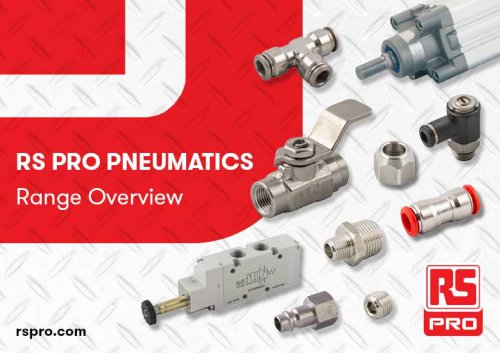 RS PRO Pneumatics Guide
84 Pages
 RS PRO Pneumatic Linecard
2 Pages
 Matting Selection Guide
25 Pages
 Tapes Selection Guide
59 Pages


- VirtualExpo Group
- Our Partners
- Recruitment
- Testimonials