
- Catalogs
- Royal Eijkelkamp
- Hand penetrometer

Hand penetrometer

Hand penetrometer
The document provides detailed instructions on the use and maintenance of the Eijkelkamp Hand Penetrometer, an instrument designed for measuring soil resistance to penetration.
The penetrometer measures resistance in a range of 200-700 N for optimal accuracy, with a mean deviation of ±8%. Measurements below 100 N are not possible, and those between 100-200 N have a deviation of ±15%. Measurements above 700 N should be avoided to prevent damage.
1. Ensure the black pointer on the manometer is at zero before use. Adjust if necessary.
2. Select an appropriate cone based on soil density.
3. Assemble the device by attaching the cone to the rod and connecting it to the measuring instrument.
4. Apply uniform pressure to insert the cone into the soil at a rate of 2 cm/sec.
5. Read the resistance from the manometer and reset the maximum pointer before each new measurement.
1. Keep the apparatus dry and clean, applying oil to prevent rust.
2. Check the measuring needle and pointers for proper function.
3. Inspect for oil leaks and refill if necessary.
4. Ensure cones and rods are clean, dry, and free from damage.
5. Return the apparatus annually for calibration.
Cones should be checked for wear and replaced if the base area is reduced by more than 5% or if the surface is damaged. Specific dimensions for rejection are provided for each cone size.
The document includes tables for converting manometer readings to cone resistance in N/cm², with examples provided for clarity.
Catalog excerpts
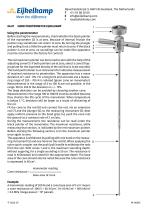
Nijverheidsstraat 9, 6987 EN Giesbeek, The Netherlands T +31 313 88 02 00 E [email protected] I royaleijkelkamp.com 06.01 HAND PENETROMETER EIJKELKAMP Using the penetrometer Before starting the measurements, check whether the black pointer of the manometer (2) is at zero. Because of internal friction the pointer may sometimes not return to zero. By turning the plunger and pulling it out a little the pointer must return to zero. If the black pointer is not at zero, no soundings can be made (the apparatus must be returned to the factory for control). Nijverheidsstraat 9, 6987 EN Giesbeek, The Netherlands T +31 313 88 02 00 E [email protected] I royaleijkelkamp.com 06.01 HAND PENETROMETER EIJKELKAMP Using the penetrometer Before starting the measurements, check whether the black pointer of the manometer (2) is at zero. Because of internal friction the pointer may sometimes not return to zero. By turning the plunger and pulling it out a little the pointer must return to zero. If the black pointer is not at zero, no soundings can be made (the apparatus must be returned to the factory for control). The red maximum pointer can be turned to zero with the help of the adjusting screw (1). If both pointers are at zero, select a cone (9) appropriate for the expected density of the soil that is to be sounded. The hand pentrometer is an instrument for indicative measurement of maximal resistance to penetration. The apparatus has a mean 7 deviation of + and - 8%. For a long term and accurate use a measuring range of 200 - 700 N is advised (green zone on manometer). Measurements in the range of 0 to 100 N are not possible. In the range 100 to 200 N the deviation is +/- 15%. The large deviation can be avoided by choosing another cone. Measurements in the range 700 to 1000 N must be avoided because they shorten the life cycle of the manometer. When temperature is below 5 °C, deviation will be larger as a result of thickening of the oil. Fit the cone to the rod (8) and connect the rod, via an extension rod (7) and the plunger (6), to the measuring instrument (5). Next apply uniform pressure to the hand grips (4), push the cone into the ground at a constant rate of 2 cm/sec. During the measurement, the resistance can be read under the black pointer of the manometer. The maximum resistance, while measuring that section, is indicated by the red maximum pointer. Before starting the following section, turn the maximum pointer once again to zero. The apparatus is withdrawn by pulling with one hand on the measuring instrument (5) and one hand on the rod (8). When applying the 8 nylon quick-coupler use the push/pull handle to withdraw the rods from the soil. With cones 1 and 2, the maximum sounding depth, without augering, for a single sounding is 50 cm. The resistance is read in N (Newton) and noted for the appropriate depth. The base area of the cone should also be noted because the cone resistance is expressed in N/cm2. The red maximum pointer can be turned to zero with the help of the adjusting screw (1). If both pointers are at zero, select a cone (9) appropriate for the expected density of the soil that is to be sounded. The hand pentrometer is an instrument for indicative measurement of maximal resistance to penetration. The apparatus has a mean 7 deviation of + and - 8%. For a long term and accurate use a measuring range of 200 - 700 N is advised (green zone on manometer). Measurements in the range of 0 to 100 N are not possible. In the range 100 to 200 N the deviation is +/- 15%. The large deviation can be avoided by choosing another cone. Measurements in the range 700 to 1000 N must be avoided because they shorten the life cycle of the manometer. When temperature is below 5 °C, deviation will be larger as a result of thickening of the oil. Fit the cone to the rod (8) and connect the rod, via an extension rod (7) and the plunger (6), to the measuring instrument (5). Next apply uniform pressure to the hand grips (4), push the cone into the ground at a constant rate of 2 cm/sec. During the measurement, the resistance can be read under the black pointer of the manometer. The maximum resistance, while measuring that section, is indicated by the red maximum pointer. Before starting the following section, turn the maximum pointer once again to zero. The apparatus is withdrawn by pulling with one hand on the measuring instrument (5) and one hand on the rod (8). When applying the 8 nylon quick-coupler use the push/pull handle to withdraw the rods from the soil. With cones 1 and 2, the maximum sounding depth, without augering, for a single sounding is 50 cm. The resistance is read in N (Newton) and noted for the appropriate depth. The base area of the cone should also be noted because the cone resistance is expressed in N/cm2. manometer reading Cone resistance = base area of cone manometer reading Cone resistance = base area of cone Example: A manometer reading of 300 N and a cone base area of 5 cm2 means a cone resistance of: 300/5 = 60 N/cm2. Or: 60 N/cm2 = 600 kN/m2 = 0.6 MPa (mega pascal = 106 pascal). Example: A manometer reading of 300 N and a cone base area of 5 cm2 means a cone resistance of: 300/5 = 60 N/cm2. Or: 60 N/cm2 = 600 kN/m2 = 0.6 MPa (mega pascal = 106 pascal).
Open the catalog to page 1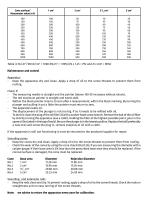
Cone surface/ Manometer value in N Cone surface/ Manometer value in N Maintenance and control Apparatus - Keep the apparatus dry and clean. Apply a drop of oil to the screw threads to prevent them from rusting. Maintenance and control Apparatus - Keep the apparatus dry and clean. Apply a drop of oil to the screw threads to prevent them from rusting. Check if: - The measuring needle is straight and the pointer (above 100 N) increases without shocks. - The red maximum pointer is straight and works well. - Wether the black pointer returns to zero after a measurement, within the black marking. By...
Open the catalog to page 2All Royal Eijkelkamp catalogs and technical brochures
 Pocket vane tester
2 Pages
 Van Veen grab
4 Pages
 Van Dorn water sampler, set
2 Pages
 Rust on gouges and augers
2 Pages