
- Catalogs
- ROSS Controls
- ROSS CONTROLS FLUID POWER PRODUCTS FOR PNEUMATIC SOLUTIONS

ROSS CONTROLS FLUID POWER PRODUCTS FOR PNEUMATIC SOLUTIONS

ROSS CONTROLS FLUID POWER PRODUCTS FOR PNEUMATIC SOLUTIONS
- General Information: Provides ordering information and additional literature references.
- Product Specifications: Details various valve types, including line-mounted and base-mounted valves, with specific series and applications.
- Industry Solutions: Highlights tailored solutions for industries such as glass container manufacturing, steel processing, and metal forming, emphasizing efficiency and reduced maintenance.
- Safety Products: Lists safety-related solutions, including control reliable valves and energy isolation products, meeting global safety standards.
- Historical Context: Describes the origins of ROSS Controls and its evolution into a global leader in pneumatic control systems.
- ROSS emphasizes customer-driven innovation through its ROSS/FLEX® process.
- The company is ISO 9000 certified and operates globally with a network of distributors.
- Safety products are designed to meet or exceed global safety requirements.
- Ambient/Media Temperature: 40° to 175°F (4° to 80°C).
- Flow Media: Filtered air; 5 micron recommended.
- Inlet Pressure: Vacuum to 150 psig (10 bar).
- Pilot Pressure: Size 1 models require at least 30 psig (2 bar), Size 2 & 3 models require at least 15 psig (1 bar).
- Solenoids: AC or DC power with standard voltages of 24 volts DC; 110-120 volts AC, 50/60 Hz.
- Power Consumption: Each solenoid uses 8.5 VA inrush, 6 VA holding on 50 or 60 Hz; 6 watts on DC.
- Manual Override: Flush; metal, non-locking.
- Options: Indicator Light available in electrical connector.
- 5/3 Valves: Double Pressure Controlled with Closed Center, Open Center, and Power Center configurations.
- 5/2 Valves: Single Pressure Controlled, Spring Return; Double Pressure Controlled, Detented; Single Solenoid Pilot Controlled, Spring Return; Double Solenoid Pilot Controlled, Detented.
- EnergySaver® Valves: Reduces compressed air consumption up to 30% by reducing cylinder retract pressure.
- The ENERGYSAVER® valve operates by directing full line pressure to port 4 and reduced pressure to port 2, providing full cylinder force to move the load while reducing air consumption during retraction.
- Solenoid Energized: Directs supply pressure from the inlet port to port 4, extending the cylinder at full pressure.
- Solenoid De-energized: The spool shifts back to a normal position, directing inlet air to the rod end of the cylinder and exhausting the cap end.
- ISO Port Valve Models are available in sizes 1/8 - 3/8, 3/8 - 1/2, and 1/2 - 3/4 with varying dimensions and weights.
- Sub-base and electrical connectors are not included and must be ordered separately.
- Manifolds and sub-bases are available for different ISO sizes with specific dimensions.
- Connectors for use with DROPCORDS (DIN 43650, Form A) are available, allowing cord orientation in multiple directions.
- Carefully read all CAUTIONS and WARNINGS provided in the documentation.
- Specify voltage when ordering valves.
- Manifold stations are equipped with NPT threads for pressure ports and electrical openings. Indicator lights are available for smaller manifold sizes.
- Solenoid and pressure-controlled manifolds have different port positions and cannot be mixed in the same installation.
- Standard voltages for solenoids are 24 volts DC and 110-120 volts AC, 50/60 Hz.
- Valves are rated for continuous duty with specific power consumption values for different models.
- Operating temperature ranges from 5° to 120°F for ambient and 5° to 175°F for media.
- Manifold stations are assembled by ROSS and ready for system integration. Consult ROSS distributors for detailed assembly information.
- Interposed pressure regulators can be used with valves having CV ratings up to 4.2, allowing for independent pressure settings at outlet ports.
- Manual override kits are available for solenoid pilot-controlled valves, with options for locking and non-locking buttons.
- Use only manifold stations for solenoid-controlled valves if both solenoid and pressure-controlled valves are required in the same installation.
- For temperatures below 40°F, ensure air is free of water vapor to prevent ice formation.
- Specify voltage when ordering valves and accessories.
- Read all cautions and warnings thoroughly, especially regarding the potential for unexpected cylinder movement with double interposed regulators.
- CV values are specific to ROSS performance charts and should not be used for comparison with other manufacturers.
- Specifications: Rated for continuous duty with standard voltages of 24 volts DC and 110-120 volts AC, 50/60 Hz. Power consumption is 0.03 VA holding on 50/60 Hz and 0.8 watts on DC.
- Temperature Range: Ambient temperature is 39° to 122°F (4° to 50°C), and media temperature is 39° to 175°F (4° to 80°C).
- Flow Media: Filtered air with inlet pressure ranging from 30 to 150 psig (2 to 10 bar).
- Certification: Certified by CSA according to UL 429 and CSA 22.2-139.
- Features: Includes a patented ball-poppet design for near-zero internal leakage and faster operation than spool valves.
- Applications: Suitable for manual control of devices like air hoists and motors, ideal for material handling devices.
- Specifications: Ambient temperature is 40° to 120°F (4° to 50°C), media temperature is 40° to 175°F (4° to 50°C), and inlet pressure is 0 to 150 psig (0 to 10 bar).
- Design: Features spring-return rubber poppet internals for dependable shifting and long life.
- Specifications: Ambient/media temperature is 40° to 175°F (4° to 80°C), with inlet pressure ranging from 5 to 150 psig (0.3 to 10 bar).
- Design: Includes self-cleaning poppet design that tolerates dirty air.
- Specifications: Similar temperature and pressure specifications as pushbutton and toggle lever valves.
- Design: Available in roller and plunger types, with self-cleaning poppet design.
- Function: Used to control air flow from air cylinders, allowing free flow in one direction and adjustable flow in the other.
- Design: Adjustment is made via a screwdriver slot or a knurled knob, depending on the model.
- Effectiveness: Isolates equipment by shutting off air supply and immediately exhausting stored air.
- Ease of Use: Simple push/pull operation with a large red handle.
- Locking Protection: Can be padlocked in the closed position to prevent accidental operation.
- Reliability: PTFE seals ensure functionality even after long periods of inactivity.
- Efficiency: Large exhaust ports for quick air release, compatible with silencers or remote exhaust lines.
- User Confidence: Three-way valve design ensures any leakage is exhausted faster than it can build up.
- Visual Indicator: Model 1155H30 with dimensions 2.33 inches (59.3 mm) and weight 0.22 lbs (0.1 kg).
- Pressure Switch: Model 1162A30 with dimensions 8.50 inches (215.9 mm) and weight 0.23 lbs (0.01 kg). Features a 316 stainless steel body and nitrile seals.
- Silencers: Available in port sizes 1/4 to 2 inches, constructed from stainless steel or nickel-plated bodies with stainless internals.
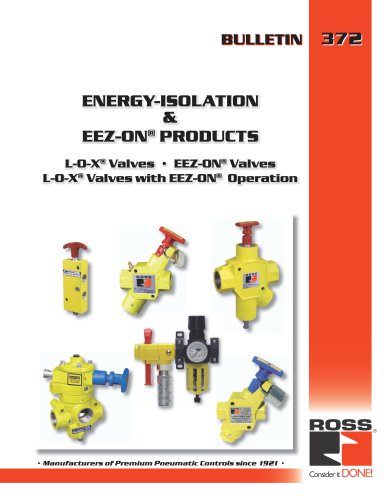
- L-O-X® Valves: Manual and solenoid pilot controlled options available, designed for lockout/tagout applications. Various models with different port sizes and configurations.
- Valve Operation: Describes the operation of L-O-X® valves, including opening and closing mechanisms, and the role of the red handle for quick shut-off.
- Pressure Control: Details on pressure-controlled and solenoid pilot-controlled operations, including inlet and exhaust port functions.
- Products are defined as energy isolation devices, not emergency stop devices.
- Machine design should include methods for verifying energy release after lockout.
- Electrical life of switches rated in excess of 15 million cycles.
- Stainless steel construction for wash-down applications.
- Visual indicators with 360° visibility and redundant verification features.
- Pressure switches integrated into safety monitoring systems.
- Flow Media: Filtered air with a 5-micron recommendation.
- Inlet Pressure: Ranges from 15 to 150 psig (1 to 10 bar) for standard valves, and up to 200 psig (13.8 bar) for modular L-O-X® valves.
- Temperature Range: Ambient and media temperatures range from 40°F to 175°F (4°C to 80°C).
- Port Threads: Available in NPT and BSPP.
- Body Paint: Gold for standard valves, yellow for L-O-X® valves.
- Solenoid Pilot Controlled Valves: These valves use AC or DC power solenoids and are available in various port sizes with specific model numbers. They feature adjustable needle valves for controlling pressure buildup.
- Internal Pressure Controlled Valves: Similar to solenoid-controlled valves but operate based on internal pressure changes.
- EEZ-ON® Valves: Designed for gradual air pressure application to prevent rapid equipment movement. They include features like exhaust ports and adjustable pressure settings.
- Manual L-O-X® Valves with EEZ-ON® Operation: These combine shut-off capabilities with gradual pressurization, featuring a blue handle for easy identification and operation.
- EEZ-ON® valves allow for gradual downstream air pressure buildup, adjustable via a needle valve.
- Solenoid and internal pressure-controlled valves shift to full open positions when downstream pressure reaches a certain percentage of inlet pressure.
- Manual L-O-X® valves can be locked in the off position for safety and feature a large exhaust port for rapid pressure release.
- Optional indicator lights for solenoid pilot-controlled valves.
- Integrated sensing ports for pressure verification in L-O-X® valves.
- Compatibility with MUFFL-AIR® silencers for noise reduction.
- These valves are defined as energy isolation devices and not as emergency stop devices.
- Special attention should be given to the CAUTIONS and WARNINGS provided in the document.
- Drain Options: Automatic, manual, or float drain (metal bowl only).
- Filter Element: 5-micron polyethylene, optional 40-micron.
- Pressure Ratings: Inlet pressure minimum 15 psig with automatic drain; plastic bowl up to 150 psig, metal bowl up to 200 psig. Outlet pressure adjustable up to 150 psig.
- Materials: Nitrile seals, brass valve, acetal slide.
- Ports: Available in 1/4, 3/8, 1/2 sizes with NPT and BSPP threads.
- Integrated filter and regulator in a compact design.
- Modular mounting for easy servicing.
- Reverse flow, self-relieving piston-type regulator.
- Lockable only in the off position for safety.
- Optional EEZ-ON® operation for ease of use.
- Closed Position: Blocks supply air, allows downstream air to exhaust, must be padlocked during maintenance.
- Open Position: Allows free flow from inlet to outlet, exhaust port blocked, handle detented in open position.
- Extra port block for auxiliary ports.
- MUFFL-AIR® silencers for noise reduction.
- Clamps and mounting brackets for module connections.
- Male and female end ports for easy module removal.
- Combines poppet technology with position and state sensing.
- Provides electrical feedback via a safety-rated DPST switch.
- Available in 2/2 and 3/2 normally closed functions.
- Enhanced safety with optional visual pressure indicator or pressure switch.
The document references several standards including CSA Z460-05, ISO 13849-1, ISO 14118:2000, EN 1037, ANSI/ASSE Z244.1-2003 (R2008), and ANSI/PMMI B155.1-2011. These standards relate to safety requirements for machinery and control systems, particularly focusing on lockout/tagout (LOTO) procedures and control reliability.
The document lists various valve types such as Solenoid Pilot and Pressure Controlled valves, with specifications on length and number of cables. For example, the Solenoid Pilot valve is available in lengths of 4 meters (13.1 feet) and 10 meters (32.8 feet), each with two cables.
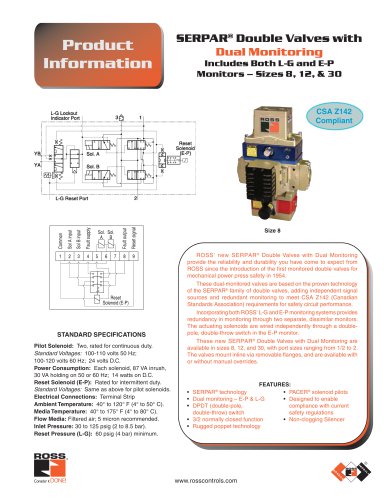
The document describes dynamic monitoring features integrated into valve elements for Category 3 and 4 applications. These valves exhaust downstream air if asynchronous movement occurs, ensuring safety by maintaining a residual outlet pressure of less than 1% of supply. The valves are designed to reset automatically without memory of abnormal behavior, except in certain series where an intentional reset is required.
The valves feature a 3/2 Normally Closed Valve Function with dirt-tolerant, wear-compensating poppet design for quick response and high flow capacity. They include status indicators with pressure switches to provide feedback on valve conditions. The valves are equipped with silencers and are inline mounted with flexible piping options.
The document provides detailed technical specifications for the valves, including power consumption, standard voltages, ambient and media temperature ranges, inlet pressure, and functional safety data. The valves are CE marked and tested for vibration/impact resistance.
The operation of the valves is explained, detailing the flow of inlet air pressure, the actuation and de-actuation process, and the handling of asynchronous operations. The document emphasizes the importance of integrating the status indicator switch into the electrical safety control system to prevent hazardous situations.
In normal operation, energizing both solenoids actuates the pilots, causing valve elements A and B to shift, connecting inlet 1 to outlet 2 via crossflow passages C and D, while closing exhaust 3. Monitoring pressure signals equalize to inlet pressure.
Completion of Normal Cycle:
De-energizing both solenoids returns the valve to its initial state, where inlet 1 is closed to outlet 2, and outlet 2 is open to exhaust 3.
Malfunction Detection:
A malfunction may cause one valve element to remain open while the other closes, leading to pressure imbalance. This triggers a switch (SW) that breaks the electrical circuit to the pilot solenoids, returning valve element A to the closed position.
Lock-out Mechanism:
In a lock-out state, monitoring air pressure is exhausted, and the electrical circuit remains broken. To reset, a reset solenoid must be briefly energized, ensuring pilot solenoids are de-energized to prevent hazardous cycling.
Specifications:
Pilot solenoids are rated for continuous duty with standard voltages of 24 volts DC or 110-120 volts AC. The E-P reset solenoid is rated for intermittent duty. The valves operate within an ambient temperature range of 40° to 120°F and a media temperature range of 40° to 175°F. The pressure range is 30 to 125 psig.
Functional Safety and Certifications:
The valves are certified with CE Mark, BG, CSA/UL, and tested for vibration/impact resistance. They meet functional safety data requirements with a Category 4 PL e rating.
Wiring and Model Information:
Single and dual input wiring diagrams are provided, with model numbers specified for different configurations and sizes. Voltage codes "W" for 24 volts DC and "Z" for 110-120 volts AC are used in model numbers.
Important Notes:
Valves without pressure switches should not be used for controlling clutch/brake mechanisms on press machinery. External monitoring systems are required for compliance with safety standards.
This document provides guidelines and safety measures for the installation and maintenance of pneumatic controls by ROSS CONTROLS, a manufacturer of premium pneumatic controls since 1921. It includes cautions, warnings, and warranty information.
Pre-Installation and Service Guidelines
1. Ensure all energy sources are turned off and locked out before servicing pneumatic components (OSHA 1910.147, EN 1037).
2. Only trained personnel should install or service ROSS products. Regular checks and maintenance are necessary.
3. Follow all instructions to prevent harm to persons or equipment. Test overhauled or serviced valves before use.
4. Use ROSS parts for repairs and adhere to specification limits.
Filtration and Lubrication
5. Install a 5-micron filter to clean air supply and prevent contaminants.
6. Use metal bowl guards for polycarbonate plastic bowls to prevent high-pressure fragmentation. Avoid exposure to certain fluids.
7. Use compatible lubricants, typically petroleum-based oils with specific properties, to avoid valve failure.
Avoid Intake/Exhaust Restriction
8. Do not restrict air flow in supply lines to prevent pressure drops.
9. Ensure exhaust silencers are clog-resistant and have adequate flow capacity.
Power Presses
10. Use a press control double valve with a monitoring device for hazardous machinery. Ensure monitoring systems inhibit operation in case of valve failure.
Energy Isolation/Emergency Stop
11. ROSS L-O-X® products are energy isolation devices, not emergency stop devices.
Standard Warranty
ROSS products are warranted for one year (seven years for FRLs) against defects. The warranty covers repair, replacement, or refund at ROSS's discretion. Misuse or improper maintenance voids the warranty.
Global Reach
ROSS distributors are available worldwide to assist with product selection and support. Contact information for various regions is provided.
Catalog excerpts

DIGEST CATALOG
Open the catalog to page 1
This catalog represents an overview of ROSS’ extensive product line. If you need products or specications not shown within this catalog, please contact ROSS for more information or visit ROSS website at www.rosscontrols.com.
Open the catalog to page 2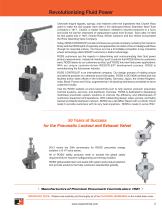
Revolutionizing Fluid Power Chevrolet engine tappets, springs, and retainers were the ingredients that Charlie Ross used to make the rst poppet valve after a re destroyed Detroit Seamless Steel Tube Company in 1917. Charlie, a master mechanic, needed to resume production in a hurry and could not wait for shipments of replacement valves from Europe. Soon after, he led his rst patent and in 1921, Charlie Ross, StClair Cameron and four others incorporated the Ross Operating Valve Company. Today, ROSS CONTROLS® proudly continues as a private company owned by the Cameron family and the ROSS spirit...
Open the catalog to page 3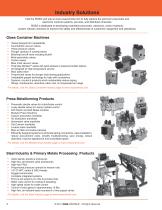
Industry Solutions Visit the ROSS web site at www.rosscontrols.com to fully explore the premium pneumatic and electronic controls systems, services, and distributor channels. ROSS is dedicated to developing matchless pneumatic, electronic, and/or hydraulic system industry solutions to improve the safety and effectiveness of customers’ equipment and operations. Glass Container Machines • • • • • • • • • • • • • • Valves designed for repeatability Counterblow vacuum valves Hi/low pressure valves Plunger up/down & cooling valves Blowhead on/off valve including kickoff Mold open/close valves Pusher...
Open the catalog to page 4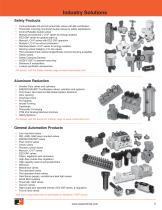
Industry Solutions Safety Products • • • • • • • • • • • • • • • Control Reliable 3/2 and 5/2 pneumatic valves with BG certication Pneumatic internally monitored double valves for safety applications Control Reliable double valves Manual and solenoid L-O-X® valves for energy isolation EEZ-ON® valves for gradual start-up Manual L-O-X® valves with EEZ-ON® operation Modular L-O-X® air entry combination Stainless Steel L-O-X® valves for energy isolation Sensing valves Category 2 In-line valves Pilot operated check valves (single/double channel sensing available) Check valves Safety Clamping Devices...
Open the catalog to page 5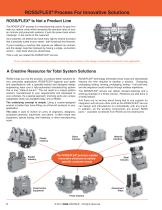
ROSS/FLEX® Process For Innovative Solutions ROSS/FLEX® Is Not a Product Line The ROSS/FLEX® process is a manufacturing culture. Its goal is to help you reduce costs while increasing the practical value of your air controls and pneumatic systems. It puts the power back where it belongs: In the hands of the customer! As a customer, we believe you have every right to receive a product that is precisely suited to your needs - both functional and nancial. If you’re building a machine that requires six different air controls, and the design could be improved by having a single, six-function control...
Open the catalog to page 6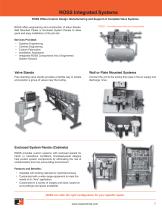
ROSS Integrated Systems ROSS Offers Custom Design, Manufacturing and Support of Complete Valve Systems ROSS – Providing more than just components ROSS offers engineering and construction of Valve Stands, Wall Mounted Plates or Enclosed System Panels to allow quick and easy installation at the job site. Services Provided: Systems Engineering Controls Engineering Custom Fabrication Installation Assistance Integrated ROSS Components into a Engineered System Solution Valve Stands Wall or Plate Mounted Systems Free standing valve stands provides a exible way to isolate and position a group of valves...
Open the catalog to page 7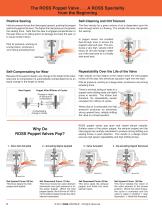
The ROSS Poppet Valve . . . A ROSS Speciality from the Beginning Positive Sealing Self-Cleaning and Dirt Tolerant Inlet air pressure forces the inlet poppet upward, pushing the poppet seal rmly against the seat. The higher the inlet pressure, the greater the sealing force. Note that the seal is engaged perpendicular to the seat; there is no sliding action to damage and wear the seal, or to cause erratic friction. The ow velocity for a given volume of air is dependent upon the area through which it is owing. The smaller the area, the greater the velocity. In poppet valves, the smallest ow-through...
Open the catalog to page 8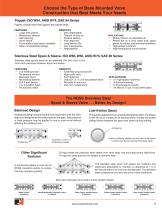
Choose the Type of Base Mounted Valve Construction that Best Meets Your Needs Poppet- ISO W64, ANSI W74, SAE 84 Series Poppet surfaces face-seal against at poppet seats. FEATURES • Large pilot pistons • Mechanical detents • Self-cleaning • Short stroke • Fluorocarbon seal option available • Wear-compensating design BENEFITS • Very dependable • Tolerant of dirty air • Positive seating • Fast response • Long service life • Low maintenance • Repeatability Where there is no lubricated air Where the air is dirty (steel mills, glass plants, foundries, and aluminum smelters) High-speed machines High-temperature...
Open the catalog to page 9
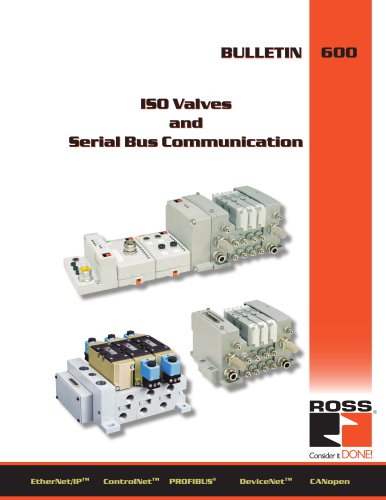
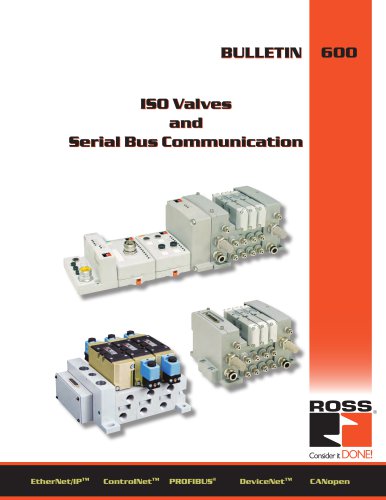
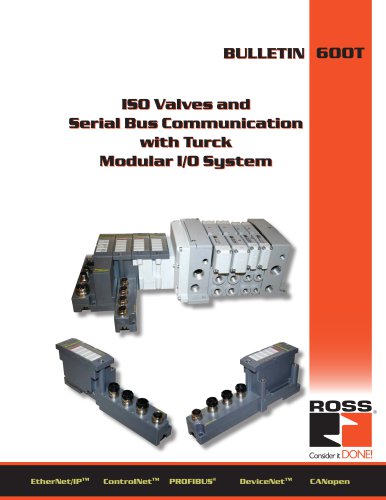
ISO Valves and Serial Bus Communication from ROSS CONTROLS For more information please refer to Please visit the ROSS web site to view the complete Bulletin 600 (Form #A10309) and Bulletin 600T (Form A10309T) at www.rosscontrols.com. © 2013, 5266 CONTROLS®. All Rights Reserved.
Open the catalog to page 10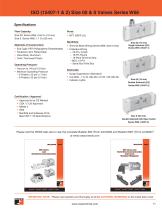
ISO (15407-1 & 2) Size 00 & 0 Valves Series W66 Specications Flow Capacity: Size 00, Series W66: 0.55 Cv (18 mm) Size 0, Series W66: 1.1 Cv (26 mm) End Caps: PBT (Polybutylene Terephthalate) Fasteners: Zinc Plated Steel Valve Body: Aluminum Coils: Thermoset Plastic Operating Pressure: • Vacuum to 145 psi (10 bar) • Minimum Operating Pressure Size 00 (18 mm) Single Solenoid (5/2) Series W66 (15407-1) • Terminal Block Wiring (Series W66, Size 0 Only) • Collective Wiring – 25-Pin, D-Sub – 19-Pin Round – 16 Point Terminal Strip – M23, 12-Pin – Serial Bus Field Bus Solenoids: • Surge Suppression (Standard)...
Open the catalog to page 11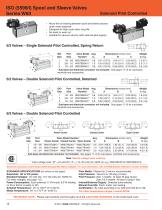
ISO (5599/I) Spool and Sleeve Valves Series W60 Solenoid Pilot Controlled • Micro-thin air bearing between spool and sleeve assures quick valve response • Designed for high cycle rates, long life • No seals to wear out • Suitable for vacuum service (with external pilot supply) 4 2 5/2 Valves – Single Solenoid Pilot Controlled, Spring Return Port Size Valve Model Avg. Number* CV * Sub-base and electrical connector not included. See pages 17-19 for sub-bases, manifolds and accessories. 4 2 5/2 Valves – Double Solenoid Pilot Controlled, Detented Port Size Valve Model Avg. Number* CV * Sub-base and...
Open the catalog to page 12All ROSS Controls catalogs and technical brochures
 safety product
32 Pages
 Line-Mount Valves
16 Pages
 DM2
DM24 Pages
 MD3
MD316 Pages
 CM series
4 Pages
 Press Industry Solutions
28 Pages
 DM2 Series D
16 Pages
 Safety-Related Products
32 Pages
 Fluid Power Safety Overview
4 Pages
 Modular Pneumatic Solutions
8 Pages
 Drip Leg Drains
2 Pages
 ISO 5599 I and II VDMA 24563
20 Pages
 Series 80 and 84 SAE Std
12 Pages
 Series 70 and 74
12 Pages
 L -O-X ® V a l v es
4 Pages
 W60
W604 Pages
 foot valves
1 Page
 manual valve
12 Pages
 Pilot operated check valves
12 Pages
 safety valve
13 Pages
 FRL ROSS
12 Pages
 poppet valve
16 Pages
 TSSA
TSSA48 Pages






Archived catalogs
 ENERGYSAVER® Valve
2 Pages
 Ross regulators
2 Pages
 serial bus system
29 Pages
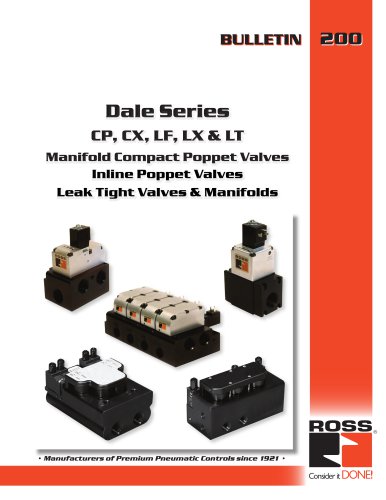
 Dale series poppet valves
16 Pages

- Manual valve
- Stainless valve
- Regulating valve
- On/off valve
- Gas solenoid valve
- 2-way solenoid valve
- NC solenoid valve
- Directional control valve
- Direct-operated solenoid valve
- Single-stage pressure regulator
- Lift valve
- Industrial pressure limiter
- Air solenoid valve
- Pilot-operated solenoid valve
- Pneumatic directional control valve
- NO solenoid valve
- 3-way solenoid valve