
- Catalogs
- ROLAND ELECTRONIC
- I100-S-WI Double Sheet Detection System


- Company
- Products
- Catalogs
- News & Trends
- Exhibitions
I100-S-WI Double Sheet Detection System

I100-S-WI Double Sheet Detection System
- Material Thickness Detection: Tinplate (0.15-0.25 mm), Aluminum (0.05-0.40 mm), Non-magnetic Stainless Steel (0.50-3.0 mm).
- Sensor: WI42GS, inductive, with a compact aluminum enclosure and IP54 protection class.
- Operating Temperature: 0° - 50°C (32° - 122°F).
- Power Supply: 24 VDC with a power consumption of approximately 2.7 W.
- Switching Outputs: 0-1-2 sheet opto coupler outputs, output sourcing (PNP).
- Easy setup via key operation or control input.
- LCD display for visualization of values and error messages.
- Minimal operator intervention with a Teach-In process for setting switching thresholds.
- Sensor Distance: Air gap < 2 mm.
- Measurement Period: Minimum dwell time of 30 ms in the sensor gap.
- Enclosure Dimensions: 130 x 155 x 37 mm (H x W x D).
Catalog excerpts

SINGLE SIDE SYSTEM, CONTACTING Single probe double sheet detection system for tinplate, aluminum and non-magnetic stainless steel • Sensor WI42GS, inductive Single probe measurement of - Tinplate 0.15 ... 0.25 mm (0.4 mm, depending on alloy) single sheet metal thickness - Aluminum 0.05 ... 0.40 mm single sheet metal thickness - Non-magnetic Stainless Steel 0.50 ... 3.0 mm single sheet metal thickness Easy set-up by key operation or via control input LCD display for visualization of nominal / current values, operational / error message, key allocation Compact aluminum enclosure for machine frame mounting,
Open the catalog to page 1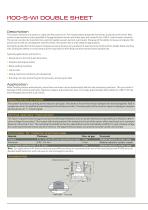
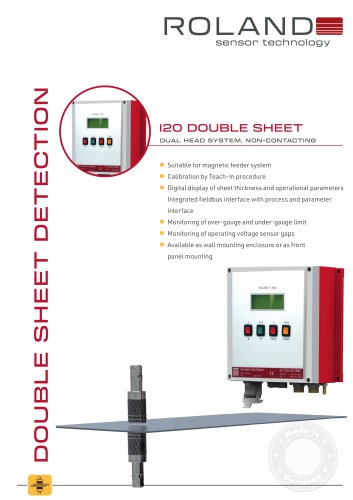
I100-S-WI DOUBLE SHEET Description The system consists of a sensor, a cable and the control unit. For measurement purposes the sensor is placed on the sheet. Noncontact measurement is also possible if the gap between sensor and sheet does not exceed 2 mm (.08 in.) and remains constant. The sensor can also be mounted into a spring-loaded vacuum suction cup bracket. Because of the ability to measure tinplate, thin aluminum as well as nonmagnetic stainless steel, this system has a wide range of applications. During the production of three piece tinplate cans practically every production step has...
Open the catalog to page 2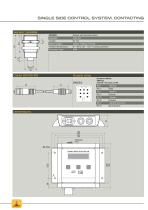
Cable SCWIS-GG
Open the catalog to page 3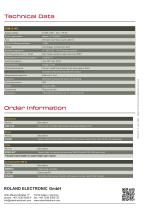
Technical Data Supply voltage Power consumption Power / Switching indication LCD display, 16 characters each Ambient temperature Switching outputs 0-1-2 - Sheet Opto coupler outputs, output sourcing (PNP) Temperature drift of switching point Switching capacity Sensor distance Measurement period The min. dwell time of sheet in the sensor gap is 30 ms. Material requirements Constant conductivity, flat and even surface Measurement target size Aluminum enclosure for screw-on mounting Plug connection Order Information Control unit Part no. Control unit, for single head sensor, operating voltage 24...
Open the catalog to page 4All ROLAND ELECTRONIC catalogs and technical brochures
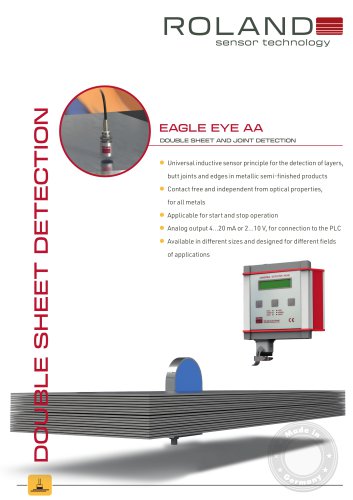 EAGLE EYE AA
4 Pages
 NS9N-AAD-SC
4 Pages
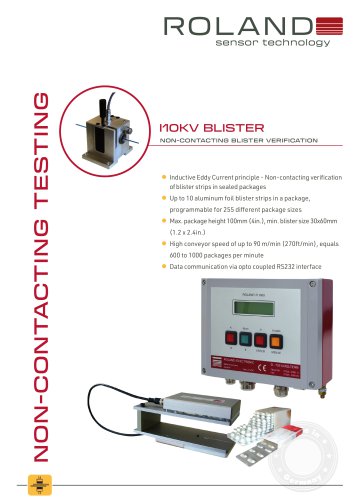 I10KV BLISTER
4 Pages
 SIS VISION
4 Pages
 SND8S
SND8S4 Pages
 SND40 for coils
4 Pages
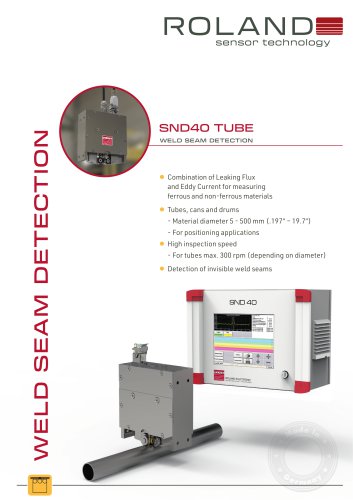 SND40 for tubes
4 Pages
 SHX42 Sensor bracket
4 Pages
 Angle Control Unit SIS-ACU
4 Pages



- Inspection system
- Industrial detector
- Monitoring detector
- Automatic inspection system
- Compact detector
- Detector with digital display
- Analog detector
- Defect detection inspection system
- Automatic detector
- Detector with LCD display
- Non-contact detector
- Pipe inspection system
- Combined detector
- Laser detector
- Detector for the automotive industry
- Multichannel detector
- Non-destructive control system
- Sensor support
- Electromagnetic detector
- Enclosure detector