
- Catalogs
- Rohrback Cosasco Systems
- Linear Polarization Resistance (LPR) Transmitter

Linear Polarization Resistance (LPR) Transmitter

Linear Polarization Resistance (LPR) Transmitter
The Model 9020 Linear Polarization Resistance (LPR) Transmitter is designed for precise corrosion rate monitoring in various water systems, including high conductivity cooling water and seawater, as well as low conductivity condensates. It operates on a two-wire loop powered system, simplifying installation and operation.
Features
- Two-Wire Loop Powered
- Continuous Corrosion Rate Monitoring
- Second Loop for Imbalance Measurement
- Extended Operating Range
- Available as an OEM Module
Specifications
- Corrosion Rate Ranges: 0-2, 0-20, and 0-200 MPY
- Imbalance Ranges: 0-2, 0-20, and 0-200 Imbalance Units
- Cycle Time: 5, 10, 15, and 20 minutes
- Resolution: 0.1% of Full Scale
- Operating Range: Refer to Graph
- Alloy Multiplier Range: 0.2 to 2.99
- Ambient Temperature Range: -18°C to +60°C
- Supply Voltage Range: 16-32 VDC at 20 mA
- Weight: 2 lbs (1 Kg)
- Enclosure: NEMA 4X, IP66
- Probe Cable: 6 ft
- Compatibility: All 2-electrode or 3-electrode LPR Probes
Functionality
The transmitter is housed in a NEMA-4X (IP 66) weatherproof enclosure suitable for field mounting. It can be integrated into existing systems or tower controllers to provide continuous corrosion rate monitoring. An independent second current loop measures imbalance, which is indicative of pitting corrosion activity and inhibitor film stability.
Ordering Information
- Model 9020: LPR Transmitter
- 9020-OEM: 4-20 mA Loop Transmitter Module
Contact Information
Cosasco, 11841 Smith Avenue, Santa Fe Springs, CA 90670, USA. Tel: 1-562-949-0123. Email: [email protected]. Website: www.cosasco.com
Disclaimer
The information provided is for informational purposes only and is not to be construed as warranties or guarantees. The company reserves the right to modify or improve product designs or specifications without notice.
Catalog excerpts

Linear Polarization Resistance (LPR) Transmitter Model 9020 Features Two-Wire Loop Powered Continuous Corrosion Rate Second Loop for Imbalance Measurement Extended Operating Range Available as an OEM Module The Model 9020 Linear Polarization Resistance (LPR) Transmitter is ideal for accurately monitoring corrosion rate in water systems ranging from high conductivity cooling water and seawater to low conductivity condensates. Power is supplied to the transmitter and the corrosion rate data obtained over a single pair of wires which facilitates installation and operation. The 9020 LPR Transmitter is mounted in a NEMA‐4X (IP 66) weatherproof enclosure suitable for field mounting; or for OEM users, the 4‐20 mA. The Loop LPR Transmitter Module can be easily installed in existing systems or tower controllers to provide continuous corrosion rate monitoring. An independent second current loop provides the imbalance measurement which is a sample of Electrochemical Current No
Open the catalog to page 1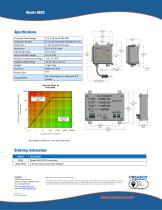
Corrosion Rate Ranges Operating Range for Model 9020 Note: Based on 20% error limit (see ASTM G96) Cosasco 11841 Smith Avenue Santa Fe Springs, CA 90670, USA Tel: 1-562-949-0123 Email: [email protected] Web Site: www.cosasco.com ©Rohrback Cosasco Systems, Inc. All rights reserved The contents of this publication are presented for information purposes only, and while effort has been made to ensure their accuracy, they are not to be construed as warranties or guarantees, express or implied, regarding the products or services described wherein or their use or applicability. We reserve the right...
Open the catalog to page 2All Rohrback Cosasco Systems catalogs and technical brochures
 SIDE-STREAM ASSEMBLY
3 Pages
 RETRACTABLE SYSTEM BIO-PROBE
2 Pages
 BIO-PROBE
3 Pages
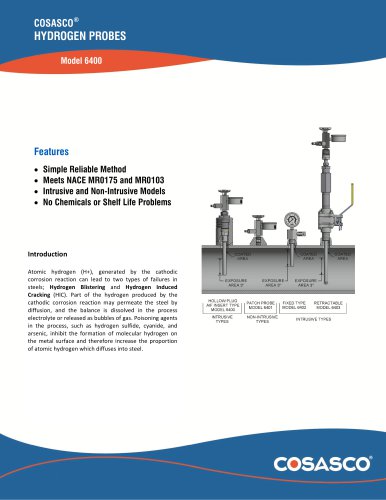 Model 6400
4 Pages
 DCMS®
DCMS®5 Pages
 DCHA
DCHA6 Pages
 CORRDATA®
2 Pages
 WIRELESS SYSTEM
7 Pages
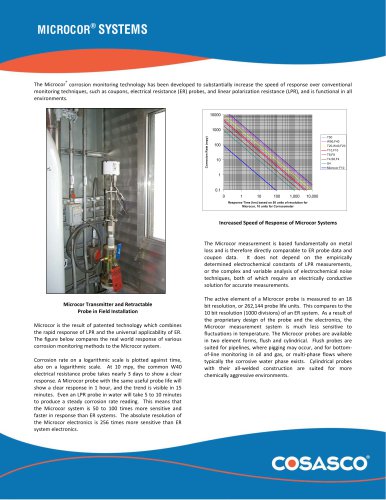 MICROCOR® SYSTEMS
4 Pages
 Electrical Resistance (ER)
4 Pages
 COSASCO®
3 Pages
 MICROCOR®
7 Pages
 Cosasco Catalog
492 Pages


- Fitting
- Hydraulic fitting
- Screw-in fitting
- Metal fitting
- Measuring device
- Threaded fitting
- T-shaped fitting
- Portable gauge
- Portable detector
- Measurement monitoring module
- Temperature monitoring module
- Continuous monitoring module
- High-pressure fitting
- High-precision gauge
- Remote monitoring module
- Production monitoring system
- Wireless monitoring module
- Online monitoring module
- Flange fitting
- Process probe