
- Catalogs
- ROHM Semiconductor
- Next-Generation Op Amp series

- Company
- Products
- Catalogs
- News & Trends
- Exhibitions
Next-Generation Op Amp series

Next-Generation Op Amp series
ROHM has developed two operational amplifiers (Op Amps) with industry-leading noise-free characteristics, essential for amplifying weak sensor signals in automotive and industrial equipment. These Op Amps are designed to have high immunity against electromagnetic interference (EMI) and do not emit noise themselves.
The increasing demand for sensors, driven by advancements in automotive electronics and the expansion of IoT in industrial equipment, requires Op Amps that can amplify small signals accurately and with low power consumption.
ROHM's development process includes product planning, circuit design, and prototype evaluation to create Op Amps with high EMI immunity and low noise. The design process enhances voltage amplification accuracy by considering element characteristics, power supply fluctuations, and signal interference.
ROHM's Op Amps achieve low noise by minimizing electron scattering and reducing thermal noise through optimized circuit design and manufacturing processes. Improvements in input bias current and input offset voltage enhance accuracy and stability.
Featuring a newly developed noise countermeasure circuit, RF-IA, ROHM's Op Amps improve noise immunity by optimizing parasitic capacitance and shielding noise lines, reducing the need for external components like CR filters.
The new Op Amps maintain high performance and reliability, complying with international automotive standards like AEC-Q100. They offer superior stability with a high phase margin and capacitive load characteristics, reducing the likelihood of oscillation.
ROHM's Op Amps provide significant improvements in noise immunity and accuracy, reducing design time and costs for automotive and industrial applications, supporting the growing need for precise sensor control in modern electronic systems.
This document provides technical specifications for various electronic components used in engine ECUs and electric vehicles (EVs), including detailed information on part numbers, packages, and electrical characteristics.
- Part Numbers and Packages: Lists part numbers such as BA82904YF-C, BA82902YF-C, and others, with package types like SOP8, MSOP8, SOP14, and SSOP-B14.
- Electrical Characteristics: Key parameters include supply voltage (3 to 36 V), circuit current (0.5 to 0.7 mA), input offset voltage (0.2 mV), input bias current (0.5 nA), output current (2.0 mA), and operating temperature range (-40 to +125°C).
- Performance Metrics: Details voltage gain (20 dB), common-mode rejection ratio (CMRR) and power supply rejection ratio (PSRR) both at 100 dB, slew rate (0.5 V/μs), and gain bandwidth product (2.0 MHz).
- LMR1802G-LB: Specified with a supply voltage range of 2.5 to 5.5 V, capacitive load characteristics of 68 pF, input equivalent noise voltage density of 500 nV/√Hz, input bias current of 0.5 pA, and input offset voltage of 0.45 mV. It operates within a temperature range of -40 to +125°C and has a phase margin of 52.9° at 1 kHz and 7.8° at 10 Hz.
The document provides comprehensive specifications for various electronic components, highlighting their suitability for use in engine ECUs and EVs, ensuring they meet necessary performance and reliability standards for automotive applications.
Catalog excerpts

ROHM Op Amps: Pursuing a Completely Noiseless Design
Open the catalog to page 1
Revolutionary noise design achieves refined operation featuring greater accuracy 2 Op Amps that pave the way to the sensing technology of tomorrow The importance of sensors continues to grow in the automotive and industrial equipment fields. Op Amps are essential for amplifying weak sensor signals, and achieving more accurate operation requires that the Op Amp itself have high immunity against EMI (electromagnetic interference) from external sources, and the Op Amp itself must not emit noise. ROHM has developed two op amps that provide industry-leading noise-free characteristics without compromising...
Open the catalog to page 2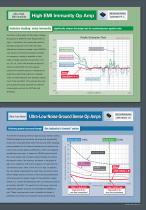
s Industry-leading* noise immunity significantly reduces the design load for countermeasures against noise As shown in the graph of the output voltage Radio Emission Test fluctuation at different noise frequencies at right, in contrast to the measured peaks of standard products A to E that are easily affected by frequency-based noise, ROHM’s new product minimizes fluctuations based on frequency, making it possible to limit Standard Product B VOUT (V) output voltage variations to less than ±1% (vs ±3.5 to ±10% with standard products). Achieving high EMI immunity greatly reduces the burden placed...
Open the catalog to page 3
b Significantly improving noise immunity by conducting a thorough review of circuits, layout, element size, and other factors optimum solution, rather than simply following the industry trend of countermeasures circuits, reviewed the layout, and selected processes reducing chip size. This breakthrough noise immunity could never be that generate optimal capacitances to dramatically improve EMI immunity. achieved with just one countermeasure, but was instead the culmination The key to success was to utilize a flexible approach in selecting the Circuit review Utilizing optimized processes Layout...
Open the catalog to page 4
f Significantly reducing the time, effort, and costs for noise countermeasures Breakthrough EMI noise immunity eliminates the need for an external CR filter and shield previously required, contributing to greater space savings while reducing peripheral component costs. Also, previously when integrating noise countermeasures, if noise evaluation fails after implementing functional and noise designs, it was necessary to start from the beginning, placing a considerable burden in terms of time, effort, and cost. In response, ROHM’s new Op Amp allows users to significantly reduce design man-hours...
Open the catalog to page 5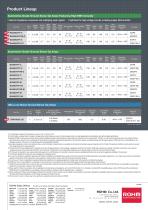
Automotive-Grade Ground Sense Op Amps Featuring High EMI Immunity ■ Ideal for Impedance conversion and amplifying weak signals ■ Optimized for high-voltage circuits, Including engine ECUs and EVs Input Input Gain No. of VOlPT® cUS OffSet BiaS cUrreUit InputVoltage Output Voltage CMRR PSRR Rite Bandwidth j^PPSaanUre ch Vo;vage c(umrA)nt » “ c(mAr <v) w s <dB> <dB> ^ pc Automotive-Grade Ground Sense Op Amps Part No. Input Equivalent Ph m i Capacitive Load Input Bias Noise Voltage Density ase ° ®rgin Characteristics Current Input Offset Voltage (mV) 1) The information contained in this document...
Open the catalog to page 6All ROHM Semiconductor catalogs and technical brochures
 PSR series
17 Pages
 Microcontrollers
32 Pages
 Speech Synthesis LSI Series
20 Pages
 Next-Generation Op Amp series
12 Pages
 LED
LED18 Pages
 Diodes
30 Pages
 Intelligent Power Modules
3 Pages
 Full SiC Power Modules
3 Pages
 SiC Schottky Barrier Diodes
4 Pages
 Microcontroller
13 Pages
 Audio & Video
11 Pages
 Sensors & MEMS
4 Pages
 LED Drivers
4 Pages
 Power Management
36 Pages
 Data Converter
2 Pages
 Clocks & Timers
2 Pages
 Memory
6 Pages
 Motor Drivers
44 Pages
 Power Device Catalog
36 Pages
 CSL1501RW
9 Pages
 UT6JC5 -60V Pch+Pch Power MOSFET
14 Pages
 SH8JB5 -40V Pch+Pch Power MOSFET
14 Pages
 CSL1104WBx Series (x=A/B/C/D)
11 Pages
 BD9F500QUZ
58 Pages
 RGW00TS65CHR
15 Pages
 RGW80TS65CHR
15 Pages
 RGW60TS65CHR
15 Pages
 QH8KC5
14 Pages
 QH8KC6
14 Pages
 QH8KB5
14 Pages
 QH8KB6
14 Pages
 SH8KC6
14 Pages
 SH8KC7
14 Pages
 SH8KB6
14 Pages
 SH8KB7
14 Pages
 QH8MB5
22 Pages
 SH8MB5
22 Pages
 BM1390GLV-Z
31 Pages
 RPMD-0100
5 Pages
 Short Form Catalog
308 Pages
 EMARMOUR Technology
4 Pages
 Industrial Motor Solutions
40 Pages
 General-purpse ICs
40 Pages
 IPD
IPD4 Pages
 Quick Buck Booster®
6 Pages
 SOT-23 Package Products
4 Pages
 DC/DC Converter Selection Guide
40 Pages
 Linear Regulator Selection Guide
32 Pages
 Sensing Networks Catalog
11 Pages
 Power Solutions Catalog
9 Pages
 Power Management
11 Pages
 Motor Drivers
36 Pages
 Automotive Product Catalog
124 Pages
 EV solutions
8 Pages


Archived catalogs

- Single-pole switch
- Technology switch
- DC-DC converter
- Diode
- Transistor module
- Industrial DC/DC converter module
- Board-mount resistor
- Power resistor
- Motor driver
- High-speed diode
- Switching transistor
- SMD DC-DC converter
- MOSFET transistor
- Power converter
- SMT diode
- Current rectifier
- Bipolar transistor
- Thin-film resistor
- Switching DC-DC converter
- Stepper motor driver