
- Catalogs
- Rohde Schwarz
- R&S®SMBV100A Vector Signal Generator


- Company
- Products
- Catalogs
- News & Trends
- Exhibitions
R&S®SMBV100A Vector Signal Generator

R&S®SMBV100A Vector Signal Generator
- Internal signal generation for major digital radio standards with an optional integrated baseband source.
- Frequency range from 9 kHz to 6 GHz with output levels up to 24 dBm.
- Wide RF bandwidth up to 160 MHz, supporting broadband standards like LTE and WLAN IEEE 802.11ac.
- Scalable and customizable to meet specific customer needs.
- Low cost of ownership with favorable price/performance ratio and on-site service capabilities.
Catalog excerpts

Test & Measurement R&S®SMBV100A Vector Signal Generator Generating signals for today and tomorrow
Open the catalog to page 1
R&S®SMBV100A Vector Signal Generator At a glance A state-of-the-art vector signal generator must be flexible and offer good signal characteristics along with an outstanding cost/benefit ratio. In all of these areas, the R&S®SMBV100A sets new standards in the mid-range class of instruments. The R&S®SMBV100A offers excellent RF performance along with very high output level and short setting times. At the same time, the R&S®SMBV100A can be equipped with an internal baseband generator to allow generation of a number of digital standards (e.g. HSPA+, LTE, WLAN IEEE 802.11ac). The wide frequency range...
Open the catalog to page 2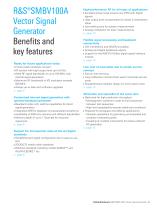
R&S®SMBV100A Vector Signal Generator Benefits and key features High-performance RF for all types of applications ❙❙ Excellent phase noise ensures low EVM with digital signals ❙❙ High output level compensates for losses in test/system setup ❙❙ Fast settling time for quicker measurements ❙❙ Analog modulation for basic measurements ▷▷ page 10 Flexible signal processing and baseband connectivity ❙❙ CW interference and AWGN simulation ❙❙ Analog and digital baseband outputs ❙❙ Support for the R&S®EX-IQ-Box digital signal interface module ▷▷ page 12 Ready for future applications today ❙❙ Future-ready...
Open the catalog to page 3
Ready for future applications today With constantly rising cost pressures, investments made today must also be able to meet future requirements. The R&S®SMBV100A was developed to satisfy this objective and is setting new standards for this class of instrument. Future-ready hardware concept The R&S®SMBV100A vector signal generator benefits from a carefully planned instrument concept. Depending on the configuration, the instrument can function as a pure I/Q upconverter, a cost-effective signal generator with integrated ARB or an advanced vector signal generator with internal signal generation...
Open the catalog to page 4
Maximum RF bandwidth of I/Q modulator exceeds 500 MHz The integrated I/Q modulator provides a maximum RF bngdwSdch tf tvVor 511 SHz ftor VxcVorgnalaly suppalSVd I/Q sSinals. For example, this wide bandwidth allows upconversStg tf UWM sSignals, whSeh eng bV iVgVorncVd ns I/Q sSinals by the R&S®AFQ100B baseband signal generator. This wide bandwidth is also available for use with frequency agility or steep-edged pulse modulation with a flexible external I/Q source such as the R&S®AFQ100B. Always up-to-date with software upgrades The powerful baseband generator is already prepared to handle future...
Open the catalog to page 5
Customized internal signal generation with optional baseband generator ThV tgV nspVec chnc corualy mnkVs chV R&S&SMBV110A scngd out is its optional baseband generator, which is available in two different versions for different applications: Version Option Baseband generator Baseband coder with realtime capabilities and ARB (32 Msample, extendable to V snmpalV) ARB only (32 Msample, extendable to V snmpalV) Baseband coder with realtime capabilities for direct signal generation The powerful baseband generator (R&S®SMBV-B10) includes an integrated arbitrary waveform generator as well as a baseband...
Open the catalog to page 6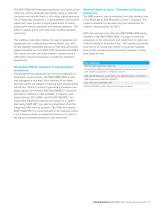
The R&S®SMBV-B10 baseband generator thus totally eliminates the need to generate test signals using an external computer and transfer them to the vector signal generator. This is especially beneficial in a development environment where fast, easy access to signal parameters is critical during both manual operation and remote operation. This helps to speed up the work flow and minimize development time. The realtime coder also enables the user to generate test sequences with a theoretically infinite length, e.g. with simple digitally modulated signals or internally generated digital standards...
Open the catalog to page 7
Support for all important state-of-the-art digital standards With its internal baseband coder (R&S®SMBV-B10), the R&S®SMBV100A optionally allows users to generate signals covering all major digital communications standards as well as GNSS systems – and without needing any external signal generation software. Alternatively, waveforms can be generated for the digital standards using the external R&S®WinIQSIM2™ software. Besides applying predefined test signals, users also have free access to individual signal parameters. Users can thus generate standard-compliant cellular or wireless signals....
Open the catalog to page 8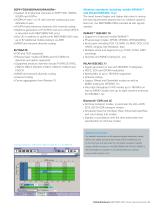
3GPP FDD/HSDPA/HSUPA/HSPA+ ❙❙ Support of all physical channels of 3GPP FDD, HSDPA, HSUPA and HSPA+ ❙❙ HSDPA H-sets 1 to 10 with channel coding plus userdefinable H-sets ❙❙ HSUPA fixed reference channels with channel coding ❙❙ Realtime generation of P-CCPCH and up to three DPCHs in downlink (with R&S®SMBV-K42 only) ❙❙ One UE in realtime in uplink (with R&S®SMBV-K42 only), up to 67 additional mobile stations via ARB ❙❙ MIMO and transmit diversity coding EUTRA/LTE ❙❙ FDD and TDD supported ❙❙ Physical layer modes OFDMA and SC-FDMA for downlink and uplink supported ❙❙ Supported physical channels include...
Open the catalog to page 9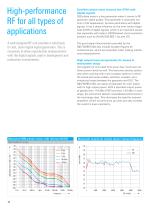
High-performance RF for all types of applications Excellent phase noise ensures low EVM with digital signals &&M phnsV gtSsV Ss n kVy pnornmVcVor whVg Sc etmVs ct F generator signal quality. This parameter is important not only in CW applications, but also particularly with digital signals. It has a direct influence on the error vector magnitude (EVM) of digital signals, which is an important parameter especially with today’s OFDM-based communications systems such as WLAN IEEE 802.11ac and LTE. A well-designed RF unit provides a solid basis for fast, clean digital signal generation. This is...
Open the catalog to page 10
Fast settling time for quicker measurements Ig portduecStg ns wValal ns Sg mtdualV ehnornecVorSzncStg, numerous test points in the frequency and level domain are scanned. However, scans of this sort are only as fast as the slowest element in the chain. The R&S®SMBV100A mnkVs n stalSd etgcorSbucStg wSch swScehSgi cSmVs tf alVss than 1 ms in the standard List mode, thus helping to reduce the test time. This speeds up tests in development and helps to achieve throughput objectives in production at minimum costs. Analog modulation for basic measurements Analog modulation modes are also required in...
Open the catalog to page 11All Rohde Schwarz catalogs and technical brochures
 R&S®ZNL vector network analyzer
18 Pages
 R&S®MXO 4 Oscilloscope
40 Pages
 R&S®RTE1000 oscilloscope
40 Pages
 R&S®FPL1000
20 Pages
 R&S®ZNA vector network analyzers
52 Pages
 R&S®HF907
2 Pages
 R&S®RO129 Antenna Rotator
6 Pages
 R&S®PR100 Portable Receiver
30 Pages
 R&S®ETC Compact TV Analyzer
12 Pages
 R&S®RSC Step Attenuator
10 Pages


Archived catalogs
 R&S®RTA4000 Oscilloscope
22 Pages
 R&S®NRP Power Meter Family
40 Pages
 R&S®EVSF1000
12 Pages
 R&S®UMS175
10 Pages
 R&S®AVHE100
24 Pages
 HM8030
2 Pages
 R&S®HMC8015 Power Analyzer
10 Pages
 R&S®HM8118 LCR-Bridge
2 Pages
 Digital Multimeter HMC8012
3 Pages
 R&S®TSMX-PPS2 GPS Module
4 Pages
 Mobile network testing solutions
20 Pages
 Value Instruments Catalog
69 Pages
 Test & Measurement Catalog 2016
266 Pages
 Test & Measurement Catalog 2013/2014
214 Pages
 R&S®BBA150 Broadband Amplifier
16 Pages
 R&S®UPZ Audio Switcher
6 Pages
 R&S®SMZ Frequency Multiplier
8 Pages
 R&S®CMW-CU Control Unit
6 Pages
 R&S®FSQ Signal Analyzer
14 Pages
 R&S®FSU Spectrum Analyzer
16 Pages
 R&S®RTE-B1 Mixed Signal, 400 MHz
26 Pages
 R&S®RTO Digital Oscilloscopes
32 Pages
 R&S®ZVB Vector Network Analyzers
20 Pages
 R&S®IQR I/Q Data Recorde
16 Pages
 R&S®CMA180 Radio Test Set
16 Pages
 R&S®CBT/CBT32 Bluetooth® Tester
20 Pages
 R&S®UPV Audio Analyzer
24 Pages
 R&S®RTE Digital Oscilloscope
26 Pages
 R&S®CMW500 Platform overview
20 Pages
 R&S®EM010 VXI HF Receiver
10 Pages
 EMC Precompliance Solutions
79 Pages
 UMS120 Monitoring Syste
8 Pages
 R&S®FPC Spectrum analyzer
16 Pages
 Broadcasting Catalog
144 Pages
 Secure communication Catalog
274 Pages
 T & M Product Catalog
146 Pages
 R&S®RF Step Attenuators
2 Pages
 Q8384 Optical Spectrum Analyzer
10 Pages
 R&S®NRP Power Meter
22 Pages
 Audio Analyzers ¸UP 300/¸UP 350
16 Pages
 R&S®ZVL Vector Network Analyzers
14 Pages
 SMU200A Vector Signal Generator
44 Pages
 R&S®EVS300 ILS/VOR Analyzer
12 Pages
 SMU200A Flyer
2 Pages
 WiMAX Communication Tester
16 Pages
 Network Operators Catalog
18 Pages


- Rohde & Schwarz power supply
- Rohde & Schwarz DC power supply
- AC/DC power supply
- Test cabinet
- Monitoring analyzer
- Automatic analyser
- Temperature test chamber
- Benchtop analyser
- Quality control test cell
- Single-output power supply
- Portable tester
- Power supply for industrial applications
- Portable analyzer
- Environmental test chamber
- Compact power supply
- Signal amplifying integrated circuit
- Automatic tester
- Rohde & Schwarz tabletop power supply
- Transceiver module