
- Catalogs
- Rohde Schwarz
- R&S®M3AR Software Defined Radios VHF/UHF Transceiver Family for Airborne Communications


- Company
- Products
- Catalogs
- News & Trends
- Exhibitions
R&S®M3AR Software Defined Radios VHF/UHF Transceiver Family for Airborne Communications

R&S®M3AR Software Defined Radios VHF/UHF Transceiver Family for Airborne Communications
The R&S®M3AR family consists of software-defined, multiband-capable airborne transceivers designed for high performance and reliability in various aircraft, including unmanned aerial vehicles. These radios feature a modular design, high MTBF values, and are equipped with different waveforms for interoperability in diverse operational scenarios.
- Frequency Range: 30 MHz to 400 MHz, suitable for both military and civil aviation communications.
- Compact and Lightweight: High transmit power (up to 20 W in AM mode and 30 W in FM mode).
- Secure Communications: EPM (ECCM) methods like HAVE QUICK I/II, SATURN, and R&S®SECOS for anti-jam communications.
- Flexible Applications: Suitable for various aircraft types and equipped with interfaces like MIL-STD-1553B data bus.
- Low Maintenance: High reliability with built-in tests for error detection and diagnostics.
- Future-Ready: State-of-the-art technology ensures long product life.
- RF Parameters: Excellent sensitivity, selectivity, and suppression of interference signals.
- Frequency Bands: Covers civil and military aviation frequency ranges, eliminating the need for multiple transceivers.
- Interference Immunity: Robust protection against strong external signals and crossmodulation immunity.
- Transmit Power: Maintains high output power even under mismatched load conditions.
- Encryption: Integrated encryption for tap- and spoof-proof communications.
- Frequency Hopping: Methods like R&S®SECOS provide reliable protection against jamming.
- R&S®MR6000A: ARINC 600 housing.
- R&S®MR6000R/L: ARC-164 form and fit compatible, with local or remote control options.
The R&S®M3AR family offers a comprehensive solution for airborne communications, combining advanced technology with flexibility and security to meet the demands of modern military and civil aviation.
The R&S®M3AR family of software-defined radios by Rohde & Schwarz includes models like the R&S®MR6000A, R&S®MR6000L, and R&S®MR6000R. These radios are designed for military aircraft, offering features such as embedded NATO encryption, interoperability with external crypto devices, and compliance with STANAG standards.
The R&S®MR6000A integrates NATO encryption, eliminating the need for external devices, thus saving space and weight. It supports the R&S®SECOS encryption method, allowing encrypted key transmission over non-secure lines. The radios are compatible with external encryption devices like KY57, KY58, and ELCRODAT 4-2.
The radios support a wide range of applications, suitable for fixed-wing and rotary-wing aircraft operated by air force, army, and navy. They offer flexible integration options through interfaces like MIL-STD-1553B and RS-485, and can be controlled remotely or via a local control panel.
R&S®M3AR transceivers provide high transmit power (up to 30 W in FM mode) for secure communications even during low-level flights. They are compact and lightweight, meeting civil and military specifications. The radios undergo rigorous testing, including HALT, to ensure reliability and long product life.
The radios feature built-in tests (PBIT, CBIT, IBIT) for error detection and diagnostics. The R&S®UCS226XB test system facilitates automatic and reliable testing, ensuring low maintenance efforts and high reliability.
The modular design and high-quality components of the R&S®M3AR family ensure a long product life and adaptability to future technological advancements. The radios support various frequency ranges and waveforms, reducing the need for multiple devices.
- Dedicated guard receiver for distress frequencies (digital 156.525 MHz or analog 156.8 MHz).
- Integrated pre-/postselector for interference minimization.
- Frequency range from 30 MHz to 399.975 MHz for tactical communications.
- High transmit power: 20 W (AM) and 30 W (FM).
- Compliance with ICAO and ED-23B for VHF broadcast immunity.
- Remote control via MIL-STD-1553B data bus and RS-485 interface.
- Development in line with RTCA/DO-178B, level C (software) and RTCA/DO-254, DAL C (hardware).
- Embedded NATO encryption algorithms and R&S®SECOS encryption.
- Support for frequency hopping methods: HAVE QUICK I/II, SATURN.
- Direction finding and homing support for VHF and UHF ranges.
- High dynamic range and crossmodulation immunity.
- Used in Eurofighter Typhoon for secure air-to-air and air traffic control communications.
- Supports both civil and military air traffic control frequencies.
- Versatile applications in UHF range for military communications.
- Interoperable with NATO partner combat net radio equipment.
- Mounting trays and mating connector sets for easy integration.
- R&S®GB6500 remote control unit for cockpit installation.
- R&S®BA6000 base station adapter for training and testing.
- R&S®ZK6000 maintenance connection box for radio testing and maintenance.
- R&S®CP6000 radio commander software for integration and control.
The document discusses the R&S®RNMS3000, a radio network management system by Rohde & Schwarz, designed to enhance the capabilities of their combat radio equipment. This system is particularly useful for military operations requiring complex hierarchical communication structures.
The R&S®RNMS3000 supports both centralized and decentralized network management. It includes a mission planner, remote device loader, and remote distributor, offering functionalities such as security key management, frequency assignments, and mission file distribution. It is compatible with proprietary waveforms like R&S®SECOS and supports mission planning for the R&S®M3xR family of radios.
Rohde & Schwarz is a leading supplier of professional radios, trusted by governments and military organizations for reliable communications. Their R&S®M3AR family of software-defined radios has been globally deployed since 2000, demonstrating reliability and robustness.
The document provides detailed specifications for various radio models, including frequency bands, interfaces, and audio outputs. It lists models like R&S®XM6023, R&S®XM6123, and others, highlighting features such as EPM (ECCM) capabilities and interface types.
Accessories for the R&S®M3AR radios include mating connectors, remote control units, mounting trays, and maintenance tools. The document also mentions the availability of a test system for radio equipment.
Rohde & Schwarz is an independent electronics group offering solutions in test and measurement, secure communications, and more. The company emphasizes sustainable product design and holds certifications for environmental and quality management.
The document provides regional contact details for customer support across Europe, North America, Latin America, Asia Pacific, and China.
Catalog excerpts

Product Brochure | Version 05.01 R&S®M3AR Software Defined Radios VHF/UHF transceiver family for airborne communications
Open the catalog to page 1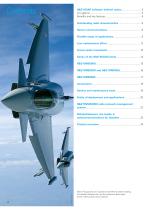
© Eurofighter – Markus Zinner Note: Frequencies are rounded to full MHz for better reading. For detailed frequencies, see the respective data sheet. Some of the pictures show opti
Open the catalog to page 2
R&S®M3AR Software Defined Radios At a glance Rohde & Schwarz satisfies the most demanding r equirements of a multitude of airborne platforms. The R&S®M3AR transceivers are in operation around the world and feature high reliability even under extreme e nvironmental conditions. The outstanding MTBF values e nsure low maintenance effort and high availability. A variety of optional EPM (ECCM) methods are available. For instance, the R&S®SECOS frequency hopping method with integrated encryption can be installed in parallel with HAVE QUICK I/II. The software defined, multiband-capable airborne transceivers...
Open the catalog to page 3
R&S®M3AR Software Defined Radios Benefits and key features Outstanding radio characteristics ❙❙ Excellent RF parameters ❙❙ Frequency bands from 30 MHz to 400 MHz ❙❙ Outstanding RF characteristics on a single platform with the R&S®MR6000A Secure ommunications c ❙❙ EPM (ECCM) methods for anti-jam communications ❙❙ Tap- and spoof-proof communications through integrated encryption ❙❙ Wideband interface for external encryption devices (e.g. ELCRODAT 4-2, KY58, KY100) Flexible range of pplications a ❙❙ High power for secure communications even during very low level flights and higher altitude instrument...
Open the catalog to page 4
Outstanding r adio characteristics Excellent RF parameters Despite its compact design, the R&S®M3AR radio amily f offers excellent RF characteristics, even under harsh e nvironmental conditions. The R&S®M3AR transceivers are compatible with common military and civil communications standards. The receiver features excellent sensitivity, high crossmodulation immunity, selectivity and suppression of strong i nterference signals. The transmitter is optimized for low spurious emissions and the suppression of wideband noise. Frequency bands from 30 MHz to 400 MHz The aviation sector has special applications...
Open the catalog to page 5
Outstanding RF characteristics on a single platform with the R&S®MR6000A If several transceivers are used simultaneously in an aircraft (co-site operation), there is a risk of mutual interference. For example, this is true especially on large airborne platforms used for air surveillance. More than 20 radio systems can be installed on such a platform. Jets or helicopters featuring a relatively small fuselage also need to be equipped with a large number of antennas. Antennas are not only required for VHF/UHF and HF radios, but also for air navigation and sensors. Transceiver emissions, for example,...
Open the catalog to page 6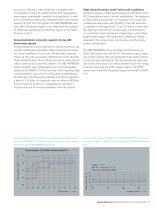
In practice, however, high sensitivity is available without limitations only if the radio exhibits both appropriate large-signal suppression capability and selectivity. In addition to the above-mentioned integrated filters that protect against HF and VHF FM signals, the R&S®MR6000A also has built-in frequency-agile co-site filters that are capable of effectively suppressing interfering signals in the same frequency band Crossmodulation immunity against strong AM interfering signals Crossmodulation occurs whenever a strong interfering signal with amplitude modulation (AM) overdrives the receiver’s...
Open the catalog to page 7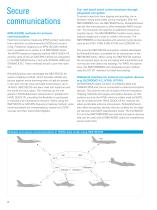
Secure communications Tap- and spoof-proof communications through i ntegrated encryption To protect radio links from tapping and spoofing, the information being transmitted can be encrypted. With the R&S®MR6000A from the R&S®M3AR family, Rohde & Schwarz was the first manufacturer to offer embedded NATO encryption. This eliminates the need for an additional external encryption device. The R&S®MR6000A therefore saves space, reduces weight and is easy to nstall in the aircraft. The i R&S®MR6000A is interoperable with external rypto devices c such as the KY57, KY58, KY99, KY100 and LCRODAT 4-2. E...
Open the catalog to page 8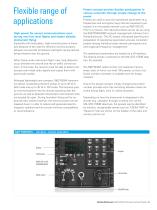
Flexible range of applications High power for secure communications even during very low level flights and higher altitude instrument flying Especially with helicopters, high transmit power is important because of the need for effective communications between two-aircraft formations and flights during tactical flying missions near the ground. When flying under instrument flight rules, long distances occur between the aircraft and the air traffic control stations. In this case, the receiver must be able to detect and process even weak radio signals and output them with good audio quality. Although...
Open the catalog to page 9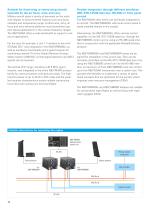
Suitable for fixed-wing or rotary-wing aircraft operated by the air force, army and navy Military aircraft place a variety of demands on the radio with respect to environmental impacts such as g-force, vibration and temperature range. Furthermore, army, air force and navy airborne platforms must sometimes support special applications in the various frequency ranges. The R&S®M3AR offers a wide bandwidth to support a variety of applications. For the navy for example, a Link 11 interface in line with STANAG 5511 was integrated in the R&S®MR6000A, as well as sonobuoy functionality and a guard receiver...
Open the catalog to page 10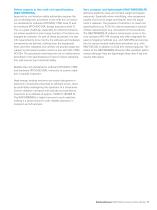
Safety aspects in line with civil specifications (R&S®MR6000A) Approval by civil aviation safety authorities requires the use of development processes in line with the civil avionics standards for software (RTCA/DO-178B, level C) and for hardware (RTCA/DO-254, design assurance level C). This is a great challenge, especially for airborne transceivers where waveforms and a large number of functions are mapped by software. As part of these processes, the specific requirements to be met by the software and hardware components are derived, starting from the equipment level, and then validated and...
Open the catalog to page 11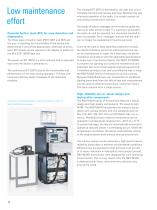
Low maintenance effort Powerful built-in tests (BIT) for error detection and diagnostics The three types of built-in tests (PBIT, CBIT and IBIT) aid the user in checking the functionality of the device and determining if, and where appropriate, what type of errors exist. BIT results can be viewed on the display or polled via the MIL-STD-1553B data bus. The power-on BIT (PBIT) is a short self-test that is executed each time the device is powered on. The continuous BIT (CBIT) checks the functionality and performance of the radio during operation. This test continuously polls the status messages...
Open the catalog to page 12All Rohde Schwarz catalogs and technical brochures
 R&S®ZNL vector network analyzer
18 Pages
 R&S®MXO 4 Oscilloscope
40 Pages
 R&S®RTE1000 oscilloscope
40 Pages
 R&S®FPL1000
20 Pages
 R&S®ZNA vector network analyzers
52 Pages
 R&S®HF907
2 Pages
 R&S®RO129 Antenna Rotator
6 Pages
 R&S®PR100 Portable Receiver
30 Pages
 R&S®ETC Compact TV Analyzer
12 Pages
 R&S®RSC Step Attenuator
10 Pages


Archived catalogs
 R&S®RTA4000 Oscilloscope
22 Pages
 R&S®NRP Power Meter Family
40 Pages
 R&S®EVSF1000
12 Pages
 R&S®UMS175
10 Pages
 R&S®AVHE100
24 Pages
 HM8030
2 Pages
 R&S®HMC8015 Power Analyzer
10 Pages
 R&S®HM8118 LCR-Bridge
2 Pages
 Digital Multimeter HMC8012
3 Pages
 R&S®TSMX-PPS2 GPS Module
4 Pages
 Mobile network testing solutions
20 Pages
 Value Instruments Catalog
69 Pages
 Test & Measurement Catalog 2016
266 Pages
 Test & Measurement Catalog 2013/2014
214 Pages
 R&S®BBA150 Broadband Amplifier
16 Pages
 R&S®UPZ Audio Switcher
6 Pages
 R&S®SMZ Frequency Multiplier
8 Pages
 R&S®CMW-CU Control Unit
6 Pages
 R&S®FSQ Signal Analyzer
14 Pages
 R&S®FSU Spectrum Analyzer
16 Pages
 R&S®RTE-B1 Mixed Signal, 400 MHz
26 Pages
 R&S®RTO Digital Oscilloscopes
32 Pages
 R&S®ZVB Vector Network Analyzers
20 Pages
 R&S®IQR I/Q Data Recorde
16 Pages
 R&S®CMA180 Radio Test Set
16 Pages
 R&S®CBT/CBT32 Bluetooth® Tester
20 Pages
 R&S®UPV Audio Analyzer
24 Pages
 R&S®RTE Digital Oscilloscope
26 Pages
 R&S®CMW500 Platform overview
20 Pages
 R&S®EM010 VXI HF Receiver
10 Pages
 EMC Precompliance Solutions
79 Pages
 UMS120 Monitoring Syste
8 Pages
 R&S®FPC Spectrum analyzer
16 Pages
 Broadcasting Catalog
144 Pages
 Secure communication Catalog
274 Pages
 T & M Product Catalog
146 Pages
 R&S®RF Step Attenuators
2 Pages
 Q8384 Optical Spectrum Analyzer
10 Pages
 R&S®NRP Power Meter
22 Pages
 Audio Analyzers ¸UP 300/¸UP 350
16 Pages
 R&S®ZVL Vector Network Analyzers
14 Pages
 SMU200A Vector Signal Generator
44 Pages
 R&S®EVS300 ILS/VOR Analyzer
12 Pages
 SMU200A Flyer
2 Pages
 WiMAX Communication Tester
16 Pages
 Network Operators Catalog
18 Pages


- Rohde & Schwarz power supply
- Rohde & Schwarz DC power supply
- AC/DC power supply
- Test cabinet
- Monitoring analyzer
- Automatic analyser
- Temperature test chamber
- Benchtop analyser
- Quality control test cell
- Single-output power supply
- Portable tester
- Power supply for industrial applications
- Portable analyzer
- Environmental test chamber
- Compact power supply
- Signal amplifying integrated circuit
- Automatic tester
- Rohde & Schwarz tabletop power supply
- Generator