
- Catalogs
- Rohde Schwarz
- R&S®ESMD Wideband Monitoring Receiver


- Company
- Products
- Catalogs
- News & Trends
- Exhibitions
R&S®ESMD Wideband Monitoring Receiver

R&S®ESMD Wideband Monitoring Receiver
- Frequency Range: 8 kHz to 40 GHz (base unit: 20 MHz to 3.6 GHz).
- Realtime Bandwidth: Up to 80 MHz (base unit: 20 MHz).
- Time Domain Analysis: Up to 20 MHz bandwidth.
- Multichannel Processing: Supports up to 128 parallel channels via 1 Gbit LAN interface.
- Data Output: Includes spectra, waterfall, demodulated audio, level measurement, and I/Q baseband data.
- Multichannel recording of security-critical voice communications.
- Signal analysis of unknown content communications channels.
- Interception and analysis of frequency hopping radios in tactical communications.
- Radar signal analysis and parameter determination.
- Nationwide networked system for ITU-compliant radiomonitoring.
- Interference source detection in air traffic control bands.
- FFT Signal Processing: Provides fine frequency resolution and high sensitivity.
- Extremely Fast Spectral Scan: Offers a fast overview with fine resolution bandwidth.
- Waterfall Diagram: Displays signal history in a three-dimensional format.
- Recording and Replay: Allows for detailed evaluation of recorded spectra and waterfall data.
- Map Display: Shows GNSS position and recorded results relative to a location.
- Single-channel direction finder upgrade kit.
- Documentation of calibration values.
- DC operation for vehicle battery use.
- System time synchronization using NTP server.
- TDOA readiness with high-accuracy timestamps and GNSS synchronization.
Catalog excerpts

P roduct Brochure | Version 10.01 R&S®ESMD Wideband Monitoring Receiver Premium-class signal reception
Open the catalog to page 1
R&S®ESMD Wideband Monitoring Receiver At a glance The R&S®ESMD wideband monitoring receiver was specially developed for signal search, radiomonitoring, radio detection and spectrum monitoring tasks. It performs ITU-compliant measurements and meets the requirements of security authorities and organizations. The receiver is ideal for both stationary and mobile/vehicular applications because it can be operated via the front panel or remotely controlled via LAN. The R&S®ESMD features a wide frequency range (8 kHz to 40 GHz), outstanding receive characteristics, 80 MHz realtime bandwidth (base unit:...
Open the catalog to page 2
R&S®ESMD Wideband Monitoring Receiver Applications Nationwide networked system for ITU-compliant radiomonitoring ❙❙ Networking of radiomonitoring nodes of civil regulatory authorities, e.g. with R&S®ARGUS and suitable options ❙❙ Automatic identification of deviations between actual and predefined spectral values ❙❙ Guided measurements with R&S®ARGUS – even for inexperienced users ❙❙ Audio demodulation and processing ▷▷ page 7 Searching for interference sources in the air traffic control (ATC) band ❙❙ Fast detection and elimination of interfering signals to maintain security-critical aeronautical...
Open the catalog to page 3
R&S®ESMD Wideband Monitoring Receiver Benefits and key features Frequency range from 8 kHz to 40 GHz ❙❙ One radiomonitoring receiver for “all“ frequencies ❙❙ Base unit: 20 MHz to 3.6 GHz ■■ R&S®ESMD-HF: option for HF signal reception down to 8 kHz ■■ R&S®ESMD-SHF: option for SHF signal reception up to 26.5 GHz ❙❙ Same size, even with the above frequency options installed (19" width, 4 HU) ❙❙ R&S®MC40: external microwave downconverter for frequencies up to 40 GHz ▷▷ page 14 Integrated antenna switch ❙❙ Two separate inputs for HF (2) and VHF/UHF (3) ❙❙ One SHF input ❙❙ Automatic switching between...
Open the catalog to page 4
Polychrome spectrum to distinguish superimposed, pulsed signals ❙❙ Display of time behavior (frequency of occurrence) of pulsed signals using color coding (for all realtime bandwidths) ❙❙ Settable occurrence frequency threshold ❙❙ Separate display of pulsed signals (superimposed in frequency, time and level) ▷▷ page 21 Video spectrum for display of subcarriers and transmission rates ❙❙ Spectrum display of demodulated signal ❙❙ Clear display of subcarriers, e.g. 19 kHz pilot tone ❙❙ Squared video spectrum to estimate the transmission rate (baud rate) of a digitally modulated signal ❙❙ Combination...
Open the catalog to page 5
ITU-compliant measurements in the receiver Single-channel direction finder upgrade kit ❙❙ R&S®ESMD-IM option: ITU-compliant measurement of signal parameters for AM, FM and PM-modulated signals (e.g. modulation index, occupied bandwidth and phase deviation) ❙❙ Offline measurement of digitally modulated signals using the R&S®CA100IS software and suitable options (in line with ITU recommendation SM.1600) ▷▷ page 31 ❙❙ R&S®ESMD-DF option: upgrade to single-channel direction finder ❙❙ Direction finding of signals in frequency range up to 6 GHz ❙❙ Reliable DF results even in difficult environments...
Open the catalog to page 6
Nationwide networked system for ITU-compliant radiomonitoring Networking of radiomonitoring nodes of civil regulatory authorities To perform civil regulatory authorities' radiomonitoring tasks in line with ITU recommendations, all available receiving nodes must be networked. This includes both stationary and vehicular radiomonitoring stations. The R&S®ARGUS monitoring software is ideal for networking and remotely controlling nationwide radiomonitoring systems as well as small regional networks. Interference can be quickly and effectively located and eliminated, even in a frequency spectrum with...
Open the catalog to page 7
Searching for interference sources in the air traffic control (ATC) band Fast detection and elimination of interfering signals to maintain security-critical aeronautical radiocommunications The ATC radio band contains all security-critical radiocommunications necessary to control national and international aircraft movements. Interference in this approx. 20 MHz wide frequency spectrum can quickly lead to critical situations. It is necessary to constantly monitor this frequency range in order to quickly detect and eliminate unauthorized emissions and wideband interference. Monitoring of entire...
Open the catalog to page 8
Radiomonitoring for security authorities and organizations Networking of several receiving stations to create a temporary networked system Monitoring station setups must be flexible in order to support local radiomonitoring tasks in both stationary and mobile applications. The R&S®RAMON radiomonitoring software was specially developed for networking receiving stations to create a temporary networked system. The software optimizes radiomonitoring of security-critical zones, for example by collecting spectra or demodulated audio content. Multiple receiver concept: parallel search, detection and...
Open the catalog to page 9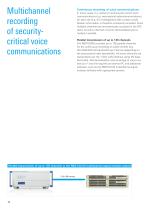
Multichannel recording of securitycritical voice communications Continuous recording of voice communications In many cases, it is useful to continuously record voice communications (e.g. aeronautical radiocommunications) for later use (e.g. for investigations after a plane crash). Spoken information is therefore constantly recorded. Since multiple channels are simultaneously occupied in the ATC band, all active channels must be demodulated and recorded in parallel. Parallel transmission of up to 128 channels The R&S®ESMD provides up to 128 parallel channels for the continuous recording of audio...
Open the catalog to page 10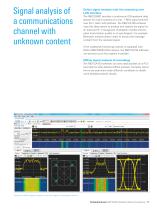
Signal analysis of a communications channel with unknown content Online signal analysis with live streaming over LAN interface The R&S®ESMD provides a continuous I/Q baseband data stream for online analysis of a max. 1 MHz signal channel over the 1 Gbit LAN interface. The R&S®CA100 software uses this data stream to analyze and classify the signal on an external PC. It recognizes modulation modes and displays transmission quality in an eye diagram, for example. Bitstream analysis allows users to extract the message content from the received signal. If the wideband monitoring receiver is equipped...
Open the catalog to page 11All Rohde Schwarz catalogs and technical brochures
 R&S®ZNL vector network analyzer
18 Pages
 R&S®MXO 4 Oscilloscope
40 Pages
 R&S®RTE1000 oscilloscope
40 Pages
 R&S®FPL1000
20 Pages
 R&S®ZNA vector network analyzers
52 Pages
 R&S®HF907
2 Pages
 R&S®RO129 Antenna Rotator
6 Pages
 R&S®PR100 Portable Receiver
30 Pages
 R&S®ETC Compact TV Analyzer
12 Pages
 R&S®RSC Step Attenuator
10 Pages


Archived catalogs
 R&S®RTA4000 Oscilloscope
22 Pages
 R&S®NRP Power Meter Family
40 Pages
 R&S®EVSF1000
12 Pages
 R&S®UMS175
10 Pages
 R&S®AVHE100
24 Pages
 HM8030
2 Pages
 R&S®HMC8015 Power Analyzer
10 Pages
 R&S®HM8118 LCR-Bridge
2 Pages
 Digital Multimeter HMC8012
3 Pages
 R&S®TSMX-PPS2 GPS Module
4 Pages
 Mobile network testing solutions
20 Pages
 Value Instruments Catalog
69 Pages
 Test & Measurement Catalog 2016
266 Pages
 Test & Measurement Catalog 2013/2014
214 Pages
 R&S®BBA150 Broadband Amplifier
16 Pages
 R&S®UPZ Audio Switcher
6 Pages
 R&S®SMZ Frequency Multiplier
8 Pages
 R&S®CMW-CU Control Unit
6 Pages
 R&S®FSQ Signal Analyzer
14 Pages
 R&S®FSU Spectrum Analyzer
16 Pages
 R&S®RTE-B1 Mixed Signal, 400 MHz
26 Pages
 R&S®RTO Digital Oscilloscopes
32 Pages
 R&S®ZVB Vector Network Analyzers
20 Pages
 R&S®IQR I/Q Data Recorde
16 Pages
 R&S®CMA180 Radio Test Set
16 Pages
 R&S®CBT/CBT32 Bluetooth® Tester
20 Pages
 R&S®UPV Audio Analyzer
24 Pages
 R&S®RTE Digital Oscilloscope
26 Pages
 R&S®CMW500 Platform overview
20 Pages
 R&S®EM010 VXI HF Receiver
10 Pages
 EMC Precompliance Solutions
79 Pages
 UMS120 Monitoring Syste
8 Pages
 R&S®FPC Spectrum analyzer
16 Pages
 Broadcasting Catalog
144 Pages
 Secure communication Catalog
274 Pages
 T & M Product Catalog
146 Pages
 R&S®RF Step Attenuators
2 Pages
 Q8384 Optical Spectrum Analyzer
10 Pages
 R&S®NRP Power Meter
22 Pages
 Audio Analyzers ¸UP 300/¸UP 350
16 Pages
 R&S®ZVL Vector Network Analyzers
14 Pages
 SMU200A Vector Signal Generator
44 Pages
 R&S®EVS300 ILS/VOR Analyzer
12 Pages
 SMU200A Flyer
2 Pages
 WiMAX Communication Tester
16 Pages
 Network Operators Catalog
18 Pages


- Rohde & Schwarz power supply
- Rohde & Schwarz DC power supply
- AC/DC power supply
- Test cabinet
- Monitoring analyzer
- Automatic analyser
- Temperature test chamber
- Benchtop analyser
- Quality control test cell
- Single-output power supply
- Portable tester
- Power supply for industrial applications
- Portable analyzer
- Environmental test chamber
- Compact power supply
- Signal amplifying integrated circuit
- Automatic tester
- Rohde & Schwarz tabletop power supply
- Transceiver module